


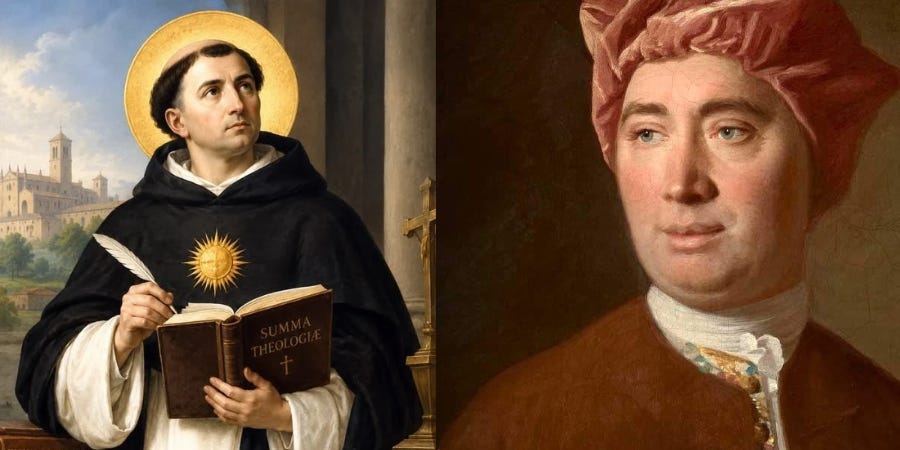
If you ever discuss miracles with skeptics, the first person they’re guaranteed to bring up is 18th century Scottish philosopher David Hume (1711-1776).
The reason why is because, unlike other “enlightenment” philosophers, Hume provided the most robust critique of the supernatural and miracles. An entire section called “Of Miracles” in his 1748 work An Enquiry Concerning Human Understanding, hailed by skeptics as an objective destruction of everything supernatural.
But does “Of Miracles” actually disprove miracles and the supernatural? And is it objective? Not in the slightest.
It’s a dungheap of an argument.
Before we get into why, it’s important to hash out some background on Hume because his history is inseparable from the failures inherent in his most infamous tirade.
David Hume (original last name Home) was born on May 7th, 1711 to a modest family of landowners in the Scottish Highlands. His father, Joseph Home, an attorney, died when Hume was an infant, and his mother, Katherine, raised him and his siblings as a single mom.
Hume tried his hand at academics at the age of 11-12, entered the University of Edinburgh to study classics and philosophy. But eventually he ditched school without a degree and went through a period of harsh intellectual and physical strain. Several of those off years were spent in France, where the secular humanist and socialist philosophies of Voltaire and Rousseau blazed a path of ideological terror through the former Catholic powerhouse of Western Europe. About to trigger the French Revolution.
Their ideas were like sweet honey to Hume. He gobbled them up as if they were a 5-star, 7-course meal.
And what were their ideas?
Man is naturally good
Society corrupts him
Civilization is the original sin
Morality comes from within
The family and church oppress
Private property inhibits liberty
People must be “forced to be free.”
Voltaire and Rousseau also claimed that religion is the opiate of the masses long before Karl Marx. In fact, they are where Marx and Hegel got the ideas in their Communist Manifesto.
Their (Voltaire and Rousseau) resolution was that philosophical naturalism is the only truth, the supernatural is a fictional invention by humanity that threatens existence, and the ancient savages (which Voltaire and Rousseau dubbed “the noble savage”) had the proper animalistic way of life the world needs to return to. Hunt, screw multiple partners, destroy all boundaries, elevate and worship the individual self.
Embracing their naturalistic bias, Hume writes this far-from-objective spew against miracles:
A miracle is a violation of the laws of nature, and the laws of nature rest on uniform and constant experience, so miracles are contrary to the whole of prior experience.
A wise person proportions belief to the evidence. When two kinds of evidence conflict, the stronger evidence prevails. In the case of miracles, the conflict is between: (1) testimony and (2) the uniform experience of nature’s regularities that the miracle would violate.
The evidence is always against miracles because: (1) Human testimony is fallible, (2) the laws of nature rest on on the most extensive and uniform experience available, (3) therefore, the probability that the testimony is false always exceeds the probability that the miracle occurred.
Additional reasons why the evidence is always against miracles:
Miracle claims typically arise from ignorant or barbarous people, or in remote times and places where they cannot be easily checked
The human passions (wonder, religious enthusiasm, love of the marvelous) incline people to accept and transmit such reports uncritically
Competing miracle claims from different religions cancel one another out, since each religion’s miracles are used to support doctrines that contradict the others
These considerations supply an “everlasting check to all kinds of superstitious delusion.”
Together, we’re going to walk through each of these objections to miracles and the supernatural step by step, tear them to pieces, and discover why miracles and the supernatural are not only real and knowable, but likely. Then we’ll examine an argument for miracles centuries prior to Hume, from the notorious St. Thomas Aquinas, that ruined philosophical naturalism years before the so-called “enlightenment.”
Defining a Miracle
Off the bat, Hume shows serious problems through his definition of a miracle. He takes the same tactic Voltaire, Rousseau, and other 18th-century philosophers did of presuming that the laws of nature are unbreakable. Hume also presumes that nature alone is the “whole weight of prior experience.”
Not so.
Every single one of the primitive savages Voltaire, Rousseau, and Hume adored made claims of supernatural encounters, and not just the savages. The civilized as well.
Throughout the majority of human history, the whole weight of prior experiences intertwined the natural and the supernatural. In fact, until the 18th and 19th centuries, nature and supernature were seen as two sides of the same coin, always interacting and either impossible without the other. For Hume to presume the weight of all prior experience is only natural is to defy the historical record and row without a paddle.
Also, since the dawn of time, the laws of nature have been understood as regularities (a term which Hume uses in his article). Repeatable occurrences in reality, not unbreakable rules.
To the contrary, laws and rules are themselves breakable in reality. People break laws and rules all the time, as do animals. Behavior across life is inconsistent and not able to be confined to a pretty little box. So even to call the regularities in nature “laws” doesn’t endow them with some divine-like unbreakability.
Laws, of course, come from lawgivers, and such lawgivers typically have the authority to dictate exceptions or even rewrite laws, so if we find laws in nature, it follows that they come from an ultimate Lawgiver who spoke them into existence and retains the power to alter them or allow exceptions at will. Something Hume-y-poo and his secularist buddies don’t seem to understand.
Regularities also do not preclude singularities (one-time events) that go against the established norm. All of history, for instance, is composed of one-time, non-repeatable, specific events and would be unnatural, according to Hume’s definition of a miracle. To be consistent, we would have to dismiss the entirety of history as fiction, or at the very least unprovable, but not even the most ardent skeptic is willing to take that logical leap.
All the above should be sufficient to show David Hume’s argument against miracles is pure hogwash, but it gets worse...
Testimony as Untrustworthy
Hume claims the uniform laws of nature trump human testimony in terms of evidence.
No one in their right mind will deny that the word of a single human cannot suffice to prove an event occurred. But when we get into examination of multiple witnesses, Hume’s argument collapses into a heap of moldy dish rags.
The credibility and possible truth of testimony increases the more witnesses there are to an event. Go to any courtroom and you’ll see this on a daily basis. Hume himself, who originally entered the University of Edinburgh to go into the family business of legal advocacy (an attorney), should’ve known this, yet he dismisses all human testimony outright, which poses serious problems for human knowledge.
As already noted, history is composed of one-time non-repeatable events. Well, not only is it that, all of those singularities are brought to us by...you guessed it...human testimony. Not a single shred of the past was observed by humans today, so we have to take it on faith through the examination of available past witnesses sharing their testimony of their lived experiences.
You think that’s bad, buckle your seatbelt.
Everything we know about science comes to us from humans who witnessed what they saw, experimented on it, wrote it down, interpreted the findings, and shared with the rest of humanity those interpretations. So even the regularities are brought to you by testimony. How can we trust the natural laws then?
Hume never recognizes or answers that particular conundrum. He just presumes that naturalism will always come up with an eventual explanation for an anomaly, which is an unproven faith claim about reality, by the way, not evidence against miracles. Indeed, it’s an argument from silence which relies on the supposed immovable regularities of nature which are themselves only recognized by humans and filtered through their interpretations, so I guess we just have to close up shop and say nothing is true.
You’d think his argument couldn’t get stranger, but it does...
What Would Be a Sufficient Testimony?
Hume’s exact sentence regarding acceptable testimony is this: “No testimony is sufficient to establish a miracle, unless the testimony be of such a kind that its falsehood would be more miraculous than the fact which it endeavors to establish.”
First problem here is Hume has already dismissed miracles outright, presumed them impossible, so for something to be miraculous at all can’t happen, according to him. How, then, is one supposed to falsify his claim?
You can’t. It’s unfalsifiable.
And circular.
As C. S. Lewis aptly notes, “No, of course we must agree with Hume that if there is absolutely ‘uniform experience’ against miracles, in other words, they have never happened, why then they never have. Unfortunately, we know the experience against them to be uniform only if we know that all the reports of them are false. And we know all the reports are false only if we know already that miracles have never occurred. In fact, we are arguing in a circle.”
Furthermore, as already established, to deny human testimony is to deny all possible avenues to human knowledge, even science, since everything comes to us through human interpretation and testimony.
One major pickle of this revelation we didn’t address above is Hume’s slaughter of his own argument. His argument is his testimony. To us. Against miracles. But if human testimony is untrustworthy, then so is Hume’s. Therefore, everything he’s said so far is canceled.
No bueno.
Thus, Hume’s main argument fails. Miserably. Far from the objective, rational case he purports it to be.
But what about Hume’s other points against miracles? Do they swoop in to save the day?
The Evidence is Always Against Miracles...or is it?
By now, I’m sure you’re exhausted, but we can’t quit yet. Hume’s last ditch effort to destroy the miraculous and supernatural is to argue (1) only primitive people claim miracles or miracle claims arise during times when they can’t be tested, (2) human passions make us uncritical, (3) competing miracle claims across religions cancel each other out, and (4) modern examples of miracles don’t hold up to Hume’s criteria. Is this all true?
(1) Only primitive people claim miracles or miracle claims arise during times when they can’t be tested
Numero uno is patently false. Hume’s fourth point proves there were contemporary miracle claims during his own time. In fact, in the actual article “Of Miracles,” he goes through a few.
So, miracle don’t only happen in times where they can’t be tested.
Furthermore, plenty of intelligent and aristocratic people in every human civilization, not just primitive men, have made miracle claims. Miracle claims have came from and still come from humans in all walks of life, some of which we’ll see below when we address point four. Stories I’ve personally evaluated and shared on social media.
(2) Human passions make us uncritical
Human passions may be something we struggle with as imperfect beings, and they definitely make us uncritical or irrational at times. But that goes for everything, not just miracles.
So if Hume is going to call into question miracles based on this criteria, then he must call into question everything in human knowledge once again. It’s the same problem established by his dismissal of human testimony as a credible source of evidence.
Not to mention, there are plenty of miracle claims that come from skeptics. Some diehard naturalists, like Hume.
There have been cases where such skeptics encountered a miracle and were turned into full-fledged believers. Are we to believe these persons, prone to radical skepticism, merely shed away all their critical instincts the moment they saw a miracle? The falsehood of that assumption is more miraculous than the fact it endeavors to establish, as Hume would say.
(3) Competing miracle claims across religions cancel each other out
My response to miracle claims across religions canceling each other out is “Why?”
By Hume’s logic here, any sort of competing contradictions would inevitably cancel each other out. Across the board. In all of human knowledge and history. Including naturalism.
We’re all individual humans with worldviews we put into practice, and those worldviews become our personal religions. Sometimes when worldviews align, people then form collective religions around those worldviews. Not even atheistic naturalists are immune to this phenomenon, their own position of naturalism being a worldview that makes doctrinal truth claims about the world, doctrines that contradict other worldviews making truth claims. This is a paramount facet of human life I cover in depth in The Atheist Conversion Manual.
Since all worldviews make truth claims, and all religions and philosophical positions are worldviews that make truth claims, any contradictions between them would mean they are all wrong. Per Hume.
So, yet again, he shoots himself in the foot. Erodes the very ground upon which he stands and thus his entire argument.
The real question, which Hume misses, is which worldview best explains the available evidence we see in reality? And naturalism automatically fails because it cannot account for all anomalies, only regularities. Which means supernature is not only possible, but likely.
(4) Modern examples of miracles don’t hold up to Hume’s criteria
Miracle claims not holding up to Hume’s criteria isn’t much of a slam dunk because his criteria suck and his argument is junk.
Therefore, we can dismiss point four without the least bit of second thought.
But since he brought it up, there are tons of miracle claims still happening today that check out. They come from more than mere primitive, uneducated men, are backed up by multiple witnesses and even empirical evidence (like X-rays, EKGs, CAT scans, etc. in some cases), and have baffled even the hardest skeptics.
Here are the stories I’ve shared so far:
If even one of these miracles is true, then the supernatural is real, and God is possible and likely. And they are a tiny sample of the massive amount of miracle claims across the world.
An Everlasting Check Against Delusion?
Hume concludes that his argument is “an everlasting check to all kinds of superstitious delusion,” but surely you see by now, the emperor has no clothes.
His own argument can’t even stand up to itself.
Per the laws of logic, that makes it irrational and leaves open the possibility of miracles and trustworthiness of certain claims.
His final conclusion also shows for a fact that he was never objective in his argument. Ever. Believed naturalism was a reality and set out to destroy the opposition, whatever the cost.
Turns out the cost is steep. Utter failure.
The only way to disprove miracles would be to disprove God. As long as God remains possible, miracles too are possible. And perhaps the most notorious expert philosopher in all of human history, St. Thomas Aquinas, serves up the argument for miracles that shuts down any doubt God can, will, and is working in this world...
This has been a preview of our weekly paid article for Allegiant Faith VIPs. Become a paid subscriber to get access to the full article and more:
Courageous Chris’s “30-Day Evangelist: How to Share, Defend, and Live Your Christian Faith in a Secular World.”
An eBook copy of Courageous Chris’s The Atheist Conversion Manual: 17 Cases that Destroy Secular Religion, Prove God, and Show You the Way to Eternal Life.
Copies of all future published works.
Access to our full archive of articles
An exclusive subscriber chat
2 articles every week
Your support means the world to us and helps us continue to grow online.
Click below and upgrade!
