


Bread and wine. Body and blood. Eternal symbols of the Eucharist, the last meal of Christ, that originated with our Savior. Or did they?
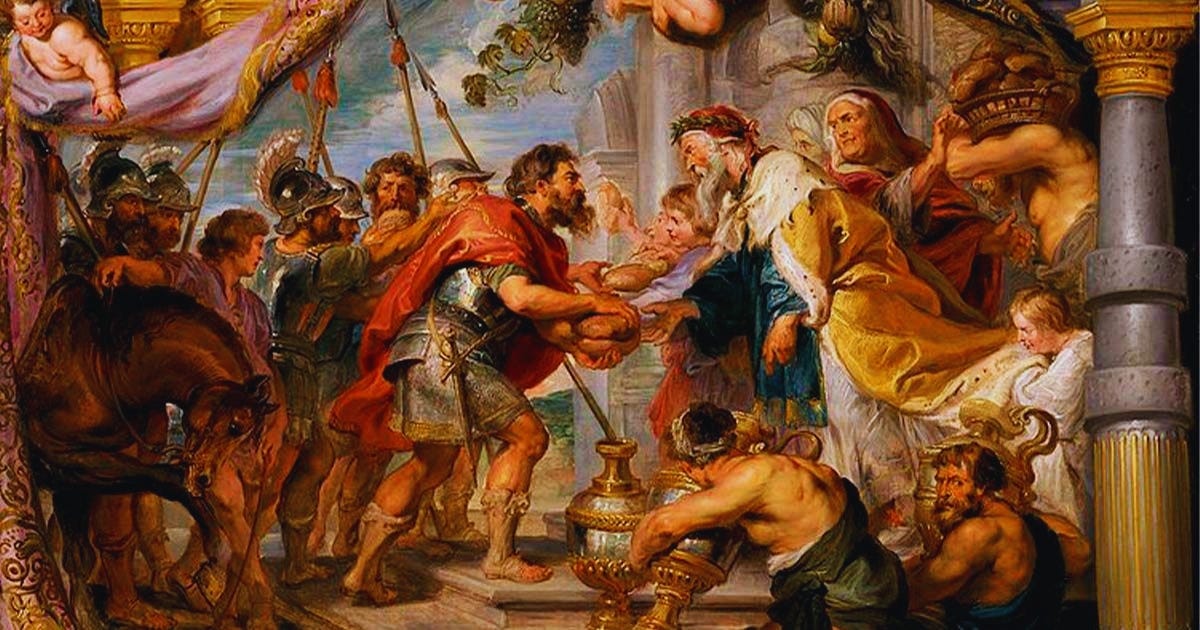
Two millennia before Jesus, a meeting occurred that most people skip over. A meal shared in the desert in the aftermath of war that quietly shifts the entire structure of the Bible.
In Genesis 14, a priest-king appears out of nowhere to meet with Abraham, the patriarch of our faith.
No lineage
No origin
He brings bread and wine. Body and blood. Abraham recognizes him instantly. And from that encounter, a line is drawn that runs through King David, through Jerusalem, and straight into the final meal of Christ.
Fates intertwined by design.
Once you understand Abraham’s meeting with Melchizedek, you stop reading the Bible as disconnected stories. You see it as a single thread moving through war, covenant, kingship, and sacrifice.
This article will show you the significance of their meeting, who Melchizedek really was, and how a peaceful meal after warfare became the most significant turning point in human history.
Before you go on…
Allegiant Faith Network is a reader-supported ministry. Become a paid subscriber and get:
Courageous Chris’s “30-Day Evangelist: How to Share, Defend, and Live Your Christian Faith in a Secular World”
2 posts every week, on Wednesday and Saturday (give or take)
Access to our full archive of articles
An exclusive subscriber chat
Your support means the world to us and helps continue to grow online.
Click below and subscribe!
Human War, Cosmic Conflict
Abraham, still known as Abram in Genesis 14, finds himself caught up in a conflict between Canaanite kings and clans of Nephilim descendants. Another rebellion. Not against God, but men against men.
Led by Sodom, multiple kings take up arms against Kedorlaomer, a conqueror who subjugated many lands and made the people cower beneath his rule. Abraham’s nephew Lot, who had already split from his company, gets captured as a prisoner of war. Forces Abraham to act.
With only 318 trained men, he routes the armies of Kedorlaomer, rescues Lot, and saves Sodom from destruction...for now.
But what looks like a military skirmish is something far greater. Kedorlaomer is King of Elam, based east of Babylon in Mesopotamia, near where Babel occurred. Abraham’s former home attacks the Nephilim descendants.
The Battle of the Valley of Siddim is interdimensional.
The eternal Creator enters where the sons of God had once rebelled and the Nephilim were born. And asserts his dominance over the ruling gods of the land.
Yahweh. On the scene. On a mission to restore justice and righteousness to creation.
He never left. He was always there but became obscured in the muddle and confusion of gods. The sons of God, given charge over the nations, worked tirelessly to steal every ounce of worship away from God Most High, El Elyon. Yahweh before Israel.
Few humans still worshipped him. One of them shows up at the precise moment of Abraham’s entrance into the political and religious disputes of early Canaan:
Melchizedek.
Melchizedek confirms God held the line. And so much more…
Priest-King of God Most High
It’s become commonplace to envision Melchizedek as a theophany (appearing) of Christ Jesus in the Old Testament, based on how the writer of Hebrews connects the two figures. And how some Second Temple texts interpret Melchizedek.
Josephus recognized Melchizedek as the first builder of the temple.
Philo expanded on the story of Genesis, picturing him as the Prince of Peace and the administrator of a great banquet over Abraham.
Fragments from the Dead Sea Scrolls connect Melchizedek to prophecies in Isaiah, Daniel 9, and Psalms 7 and 82, framing him as the anointed bringer of good news in the Spirit. Who will both restore, atone for, and liberate humanity, while simultaneously judging the nations and the fallen sons of God.
The connections are true.
The theophany false.
Confusion arises because we’re provided little detail about Melchizedek’s background. There’s no explanation for how a Canaanite city-king came to follow El Elyon (God Most High) and no inclusion of Melchizedek in any biblical lineages. The priest-king of Salem is a genuine mystery.
But as far as we know, Melchizedek is a real human being, living in the land of Canaan, encountered early after Abraham arrives and makes it his home. Any assessment that makes the priest-king godlike is speculation.
Genesis tells us he’s king of Salem. An antiquated short for Jerusalem. The city central to the later Israelite kingdom, where Solomon would one day build the Temple.
His name, Melchizedek, means “My King is righteous.” While utilized as a proper name in Genesis, it’s also a title. Representation of the priest-king’s God. Wherever Melchizedek went, people knew the God he served was the source and embodiment of righteousness.
And his God is the same God Abraham followed to Canaan. Our God.
Who establishes a foothold in the heart of Nephilim territory. And is about to work wonders...
Only God Will Be King
Melchizedek approaches Abraham after the victory against Kedorlaomer. The text doesn’t say why, or mention anything about the priest-king’s involvement in the war, if there was any.
Some scholars think his appearance in Genesis 14 is a later addition because of its odd placement. In the preceding paragraph, the king of Sodom is the only king said to meet with Abraham in the Valley of Shaveh (Valley of the Kings).
But Melchizedek’s entrance flows with the story and sets up a sharp contrast between him and the king of Sodom.
Melchizedek asks for nothing. Abraham gives him a tenth of everything anyway, because of Whom he represents. A spontaneous act of reverence later formalized in the Mosaic Law. The 10% tithe.
To the king of Sodom, however, Abraham refuses to give or take any gain.
The king of Sodom proposes a trade: He’ll take the prisoners of war, and Abraham can keep the loot. Based on what we see of the Sodomites in Genesis 19 (the abominations they practiced which led to their decimation by heavenly fire), we can assume all prisoners of war were destined for heinous abuse.
Abraham, having already sworn an oath to God Most High, denies even a thread or a sandal strap from Sodom. He instructs the king of Sodom to divide the spoils among Abraham’s Amorite (Canaanite) allies, the ones who accompanied his family into battle.
His denial is a complete rejection of everything Sodom represents, and an early recognition of the covenant God Most High would inaugurate with him in chapter 15. Abraham’s lineage would, both materially and spiritually, replace the post-Babel nations and the gods who had abandoned their Creator.
Abraham chose the priest-king of righteousness over a damned king of this fallen world. Every generation since has been asked to make the same choice.
A request sealed in blood...
Libations for the Fallen
Melchizedek hosted Abraham and the king of Sodom on behalf of El Elyon, near the mountain of God. Moriah. Showing ancient hospitality to the victors.
Their meeting spot, the Valley of the Kings, is our clue. It’s the same location where David’s son Absalom later sets up a monument to himself in 2 Samuel 18:18. Close to Jerusalem.
A great feast is prepared in honor of the slain. Bodies fell, blood was spilled, but victory was attained because of Abraham and his God.
Two unique items are highlighted amidst the mix of mourning and celebration.
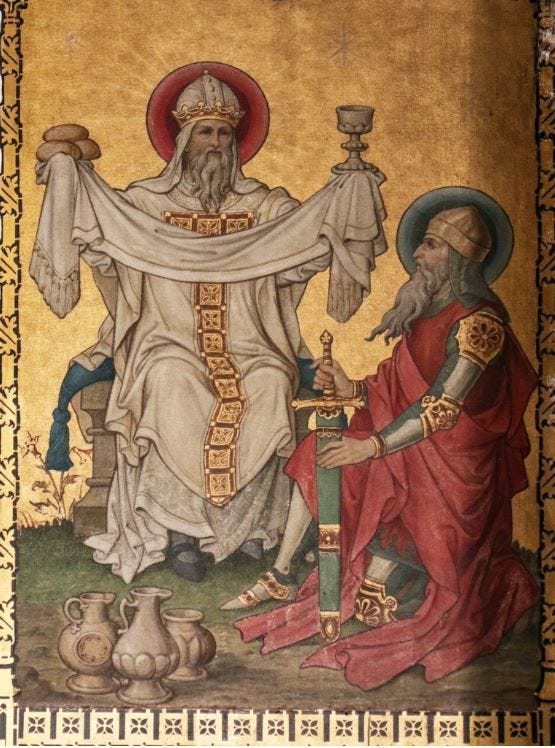
Here’s what the passage says:
“And Melchizedek king of Salem brought out bread and wine. He was priest of God Most High. And he blessed him and said, ‘Blessed be Abram by God Most High, Possessor of heaven and earth, and blessed be God Most High, who has delivered your enemies into your hand.’ And Abram gave him a tenth of everything.” (Genesis 14:18-20)
Bread and wine. Body and blood.
El Elyon would no longer be one option among many. He was actively moving. He would re-establish himself as King over the heavens and the earth, taking back the rights that duly belonged to him.
The king of Sodom and his men are brought forth to participate and bear witness to his sacramental blessing. To acknowledge the supremacy of God Most High and the man (Abraham) he chose as his instrument of salvation.
Melchizedek’s meal also looks forward to the near-sacrifice of Isaac. Where Abraham’s faith is tested, and God provides the sacrifice of his own design. A foreshadow of the final sacrifice. On Mount Moriah…the Temple Mount.
Bread and wine. Body and blood.
Sound familiar? It should…
The Last First Supper
Abraham is God’s people pulled from the nations. Melchizedek is God’s people among the nations. And Christ is the intersection.
Psalm 110 shows evidence that during and shortly after David’s rule in Israel, there was an effort to inaugurate kings who would double as priests. Modeled after Melchizedek, the first priest-king of Jerusalem:
1 The Lord says to my Lord:
“Sit at my right hand,
until I make your enemies your footstool.”
2 The Lord sends forth from Zion
your mighty scepter.
Rule in the midst of your enemies!
3 Your people will offer themselves freely
on the day of your power,
in holy garments;
from the womb of the morning,
the dew of your youth will be yours.
4 The Lord has sworn
and will not change his mind,
“You are a priest forever
after the order of Melchizedek.”
Other surrounding kings and nations could also function as priests, but most were considered gods in the flesh or demigods like the Nephilim. Melchizedek was not.
Only Israel held the anticipation of a King of kings, Lord of lords, Priest of priests, who would become the Messiah of God. Merging the lines of David and Melchizedek.
And then comes Jesus.
He makes direct reference to Psalm 110 in Matthew 22, when the Godhood of the Messiah is contested:
41 Now while the Pharisees were gathered together, Jesus asked them a question, 42 saying, “What do you think about the Christ? Whose son is he?” They said to him, “The son of David.” 43 He said to them, “How is it then that David, in the Spirit, calls him Lord, saying,
44 “ ‘The Lord said to my Lord,
“Sit at my right hand,
until I put your enemies under your feet” ’?
45 If then David calls him Lord, how is he his son?” 46 And no one was able to answer him a word, nor from that day did anyone dare to ask him any more questions.
Jesus then connects himself to Melchizedek, in all four gospels, through body and blood, bread and wine.
God and King.
At his last first supper with the disciples, our Eucharist, he celebrates final victory in the cosmic war with the sons of God and mourns the coming trial. His own death and resurrection, through which sin and death would be slain.
Jesus links to David as King, Melchizedek as Priest, and Abraham as chosen one of God Most High. Through whom all nations are saved and blessed.
The writer of Hebrews traces that connection in depth. Shows how Christ takes back the rightful rule of Yahweh over creation, as true heir of both the heavens and the earth:
15 This becomes even more evident when another priest arises in the likeness of Melchizedek, 16 who has become a priest, not on the basis of a legal requirement concerning bodily descent, but by the power of an indestructible life. 17 For it is witnessed of him,
“You are a priest forever,
after the order of Melchizedek.”
18 For on the one hand, a former commandment is set aside because of its weakness and uselessness 19 (for the law made nothing perfect); but on the other hand, a better hope is introduced, through which we draw near to God.
20 And it was not without an oath. For those who formerly became priests were made such without an oath, 21 but this one was made a priest with an oath by the one who said to him:
“The Lord has sworn
and will not change his mind,
‘You are a priest forever.’ ”
22 This makes Jesus the guarantor of a better covenant.
God’s first elect bound to God’s final elect through covenant and sacrifice. By which all nations may be saved.
God’s Eternal Offering
Christ took the journey into our world of his own accord with full intent to live a perfect life and lay it down upon the altar for us.
To save the fallen and broken
To forge an everlasting covenant
To build a kingdom beyond this world, in this world, for this world
Through him, the rule of the gods is destroyed. The corruption of sin and death erased.
From Salem to Jerusalem, from Abraham’s tent to the upper room, the table is always set.
Melchizedek let us know dinner was coming. Christ served the victory. And you and I...we’re invited to the banquet.
Don’t forget to subscribe!
We love writing for you and for our Lord Jesus Christ. All to Him we owe. And you can help keep us in the good fight.
If you’re already a free subscriber, consider upgrading to a paid membership.
Paid subscribers, whether $8 a month or $80 a year, get additional perks:
Courageous Chris’s $35 e-guide, “30-Day Evangelist: How to Share, Defend, and Live Your Christian Faith in a Secular World.”
Access to every single article we’ve ever written since we started in June 2025.
Exclusive lessons every Wednesday (give or take) explaining why you can believe in God with conviction and/or how to live for him with courage, OR deeper dives into Scripture, theology, or apologetics.
An exclusive subscriber chat to get real-time fellowship with Courageous Chris and other like-minded Christians and discuss doubts, evidence for God, and much more.
The humble feeling of knowing you are supporting a growing ministry with a mission to spread the good news of Christ to a dying generation.
Join us today!
What an awesome connection to Melchizedek!