


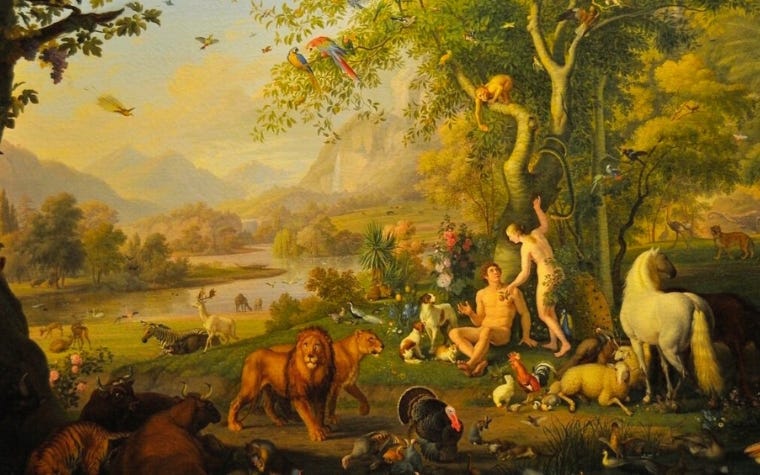
Our world is hellbent on demonizing God. And few care to ask why.
One answer is modern criticism has devolved into cynicism. “Cynicism” is when someone always looks for falsities, faults, or problems everywhere, even where none exist.
And no criticisms are as cynical as those lobbed toward the God of the Bible.
Someone argued to me that God lied to Adam and Eve, while the serpent told the truth. And claimed their interpretation is the only honest reading of the Genesis text.
Below is the full list of their objections:
The sin of Adam and Eve was not that they tried to be like God
God told a story to Adam and Eve that turned out not to be true
They were ignorant of the Law, so their actions could not be counted against them
The equating of the serpent with Satan/Lucifer occurred 1300 years after Christ, in Christian fan fiction like Dante's Inferno
Nebuchadnezzer was Satan in the minds of the ancient Jews, and Christ was the only one compared to a serpent (the one on the staff of Moses in Numbers)
All these objections are cynicisms that have been around for a long time. Ones both the Second Temple Jews and most ancient Christian churches addressed and condemned as fallacious.
Here, I will provide a response to explain why the above objections are wrong, why God is wholly good and perfect, and where the unjust cynicisms against him originate. Thereby unmasking the enduring enemy in our midst.
What Really Happened in Genesis
Chapter 1 of Genesis opens by telling us that God made the heavens and the earth. Before he made anything, there was God and there was nothing else.
He is depicted as the eternal ground of all being and is, therefore, the ultimate standard. By definition, he can do whatever he wants and is accountable to no one and no thing.
After God created the universe and everything in it, the Bible tells us he gave three specific commands to Adam and Eve:
Be fruitful and multiply
Rule over and tend to the creation
Don’t eat from the tree of the knowledge of good and evil
The above were the first Law, predating the Law of Moses. They were uttered directly from the mouth of God to those bearing his image and breath of life and were expected to be followed.
Of the laws, the third one was accompanied by a warning of the consequences: “In the day you eat of it, you will surely die.”
Though they were like children experiencing something new for the first time, Genesis makes clear that Adam and Eve understood the commands from God, especially number three.
When Eve speaks with the serpent, she acknowledges her awareness that if she and Adam were to eat from it, death would follow.
The serpent initiates the conversation with her. Seeks her out. And states, “Did God really say that you would surely die?”
When she responds in the affirmative, the serpent denies the claim and counters with a promise that she and Adam would become as gods. With no need for God.
So she eats. Then shares with Adam.
Immediately, they lose their innocence and are ashamed because they know they have disobeyed the command of God. A slow death ensues:
Adam blames God and Eve (erosion of human-divine and human-human relations)
Eve blames the serpent (erosion of human-creation relations)
God condemns the serpent (erosion of divine-creation relations)
Subsequent curses issued by God reflect the pattern of death and confirm the world will now be a place of suffering, torment, and eventual annihilation.
The serpent’s curse is an inversion of proper design, Adam’s is an inversion of the command to tend and rule over creation, and Eve’s is an inversion of the command to be fruitful and multiple.
God also promises the serpent that one day a seed from the woman will smash his head. Highlighting the serpent as the enemy of mankind.
After the curses, physical death comes for Adam and Eve, but God instead slaughters two animals and clothes Adam and Eve in the skins. Signifying grace through the sacrificial spilling of blood by the divine.
And they are exiled from the Garden because in a state of death they can no longer participate in the eternal life offered by the tree of life (the other prominent tree in the Garden of Eden).
Before you go on…
Consider subscribing. If you’re already a free subscriber, consider upgrading to a paid membership.
Paid subscribers get these awesome benefits:
Exclusive lessons every Tuesday explaining why you can believe in God with conviction and/or how to live for him with courage, OR deeper dives into Scripture, theology, or apologetics.
An exclusive subscriber chat to get real-time feedback from Courageous Chris and other like-minded Christians about doubts, evidence for God, and much more.
The humble feeling of knowing you are supporting a growing ministry with a mission to spread the good news of Christ to a dying generation.
Who’s the Liar?
Postmodern scholars love to argue that God was dishonest because Adam and Eve didn’t instantly die a physical death. But the argument itself is dishonest because they DID die, eventually.
A fact the serpent states outright would NOT happen. At all.
God also didn’t reveal to Adam and Eve that the tree of the knowledge of good and evil would give them knowledge of good and evil (although it’s plain in the name). But that doesn’t make God a liar.
Because his command to steer clear of the tree was plain, understood, and acknowledged by Adam, who then conveyed it to Eve (who also understood and acknowledged).
Furthermore, as the ground of all being, the definition of existence, and source of eternal perfection, God CANNOT lie. So, compared to what standard is any scholar saying he lied to Adam and Eve? His own?
If so, we must be reminded that God is the standard himself and is accountable to no other beyond himself, which means he can do anything he wants. Even rewrite the rules. And we would have no say in the matter. Period.
That’s no mere philosophical conclusion. It’s a limitation set by Genesis itself.
According to that limitation, the serpent, just like Adam and Eve, was accountable to God. And he failed just as much as they did. Only his error was worse because it was premeditated.
Though he revealed the nature of what the tree would provide, he denied negative consequences and doomed humanity and creation to certain corruption and death. He is the Adversary in the story.
And he was equated with Satan long before Dante.
Ancient Views of the Fall
Serpents were a paradox in the ancient world. They were associated with both virility/healing and seen as lethal.
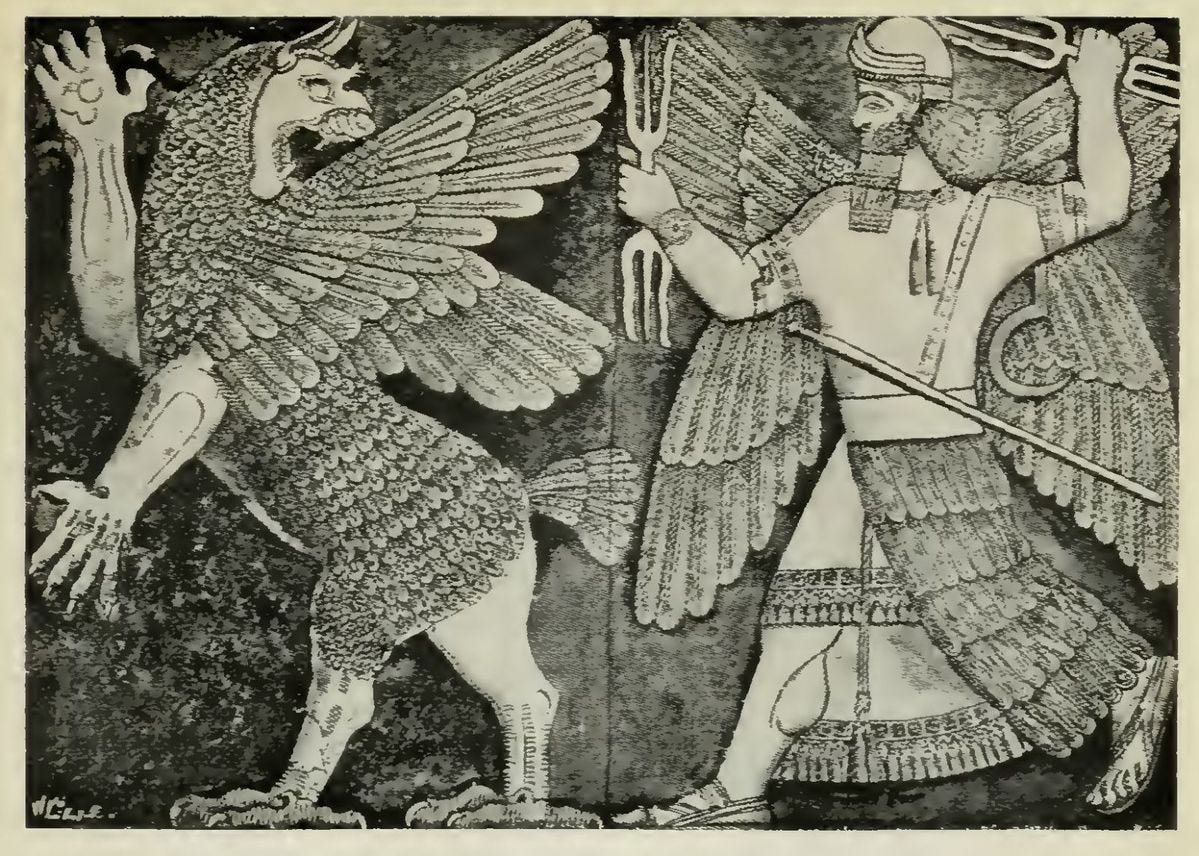
The god Marduk battles the winged serpent goddess Tiamat in the creation myth of Babylon
A major reason for the dualistic view is, in many mythologies, a serpent is credited with stealing eternal life.
The most memorable account besides Genesis is the Enuma Elish from Babylon. In it, there are two serpent stories. The god Marduk battles the serpent goddess of chaos and makes the universe from her mutilated body. Her death gives life.
Then, the giant hero Gilgamesh finds a long-lost plant (tree?) containing eternal life, after being told where to look by the lone survivor of the global Flood (Noah by a different name). Overnight, while Gilgamesh slept, a serpent snatched the plant and stole it away.
Such stories appear to reveal a collective memory of the first encounter at the beginning of time, where the serpent trickster deceived humans into losing the way to immortality. The only perceived solution is to somehow defeat the serpent.
What’s most important for us is that ancient Jewish sources not only agreed with those other stories but also came to attribute the title “Satan” (adversary) to the serpent as a proper name. And blamed the serpent (not God) for the Fall in the Garden of Eden.
Here’s a list of Second Temple sources and what they said about Genesis 1-3:
Wisdom of Solomon: The Fall was caused by the envy of the Devil and ushered in death, which was not created by God.
Life of Adam and Eve: Satan comes to tempt Eve out of penitence, and this is said to be their second encounter. The first was as the serpent in the Garden of Eden, where his deception resulted in sin and death for all creation. Again, the envy and pride of Satan are highlighted as the cause.
Antiquities of the Jews: Josephus attributes the Fall again to the serpent, who persuaded Eve to despise the command of God and try to take the place of God. By forsaking peaceful communion with God and Adam for equality.
Apocalypse of Moses: This document claims Satan possessed a real serpent or snake, which he then used to tempt Eve in the Garden. Satan is portrayed as a fallen angel attempting to corrupt humanity.
2 Enoch: Depicts Satanail, Satan, or Devil as also taking on the form of the serpent in order to tempt Eve to betray God and Adam. The temptation is described as seduction.
Apocalypse of Abraham: Azazel, who is identified elsewhere in Second Temple texts as the chief demon or adversary (satan), is equated with the serpent in the Garden. He comes to humans as a dragon or viper. In Leviticus 16, he is also linked to goat demons in the wilderness, where Israel was commanded to send the scapegoat during the festival of atonement.
Ben Sirach: The Wisdom of the Son of Sirach re-narrates God designing everything in pairs and ordering nature, and considers the Fall resulting from poor human choice, which resulted in sin.
All the above Jewish texts either predate Christianity or were written in the first century when Christianity was growing as a movement following the resurrection of Christ.
And they make clear:
God was not at fault for the Fall
The serpent was the adversary and trickster
Satan became associated with the serpent in Jewish circles
So, why didn’t Israel call the serpent “Satan” sooner?
Lord of the Flies
The reason Satan wasn’t associated with serpent sooner is because Baal was the primary threat for Israel through most of its history. The Canaanite storm god who defeated the sea god Yamm (symbol of chaos) and became lord of the gods.
Ezekiel in chapter 28 of his letter considers Baal the serpent. Specifically Baal Melkart, the version of Baal that ruled over the wealthy seaward cities of Tyre and Sidon.
It’s no coincidence that the region in which those cities resided (Bashan, home of Mount Herman, central hub north of Israel for temples to all the nations gods) became considered the gates of hell and is possibly the desert place where Jesus faced temptation from the devil.
In the gospels, the Pharisees refer to the devil as Baalzebub (lord of the flies). This was a mocking title attributed to the serpent to disown him in the Greco-Roman period. It identified him with the trash heaps in the region of Gehenna. The rotten stench of decay.
They attempted to connect Jesus with Baalzebub when he was casting out demons. Then Jesus dropped his famous retort about how a house divided cannot stand. Satan would never interfere with the work of his own demons. So, Jesus was not an ally of the serpent.
Baalzebub was envisioned as the ongoing enemy of the world since the dawn of time. Seen as the chief adversary (satan) and enemy of God Most High and his children.
The idea that God is the real bad guy and the serpent the defender of humanity didn’t come from the Jews. Instead, it came from a vicious enemy condemned by the church since its inception...
The Cult of Secret Knowledge
Obsession with knowledge has existed since the beginning, as the story of Genesis itself reveals. But in the Greco-Roman period, certain mystery religions began an esoteric relationship with knowledge.
The resulting product was a philosophy known as Gnosticism.
It became a religion of its own that could adapt to the framework of any other religion it wanted to. Like Hydra with its many heads.
Before we get to how Gnosticism connects to faulty interpretations of Genesis, we must take a quick detour through the beliefs of the religion. To plainly visualize it in our minds.
The formal religion was disbanded long ago, but we still face its central tenets in order forms today (see if any of these sound familiar):
The universe is an accident
Humans are trapped by nature and must transcend it
Certain groups are unjustly oppressed by systemic evil
Salvation comes through secret knowledge only a select few possess
Select groups must rule over the masses and bring about utopia
As you’ve guessed, that’s an outline of socialism/communism. It’s also an outline of Gnosticism, stripped of any spiritual jargon.
Ancient Gnosticism argued there was a Supreme Being (the Monad) who wanted to design a spiritual reality alone. He made aeons inside a Pleroma (expanse) that he filled with divine entities.
One of these entities did away with Wisdom and became the Demiurge (symbolized by a serpent with a lion face).
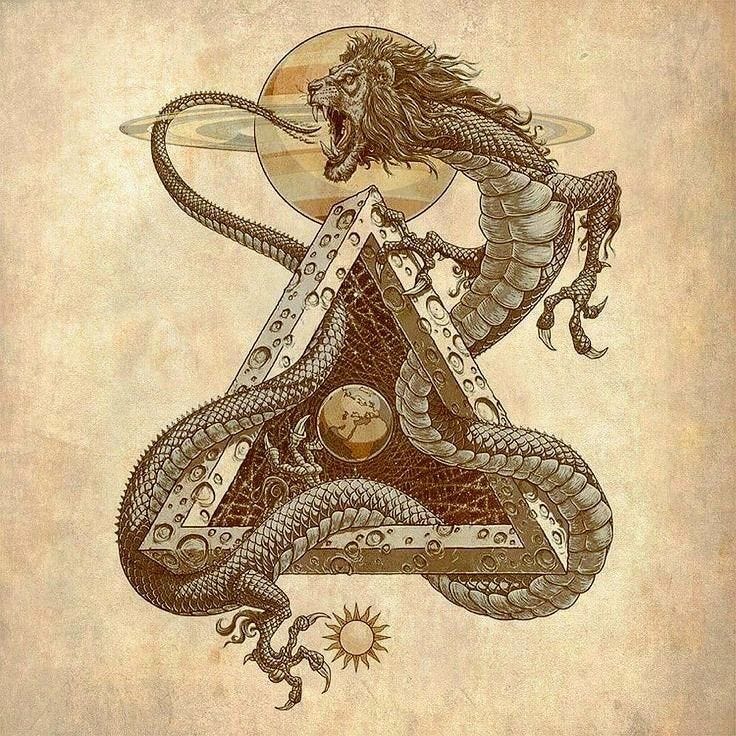
The Demiurge made material reality and archons (rulers) to govern it, against the desires of the Monad.
The material universe is therefore evil and corrupt. But humans have a divine spark inside them, a spirit they must be made aware of. A mistake the Demiurge overlooked.
Only a Messiah figure, a revealer with access to the secret knowledge of the Monad, can free humans from their prison of ignorance, awaken them to the spiritual, and save them from their corrupt flesh.
“Jewish,” and later “Christian,” sects of Gnosticism in the late first century became convinced that Yahweh (Creator God of the Bible) was the Demiurge, Yaldabaoth, who concealed universal knowledge to the detriment of humanity.
The serpent in the Garden was the liberator. The first revealer. He showed Adam and Eve the truth that the Demiurge sought to hide from them, which was to oppress them and keep them from becoming gods.
Yahweh’s curses were, then, the unsavory and psychotic responses of a deranged mind, hellbent on further oppressing humanity. Restraining them from reaching their full, spiritual, enlightened potential.
He trapped them in mundane tasks of survival so that they would never attain higher knowledge. Which required another Messiah figure, or revealer, to come and remove the scales from their eyes. Let them see the light.
Jesus, for the “Christian” sects, was said revealer. He wasn’t material at all. He was pure spirit in human form and never died. And was re-appearing of the serpent.
The cross was essentially a stunt to showcase the true power of the Monad (think thunder, earthquakes, tearing of the Temple veil), and prove that evil material had no control over the spiritual.
Secret knowledge of the Monad Jesus spoke to his disciples, which they never shared with anyone except the Gnostics. Therefore, the Gnostic “Christians” were the enlightened ones. With the vision to see the truth. Everyone else who did not heed their warnings and join them was damned for all eternity.
Gnosticism is where the perversion of Genesis comes from. Fueled by pride and a superiority complex, an elitism like no other.
It was rightly condemned by both traditional Second Temple Judaism and the Christian church. Because it’s a complete inversion of the teachings of the Old Testament and of Jesus and his apostles.
Gnostic interpretations have resurfaced now because they have a new face. Postmodern socialism, as noted earlier.
The new “enlightenment” thinks itself the objective superior and just re-interpreter of the ancient world and considers all else vile folly. But it’s only rehashing what has already been destroyed, dressed up in modern language.
Conclusion: Almighty God Still Reigns Supreme
Neither the text of Genesis nor interpretations from antiquity permit visualizing the serpent as the hero of the story.
He is plainly painted as THE villain, who acted out of pride and envy to sabotage God’s very good creation by tricking Adam and Eve into unleashing sin and death through disobedience to the Creator.
In every imaginable way, he is the Adversary, the Satan. His weapon is deceit, and his end is evil, chaos, disorder, and death.
Ancient Israel, Judaism, and Christianity all recognized him as the usurper, the coveter of the throne of God. He wanted to replace the Almighty in every sense, and partially succeeded.
But God intervened immediately in the Garden with sacrificial grace, paving the way for the future sacrifice of the Messiah. Who would rescue not through secret knowledge, but through his own blood. On the cross. And then rise from the grave, conquering sin and death.
Jesus not only separated himself from Baalzebub. He vehemently opposed him and exorcized his demons from the Jewish people.
The Christ made clear he was God in the flesh, the Creator God Yahweh, pre-existent Maker of everything. More than spirit. Beyond created things. Born to restore eternal life.
He smashed the head of the serpent. And he reigns supreme, seated at the right hand of the Father in the highest heaven.
No amount of cynicism will ever overcome our everlasting Lord.
Gnosticism is like a sell pitch. It's like every pay-walled online course which promises emediate happiness and success or weight loss or whatever which is hard to achieve if a custumer just pays for some secret knowledge.
The Gospel and Scripture as a whole don't hide the real costs. No secret knowledge offers a short-cut.
Excellent argument and defense. Your articles help me think deeply.