


I must confess I used to be a diehard Walking Dead fan. The show concluded a while ago, and I never got into the spinoffs.
It lasted so long, I think, because it told story well. Depicted humans finding value, beauty, and hope in a hopeless world.
There’s a line spoken in The Walking Dead that haunts me to this day:
“People are a resource.”
It comes from Negan, one of the most vile characters in the series.

With “people are a resource” as his banner, he murdered, enslaved, and tortured thousands of people to create his idea of a utopia in a dead world. A utopia revolving around him and his God complex.
His words should haunt you too.
Many in this world operate with his worldview: Humans are mere objects to be exploited.
On the other hand, many presume inherent value in human life, with no grounding for that view. Most go about saying things like:
“Cherish your family and friends”
“Love your neighbor as yourself”
“Always treat everyone nicely”
“Mind your own business”
Atheists like to say we developed good values over time as a product of close social relations. But this defies logic.
Experience shows value is in the eye of the beholder, and we each value things and others differently. Universal stable principals of value and beauty wouldn’t have “evolved” during any period of time.
In a materialist universe devised of random processes, views like Negan’s should be normative. Relativity provides no stability for worth or moral assessment.
Good values must be grounded in something greater and transcendent.
Higher Causation

Beauty and design are hallmarks of higher causation. They are billboards pointing to purpose. Speak of intention. Remind us what we see didn’t arise by chance.
Those who disagree are often hard-pressed to explain themselves otherwise. Most end up reducing everything to molecules and random processes. They insist beauty doesn’t exist in and of itself. That humans project “beauty” onto things.
In their view, the sunset is only colors refracted through atmospheric particles, and music is only vibrations interpreted by the brain. If this is true, beauty is nothing more than a trick of the mind.
But if beauty is just a trick, why does it matter? Why should we care at all? What kind of life is that, where everything that moves us is written off as mere illusion?
Even more pressing is the question of creativity.
Where does the creative drive within us come from if everything is just random and material? Why do we write stories, paint scenes, compose music, and chisel sculptures unnecessary to rote survival? What is creativity, and what is beauty, if they have no anchor?
Become a courageous warrior for Christ in 30 days or less, without spending your entire life savings on a massive library of books. Or theology degree.
Get “30-Day Evangelist: How to Share, Defend, and Live Your Christian Faith in a Secular World.”
A digital guide containing all you’ll ever need to discern and speak Gospel truth clearly and powerfully to persuade hearts and minds toward the Kingdom of Heaven.
Paid subscribers to Allegiant Faith receive a 30% DISCOUNT.
Don’t wait. Learn how to discuss your faith and convince your loved ones to repent and follow King Jesus today.

Purpose and Value
We don’t live in a reality plagued by undead monsters trying to devour us every waking second. Not like The Walking Dead, anyway.
Ours is a dog-eat-dog world. Popular worldviews like nihilism (hopelessness), produced from materialist philosophies, encourage selfish isolationism or animalistic behavior.
So, the material answer is never enough.
Molecules can’t explain longing.
Randomness can’t explain order.
Survival can’t explain self-expression.
Such are anomalies if we are mere clumps of cells. And those who deny design and higher causation can’t provide satisfactory answers. Theirs are empty words, avoiding the root of the problem.
Unless there’s design from a Designer, craft from a Crafter, order from an Order, there’s no such thing as beauty or value. Without a source of purpose, each collapses into nothing more than preference, like choosing between flavors of ice cream.
Beauty is born from purpose, and purpose determines value.
If something was made with intent, it carries meaning.
If it carries meaning, it has value beyond what any audience assigns.
That’s why inherent value can’t exist without objective meaning.
But objective meaning doesn’t simply appear out of thin air. It can’t exist on its own. It must be grounded in something.
The Delusion of Fact-from-Opinion

Atheists are partly correct when they say meaning is a matter of perspective. We do assign meaning in different ways. But they don’t go far enough.
If human perspective is all there is, we’re left with endless disagreement, constant flux, and no foundation. If we can’t stabilize beauty or meaning in anything concrete, universal, nothing matters at all.
Good and bad are opinions playing tug-o-war with our minds.
There must be something above us, beyond us, greater than us, to rule on and/or be the source of true meaning.
Otherwise, one man’s trash really is another man’s treasure. And trustworthiness is mere delusion.
God’s Cosmic Investigators
Proverbs 25:2 says, “It is the glory of God to conceal things, but the glory of kings is to search things out.”
A Godless world contains no glory because it contains no meaning. But in God’s cosmos, it is our glory to discover the mysteries and wonders of his astounding creation.
To study the stars, to explore the oceans, to dig into the soil, and to uncover the patterns of life is a fulfilling exercise because we are wired to explore, appreciate, learn, and grow.
That we can even ponder this cosmos and its wonders is itself testament to our Creator. The same God who spoke galaxies into existence made us capable of delighting in a flower, marveling at the night sky, and being moved by a song.
Beauty isn’t accident. It’s a gift, a reflection of divine intention.
And that intention remains viewable, tangible, even in a universe marred by sin and death. Written into its very fabric.
In fact, there wouldn’t be a way to know evil unless there was beauty and goodness. People mistake evil as an object. But evil is the corruption of objects; the destruction of intended order.
His Higher Ways
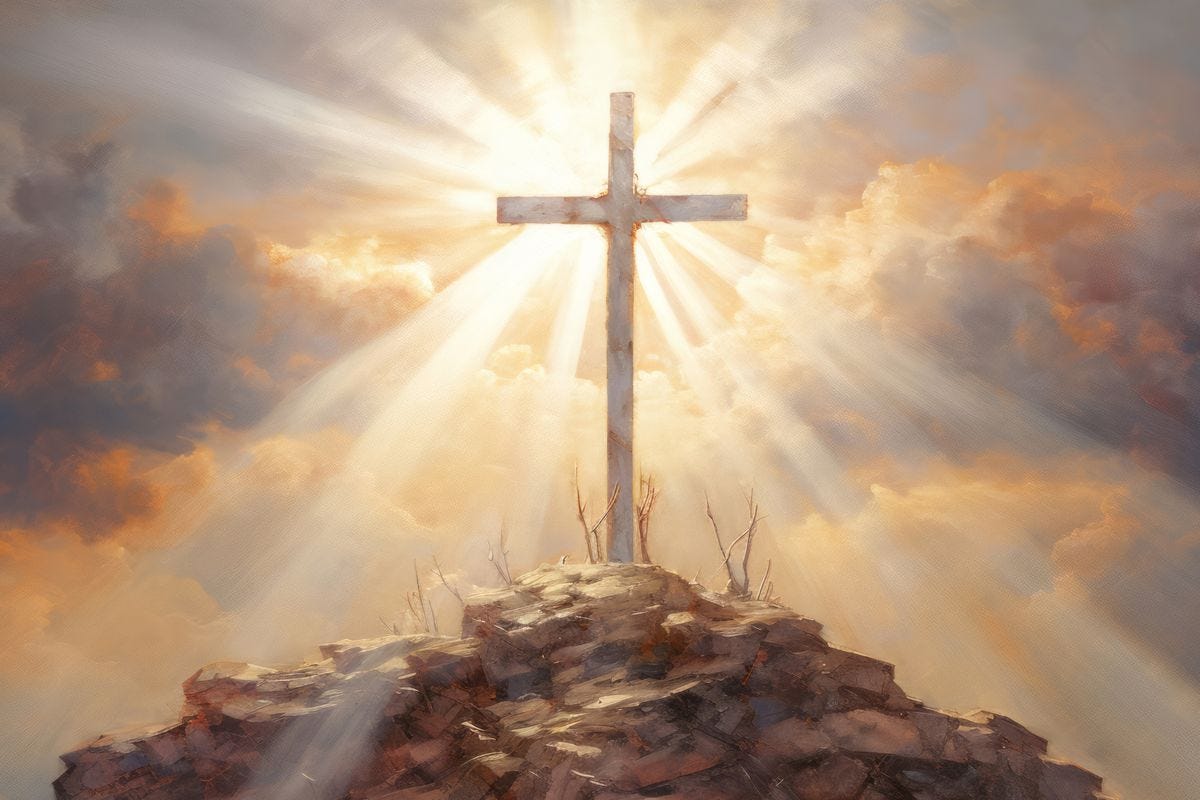
There’s a greater beauty still. The most stunning design is not found in the stars, the oceans, or the mountains. It’s found in the gospel of Jesus Christ.
What could look more chaotic than the cross? On that day, human pride, hatred, and corruption collided in an act of brutal injustice. To the world it looked like defeat and ruin. But hidden within the horror was the deepest design.
God was crafting redemption.
The Creator was restoring his creation.
The cross shows us true beauty often comes out of brokenness.
What looked like death became life.
What looked like ugliness became glory.
What looked like cruelty became the foundation of eternal hope.
The resurrection confirmed it. Out of the grave came the proof that God’s design triumphs over disorder. Christ reversed death.
Jesus is the clearest demonstration that beauty isn’t random, meaningless. It comes from God himself, who makes all things new.
The gospel is beauty with purpose. Design with eternal meaning. The Creator showing nothing is wasted, not even suffering, not even death.
He works all things for the good, beautiful, and valuable.
Human Meets Divine
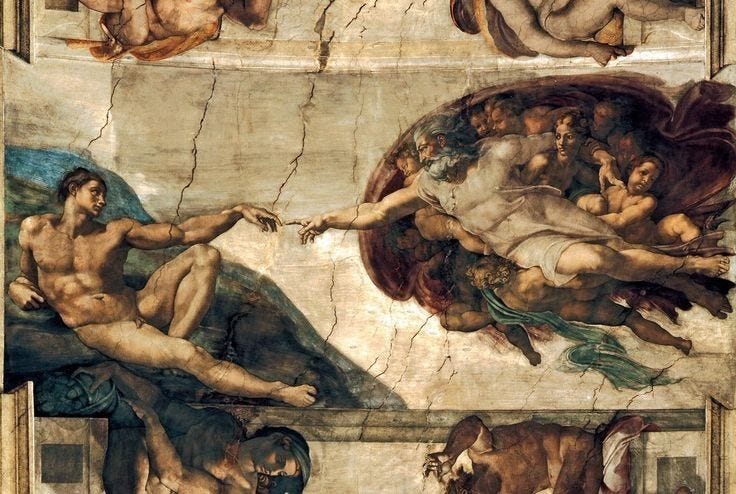
Here is where human creativity fits in:
We paint, we write, we build, and we compose because we are made in the image of the Creator. Our longing to make beautiful things isn’t coincidence. It’s an imprint of God’s own nature.
When we paint to a canvas, add words to a page, or melody to a song, we are echoing the first words spoken in Genesis:
“Let there be.”
Our creativity reflects the gospel itself.
Out of emptiness, God brought form.
Out of chaos, he brought order.
Out of sin and death, he brought redemption.
When we create, we imitate this pattern small-scale. We take what is raw and give it structure; we take what is ordinary and breathe life into it; we take what is broken and imagine it whole again. Every story we tell, every song we sing, every piece of art that captures beauty testifies to His story of glory.
Beauty is not meaningless. It’s a reflection of eternity.
Creativity is not an accident. It’s evidence of the divine.
And the Gospel isn’t only the greatest story ever told, but the truest story, where beauty and design meet, are perfected, and expose the objective value within creation.
What Will You Choose?
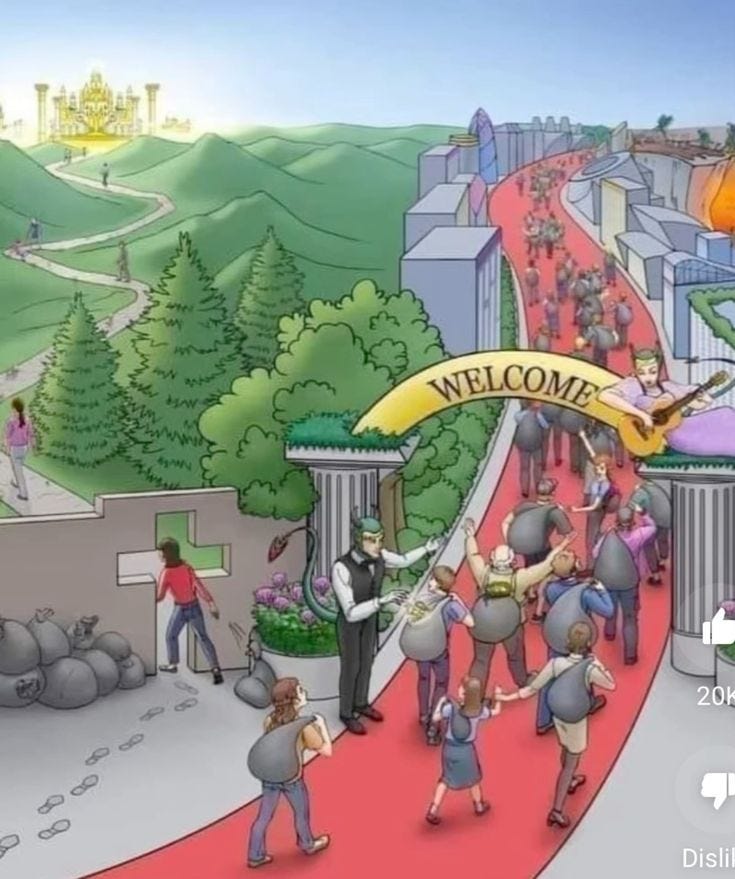
The cool thing about Negan is later in The Walking Dead he realizes he was wrong and repents of the horrific and monstrous actions he committed in the name of his worldview.
He remarries and becomes loyal to a woman, with whom he has a child. And he attempts to make right the past by creating something new, either abandoning or redirecting his destructive tendencies toward protecting others.
Though Christ is never mentioned, Negan’s story arc reflects the Gospel’s. Jesus’s very words are, “Repent and follow me.”
That’s the choice before you.
You can treat beauty as an illusion, as nothing more than a passing trick of the brain, and in doing so you will hollow out your soul. Or you can receive beauty as a signpost pointing you back to the God who made you, who calls you, and who has written eternity on your heart.
One path ends in emptiness.
The other ends in life.
The Designer has left his signature everywhere.
The question isn’t whether beauty and value are real; the question is whether you will follow them home.
Nature cannot be fully conquered while beauty exists
Great work! I've just recently dived into moral objectivity and other Christian apologetics from Frank Turek and the like.
I only wish I've heard of them during my years of being a militant atheist.
By the way, loved The Walking Dead - I just couldn't push through to the ending, if it even ended at all? Is it worth slogging through?