


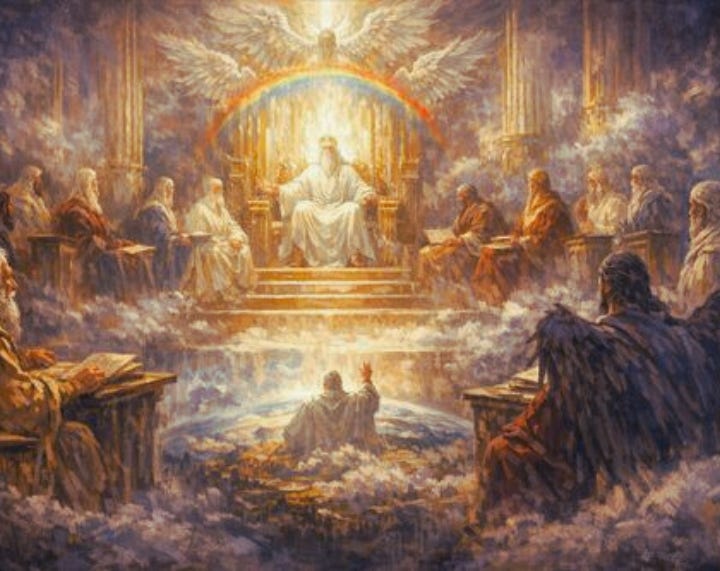
You hear atheists these days trying to discredit Yahweh as an unruly or demonic god in the Old Testament.
The accusations stem from Yahweh’s behavior. Sometimes he’s calm and merciful, sometimes he’s stubborn and immovable, sometimes he’s angry and exacts tragedies.
There are even times, like with Abraham before Sodom and Gomorrah, where Yahweh appears to change his mind.
The popular sentiment recently has been to dismiss Yahweh as evil. But in a previous article, I already outlined how that view is dangerous. Gnostic in its roots:

Gnostics portrayed Yahweh as the demiurge, the anti-life/spirituality force working against the eternal God. Theirs was seen as a false religion by both the Jews and the earliest Christians, one that slandered God Most High (Yahweh and then Christ Jesus) and produced in adherents a grotesque superiority complex wielded against the flesh.
With its hyper-dualism (division of spirit and body) and emphasis on secret knowledge for the elect, Gnosticism erodes anything it touches by convincing proponents to destroy “oppressors” and can be found embedded deep in the worst political movements of our time, particularly socialism.
So, it isn’t to be trifled with.
But an important question is raised atheists and gnostics: How can the eternal, perfect God, Yahweh, be emotional and still sovereign and good?
The issue arises from a misunderstanding of sovereignty and goodness. A misunderstanding derived from Ancient Greek philosophy about the eternal God.
Below is a summary of said misunderstanding, how some scholarship has tried to cope with it, and why you can do away with both (the misunderstanding and scholarship) and trust Yahweh is the perfect, eternal, good Creator God of the universe, made flesh in Christ Jesus our Lord.
Fictitious Immovability
Philosophers like Plato and Aristotle, and others like Xenophanes before them, had trouble with the gods because they saw them as unruly caricatures of humankind.
They (the gods) would sleep around, get drunk, hold orgies, get high on drugs, experience fits of rage, slaughter and mutilate opponents, etc. Enslaved to desires, just like the Greeks and other humans.
Honor was a scarce trait among them. Goodness, a trampled memory, if ever it existed.
In their minds, an eternal, perfect God had to be immovable, including void of emotion. Different from humanity in every way.
Because the Romans conquered mostly Greek lands, such philosophies were everywhere in the Empire, and Gentile Christians, who were former practitioners of their schools, mixed them with the Christian faith.
Tertullian (2nd century AD) famously saw that mixing as a problem and is known for his line, “What has Athens to do with Jerusalem?”
Nevertheless, the mixing continued throughout the Middle Ages after Constantine made Christianity the official religion of the Empire, and eventually influenced famous philosophers like Thomas Aquinas, who postulated God as the Unmoved Mover.
While philosophy itself is not bad (it means “love of wisdom” and entails logical study of everything available to the human mind), the idea of immovability as a component of sovereignty and goodness is not one that was shared by Ancient Israel. Or at least, not in the way the Greeks saw it.
That contradiction and the so-called “enlightenment” mingled to produce some strange scholarship.
Before you go on…
Consider subscribing. If you’re already a free subscriber, consider upgrading to a paid membership.
Paid subscribers get these awesome benefits:
Exclusive lessons every Tuesday explaining why you can believe in God with conviction and/or how to live for him with courage, OR deeper dives into Scripture, theology, or apologetics.
An exclusive subscriber chat to get real-time feedback from Courageous Chris and other like-minded Christians about doubts, evidence for God, and much more.
The humble feeling of knowing you are supporting a growing ministry with a mission to spread the good news of Christ to a dying generation.
Enter the “Enlightenment”
With Rene Descartes and others like him in the 1600s, the scope shifted away from the divine toward humanity as the ultimate good.
Renaissance humanism from the 1400s (built upon an appreciation for humanity as designed in the image of God) was confiscated by those who distrusted Christianity and made into a supreme philosophy. With the underlying idea that humanity is inherently good and must be freed from the shackles of spiritual rule.
Socialism and evolutionism became prime outlets for the expression of the separation between spirit and flesh, unknowingly accepting Gnostic ideals in reverse. Flesh is all there is, they mused, and subject to systems of oppression.
Power slowly replaced truth, culminating in the current postmodern leftism seen everywhere today.
How it manifested in biblical scholarship was through what is known as the Documentary Hypothesis (18th-19th centuries).
Elohim and Yahweh (the two names for God in the Old Testament) became seen as separate entities invented by different camps amongst the Israelites. Using linguistics (a highly speculative form of analysis), said scholars (Julien Wellhausen being the most famous) outlined four strands of fictional authors throughout the Hebrew Bible:
1) J (Yahwist/Jahwist): containing vivid, humanistic images of God; considered “early” (10th cent BC); including Genesis 2-3, flood narratives, and southern (Judah) patriarchal stories
2) E (Elohist): abstract God; northern Israel; fear of God focused; uses Horeb and not Sinai (9th cent BC)
3) D (Deuteronomist): legalistic and focused on ethics with a centralized worship pattern; considered part of King Josiah’s reforms (7th cent BC)
4) P (Priestly): ritual texts, genealogies, tabernacle details, and precise dates; Genesis 1, Leviticus, Numbers (6th-5th cent BC)
While interesting, the Documentary Hypothesis has major, unreconcilable problems and has been all but abandoned in most scholarship, despite being taught in introductory Old Testament courses as “fact”:
Methodological weaknesses: Ancient Near Eastern deities often went by multiple title/names; no clear lines of thought can be traced for each member of JEDP; styles in the Pentateuch (the first five books of the Bible) and the other books match styles from their purported time periods (like Hittite suzerainty treaties, etc.); alleged contradictions often end up complementary (like Gen 1 being panoramic and Gen 2 being focused).
Philosophical bias: Wellhausen relied heavily on Hegelian (socialist) evolution of religion (nature to ethics to ritual), which has been discredited again and again; naturalism cannot explain morality.
Lack of external evidence: No manuscripts from J, E, D, or P exist; Jewish tradition was unaware of the source (which is strange considering how good they were at documenting), and the Dead Sea Scrolls treat the Torah as unified (so do the New Testament writers); and there are no Ancient Near Eastern parallels for such fragmentary piecing together of texts.
Overly speculative dating: Early J has minimal support and E is virtually non-existent, suggesting better explanations are out there variances in the Bible.
Literary alternatives: Hebrew prose uses parallelism, multiple perspectives, and resumptive repetition to create emphasis, not multiple authors.
Conservative rebuttals: Biased against the supernatural without adequate support; again, the texts match very early styles consistent with the alleged time periods within their stories; and archaeological support for early dating (Yahweh inscription, Soleb 1400 BC).
Hence, the Documentary Hypothesis is pure, unreliable fiction devised to remove trust in Yahweh and the Hebrew Scriptures.
Which means another, better explanation for Yahweh’s personality exists.
Emotional but in Control
The name Yahweh is a variant of the Hebrew verb for “being,” meaning “I AM.” Elohim is a general descriptor for spirit beings, often translated as “gods.”
The former is God’s formal name and was used to designate his eternality and transcendence by the Israelites.
He is supreme and sovereign, the determiner of all reality and morality. That alone signifies his status as perfect and good because he is THE STANDARD.
But the Israelites also did not see emotions as bad. Emotions are part of our design in the image of God. A way in which we reflect him in this universe.
Emotions can be corrupted, but that isn’t on God. He, being spaceless, timeless, immaterial, and the standard, did not invent evil. Evil is the absence of his goodness. The nothingness encroaching into the something he made.
Sin and death are the manifestations of evil unleashed upon the world by Adam and Eve disobeying God, which disrupted and corrupted God’s very-good design.
So, humanity is no longer inherently good. But God is. This means that even God’s emotions are good.
The Unmoved Mover Still Moves
In the Israelite view, then, God is an Unmoved Mover with his own good emotions, and unlike what Greek philosophy often forgot, the Unmoved Mover still has agency and can move on his own.
Whenever we read the Old Testament, we have to take said agency into account: God is the ultimate Agent, and humans are small agents made of his own design, to relate to him and follow him.
Whenever Yahweh expresses emotions that appear “bad,” one has to consider the human component. Every time, his (God’s) reactions are instructive (pointing toward the best path), just (righting wrongdoing), and/or relational (inviting participation in his divine plans). Human actions, to the contrary, are flawed and without clear direction, especially when they do not align with God’s perfect will.
Nothing God does happens by accident. He is always in control. That’s how the Jews saw it and how the earliest Christians saw it, so whenever we see otherwise, we have to question ourselves first and the humans in the text before we ever question God.
God consistently shows himself as leading with mercy throughout the texts from the beginning:
Instead of Adam and Eve dying outright, God pushes death off on an animal and clothes them
Humanity persists for generations despite their sins until led into endless violence by the Nephilim, resulting in the Flood
Humans exist together in unity until they try to storm the heavens by force with the Tower of Babel, making God divide them
God makes a covenant with Abraham to create his own nation amongst humanity to save them
Humans prove so corrupt that even the nation produced from Abraham, the Israelites, betrays God over and over again, repeating the Fall
God sends them into Exile with the promise that he will bring up a Savior among them
Yahweh comes as Christ Jesus in the flesh, lives a perfect life, dies on the cross, and then rises again, destroying the bonds of sin and death with a new, willing sacrifice unlike the animal in the garden
Jesus sends his church out into the world to be the renewed very-good image of God, the body of Christ, the kingdom of heaven on earth
Mercy is at the forefront. Always. But it is paired with justice throughout that entire narrative.
All humanity was not destroyed in an instant with the Flood; they lasted generations. Sodom and Gomorrah were around performing despicable acts for centuries before God destroyed them. The Canaanites and Amorites were barbaric but allowed to thrive a long time before the Israelites conquered them. The Israelites were stiff-necked and dishonorable toward God relentlessly before God sent judgments.
And many judgments were the consequence of their own actions, like what happened in the Book of Judges. They did what was right in their own eyes, and the repercussions were disastrous. A product of the contingency built into our reality.
Everyone who dismisses Yahweh must overlook these cases or twist them by pretending humanity is good, despite evidence to the contrary.
Test Everything by the Word
The prevailing data supports the Bible being authentic and an excellent explanation for the human condition. When allowed to speak for itself.
We too move without clear direction or purpose without God. Fall into horrid evils. When he’s abandoned, everything falls apart. Every time.
As the writer of the Book of Hebrews notes, the Bible is alive and active, sharper than any two-edged sword, dividing unto soul and spirit. If you pick it up and find yourself arguing with it more than considering its wisdom, then you are using it wrong.
Yes, there is a place for detached study, but the Bible demands much more than that. Transcends it like the Author behind its words.
When you get trapped in detachment, you risk becoming blind and resisting the Truth. And when you misunderstand God’s nature, you misunderstand yourself.
God is real, God is good, God is supreme, and he left you his revelation to show you the way to his eternal kingdom. Drown out the noise and heed his beautiful, perfect will.
Chris raises an important issue, one that resurfaces every generation because people continue to read the Old Testament through philosophical lenses the biblical writers never used. As someone who was mentored by Dr. Michael S. Heiser, I want to affirm the core of Chris’s argument: the problem is not Yahweh’s character but our categories the we try to fit him into.
Modern critics, whether atheists, neo‑Gnostics, or post‑Enlightenment skeptics, consistently make the same mistake:they impose Greek metaphysics onto a Hebrew text and then blame the text for not fitting their imported framework.
1. The Problem Isn’t Yahweh, It’s the Lens
The Hebrew Bible never presents God as an emotionless abstraction.Heiser used to say, “If you want to understand the Bible, you must read it like an ancient Israelite, not a Greek philosopher.”
The Greeks equated perfection with impassibility.Israel equated perfection with covenant faithfulness.
Those are not the same thing.
So when modern readers accuse Yahweh of being “unstable” or “immoral,” they are not critiquing the biblical God, they are critiquing a caricature created by philosophical categories foreign to the biblical worldview.
2. The Gnostic Echo: A Very Old Heresy Wearing New Clothes
Chris is right to identify the Gnostic impulse behind the accusation that Yahweh is evil.Gnosticism has always despised embodiment, covenant, and the God who enters history.
The Gnostic demiurge myth was an ancient smear campaign against the God of Israel, a theological hit job.Modern atheists simply recycle the same talking points with new vocabulary.
But the biblical writers, and the earliest Christians, unanimously rejected the idea that Yahweh was anything less than the Most High God.
3. The Documentary Hypothesis: A Solution in Search of a Problem
Chris’s critique of the Documentary Hypothesis is well‑placed.Heiser himself repeatedly emphasized that JEDP is:
methodologically weak
textually unsupported
historically uninformed
and built on philosophical assumptions rather than data
The Dead Sea Scrolls alone should have ended the debate.The Torah appears unified, not fragmented.The ancient Jewish community, the people closest to the text, never heard of J, E, D, or P.
When a theory requires imaginary documents to explain real ones, the theory is the problem.
4. Yahweh’s Emotions Are Not Flaws, They Are Revelations
The biblical writers never saw divine emotion as a threat to sovereignty.Emotion is not instability.Emotion is not imperfection.Emotion is not moral failure.
Emotion is relational intentionality.
Yahweh’s anger is always judicial.Yahweh’s compassion is always covenantal.Yahweh’s grief is always redemptive.Yahweh’s patience is always purposeful.
The God of Israel is not a passive abstraction, He is the living God who acts, responds, judges, forgives, and saves.
That is not weakness.That is holiness in motion.
5. The “Unmoved Mover” Was Never the Biblical God
Chris is correct: the Greek “unmoved mover” is a philosophical construct, not a biblical description.
The God of Israel:
speaks
listens
responds
relents
judges
forgives
enters covenant
and ultimately becomes incarnate
A deity incapable of relationship is not the God of Abraham, Isaac, and Jacob.It is the god of Aristotle.
The biblical God is not unmoved, He is unmanipulated.He is not impassible, He is incorruptible.He is not static, He is sovereign.
6. The Old Testament Narrative Shows a Consistent Pattern of Mercy
Chris highlights this well. From Eden to the Flood, from Babel to Abraham, from Israel’s rebellion to the Exile, the pattern is unmistakable:
Humanity sins.God responds with patience.Judgment comes only after prolonged mercy.And redemption is always the final word.
The culmination of that pattern is Christ, Yahweh in the flesh, who absorbs the consequences of human evil and defeats death itself.
That is not the story of a capricious deity.It is the story of a God who refuses to abandon His creation.
7. The Real Issue: People Want a God Who Never Disagrees With Them
The modern discomfort with Yahweh’s emotions is not intellectual, it is moral.
A God who judges sin is offensive to a culture that denies sin.A God who defines goodness is intolerable to a culture that worships autonomy.A God who enters history is inconvenient to a worldview that denies transcendence.
So critics reinvent God in their own image, or reject Him altogether.
But the biblical God refuses to be domesticated.
Yahweh Is Not the Problem, Our Assumptions Are
Chris is right: the accusations against Yahweh arise from philosophical confusion, not textual evidence.
When we read the Old Testament on its own terms, in its own worldview, the picture is clear:
Yahweh is sovereign.
Yahweh is good.
Yahweh is relational.
Yahweh is emotionally invested in His creation.
Yahweh’s actions are always just, always purposeful, always redemptive.
And in Christ, Yahweh’s character is revealed with perfect clarity.
This is not a God to be dismissed.This is a God to be worshiped.
Sadly, this is all truth that I discovered just in the past few years. As a child, it was never explained to me WHY God punished Pharaoh, WHY He made the flood, WHY He enacted any of His judgements. It was far more told as a threat, if you don’t behave in this way God will severely punish you.
Why would I want to follow, believe in, a God who basically hated me? Or so I was taught, intentionally or not.
And you parents, you MUST make sure that your kids understand the whys of what God did so that it isn’t a reason they turn away from Him! Make a promise to your kids, and to our Lord, the great I AM, that you will do your best to teach them the truth. Ask for His help with that, He is glad to assist!
May your season of Lent be greatly blessed!