


You’ve heard the buttered-up versions of his story. The real one is much less pleasant, but tells timeless lessons you can’t forget.
In elementary history books, Squanto the Indian approaches the new colonists from out of nowhere, teaches them how to fish, fertilize, hunt, and acts as their interpreter with the local Wampanoag tribes, they celebrate together for 3 days, and everything’s sunshine, rainbows, butterflies, and candy dreams.
Not how it happened at all.
What became a great and diplomatic celebration of peace and giving was born from blood, sweat, tears, and overwhelming loss.
Had Squanto been alive today, he would’ve been told to squash those pesky “oppressive” colonizers. Instead, he forgave and rescued the same Englishmen who years earlier had deceived him and tried to drag him into slavery.
His story has so much to teach you about real thanksgiving...
Deceived, Kidnapped, Beaten, and Almost Enslaved
Squanto belonged to the Patuxet tribe. A branch Wampanoags who called the Town Brook falls home. Their name means “at the little falls.”
Merchant settlers came across that region of New England when mapping out the coast, including the expedition of John Smith (yes, the one who knew Pocahontas), who described the land as well-watered, stunning, and bountiful in harvest.
Smith grew to appreciate the Patuxet and always sought peace, but unfortunately, one man in his fleet, Captain Thomas Hunt, saw an opportunity for wealth. In slaves.
In 1614, he and his crew tricked 20-24 of the Patuxet men down into the bowels of their ship with the promise of good trading, locked them away, and sailed for Malaga, Spain. Squanto among the captives.
Months of grueling high seas. Hart’s sailors treated the Indians with contempt. Beat them and kept them shackled together in their own sweat and feces and rancid stench and fed them only enough to keep them alive.
When they arrived at the dock, their emaciated bodies looked like ghosts.
Franciscan friars got wind of the human cargo and objected to the travesty, fought for the release of all the prisoners. The monks secured custody of most and prevented their sale into slavery, including Squanto. And they publicly shamed Hunt and his men.
Hunt was condemned by his fellow Englishmen as well. Smith called his actions dishonest and inhumane to deceive and rip 24 men from their homeland, abuse, and attempt to sell them for profit.
Yet, for Squanto, it turned out to be transforming.
Transformation Under Christian Wings
The Franciscans took the men they could rescue to a monastery and trained them in the Christian faith. Squanto, though there is no record, was most likely baptized, since that is standard practice after an acceptance of faith and catechesis.
Even if not, he witnessed revolutionary kindness and generosity over the next few years. Unlike any before. And the training he received stayed with him.
We don’t know how long he stayed in Spain, but the impact stretched far into his later life.
He eventually made his way to England where he joined the very merchant industry that had torn him from home years before. John Slany, a wealthy merchant and treasurer for the Newfoundland Company, took Squanto under his wing and taught him how to speak English. Within no time, Squanto could speak fluently.
He picked up the shipping tradecraft fast and in 1617-1618 earned himself a spot on an expedition to Newfoundland (Cupid’s Cove), where he met Captain Thomas Dermer.
Dermer saw Squanto was an honest and hardworking man. Knew they needed an interpreter down in New England. So he arranged with Sir Ferdinando Gorges to have Squanto transported south, back to Town Brook falls.
No doubt Squanto beamed with excitement. He was at last going home.
But only sorrow awaited.
Tears of Sorrow in Patuxet
Between 1616 and 1619, a mysterious epidemic swept the coast of New England. A catastrophic plague many dubbed the “Great Dying.”
Guesses have been smallpox, leptospirosis (a bacterial infection that jumped ship on the backs of rats from European settlers, something akin to the Black Plague), or any number of pathogens introduced into the New World without their knowing.
Regardless, the Wampanoag and their neighbors suffered grueling losses. 75% to 90%, by some estimates.
Every single Patuxet was wiped out.
When Squanto arrived home in 1619, he found nothing but an overgrown ghost town. Houses abandoned and human remains still visible above ground, decayed skulls and bones picked clean by wildlife. He was the last Patuxet.
Squanto returned to his duties as an interpreter and lived among a Wampanoag tribe led by Chief Massasoit. Threw himself into work to hide the fiery torment of pain.
He never expected what God had in store...
What You Meant for Evil, God Used for Good
William Bradford and the Quaker pilgrims arrived at Plymouth aboard the Mayflower in 1620. A year later. And they knew nothing about the New World.
Winter with its blistering cold hit and decimated half their people. All they wanted was a place to freely practice their faith, and they found an unforgiving land.
But they made connections with the local tribes, which proved their salvation.
Samoset (an Abenaki man who spoke some English) introduced Squanto to the newcomers. Soon as he saw them, he surely noticed them as men and women of the same Christian faith which had produced the Franciscans who were so kind to him in Europe.
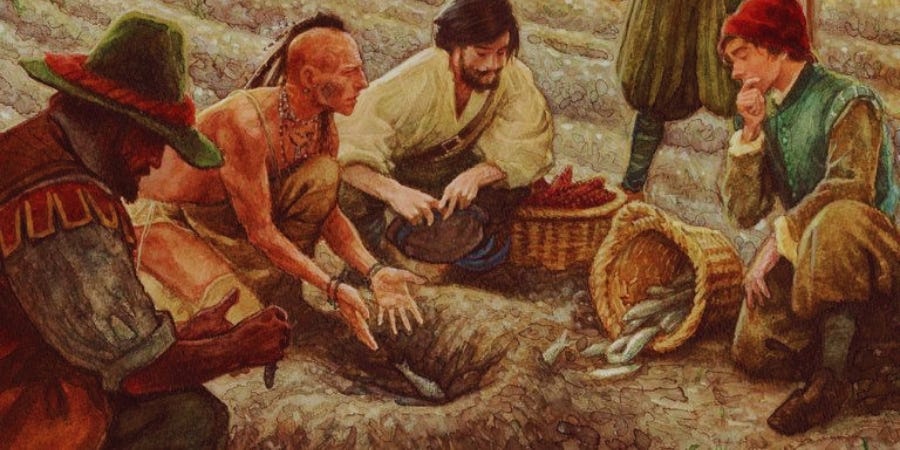
Squanto brokered a peace agreement between them and the Wampanoag and taught Bradford and all able-bodied men how to plant corn with fish as fertilizer, where and how to fish and hunt, local geography, and how to navigate alliances with local tribes to trade. Without his help, they would have perished from the face of the earth.
Instead, in the fall of 1621, the pilgrims and Wampanoag celebrated a 3-day feast in recognition of the unity of two worlds. None of them called it “thanksgiving,” but the pilgrims saw it as divine providence that they stumbled upon Squanto and the Wampanoag and refused to let the opportunity to praise and celebrate go to waste.
William Braford said of Squanto in his journal that he was “a special instrument sent of God for their good, beyond their expectation.”
Squanto had to have seen God’s providence as well. Looked back on his life and recalled what Joseph said to his brothers in Genesis, “What you meant for evil, God used for good.”
Joseph in Egypt
Whether or not they called it Thanksgiving, that meal went down in history as the first. All because one man who had every opportunity to hate the world and those who stripped him from home and abused him chose to instead focus on the goodness and kindness he’d been shown by men of the cloth and become a man of good character himself. A hard worker and giver.
Squanto’s life mirrors Joseph’s almost verbatim. Both were deceived and beaten by someone they trusted, both spent months in captivity and grew up in a foreign land, both devoted themselves to becoming better and building instead of staying trapped in grievances, both saw God at work behind the scenes putting the pieces together (not knowing what would happen but determined to be strong), and, when the trouble came, famine struck, they knew how to take charge and foster peace and bounty throughout the land.
Scholars say the three days of the feast have no theological significance, but considering this connection between the savior of Egypt and the savior of Plymouth, there’s no doubt in my mind the three-day first Thanksgiving links to the Savior of the world. And He’s still teaching us the same lesson.
No matter the circumstances, YOU choose what to become. You decide whether you will resist or follow the Creator. No one else can do it for you.
Men of honor and courage take hold of the ship and steer it where it needs to go, even if that isn’t what they want. Forgive, sacrifice, and sacrifice some more. Whatever it takes.
This Thanksgiving Day, that lone Indian still has a name because he refused to quit and let hardships have the final say. As you dine and celebrate with family, remember those three days in 1621 and Squanto and emulate his appreciation for the good and holy.
“And we know that for those who love God all things work together for good, for those who are called according to His purpose” (Romans 8:28).