



Atheists would have you believe that religion is the result of lack of wealth and poor education, but that’s an outdated, debunked myth they refuse to let go of.
They go so far as to insist it's a fact, like this guy who showed up in my comment section just yesterday.
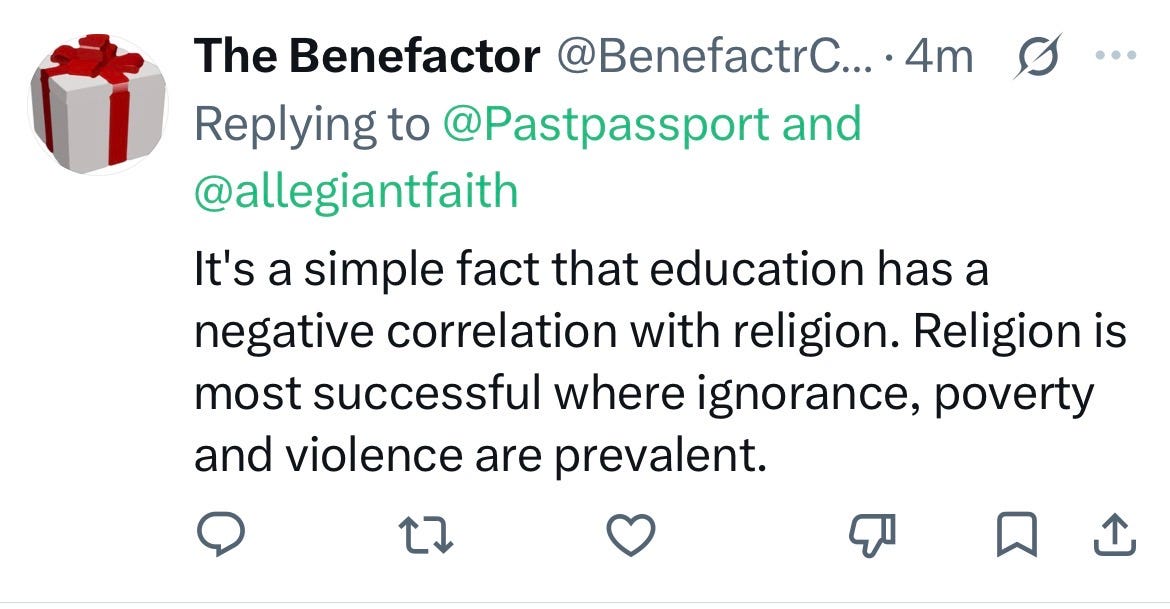
However, the claim that “only the poor and uneducated are religious” is rather a crude stereotype that doesn’t match the available data. A lie pushed to keep you doubting your faith and surrendering more and more control to secularism.
To be fair, no one is questioning that those with higher education are more likely to be atheist. The evidence shows a real cross-country pattern of secular education producing secular worldviews and some overall U.S. averages on belief in a nature-only cosmos derived from secular schooling. Which makes sense since Darwinian evolution gained a forced monopoly in public schools through cases like the Scopes’ Trial and Kitzmiller v. Dover.
But the assertion that religion stems from poverty and less education fails as a description of who is actually religious in the United States and abroad and ignores large, highly educated, high-income religious populations.
Statistics get more precise when you separate (1) country-level development, (2) affiliation vs. practice vs. belief, and (3) specific groups rather than “religious people” as a bloc, and paint a much different picture than religion as “the opiate of the masses.”
The truth is much more complex than atheists make it seem.
Before you go on, Allegiant Faith Network is a reader-supported community. Become a paid subscriber to help us keep up the good fight for Christ for ages to come and get:
Courageous Chris’s “30-Day Evangelist: How to Share, Defend, and Live Your Christian Faith in a Secular World”
A digital copy of Courageous Chris’s The Atheist Conversion Manual: 17 Cases that Destroy Secular Religion, Prove God, and Show You the Way to Eternal Life.
A bi-weekly “Defenders of the Faith” book club.
Copies of all future published works.
Access to our full archive of articles.
An exclusive subscriber chat.
2 articles every week.
Your support means the world to us and helps us continue to grow online.
Click below and upgrade!
What do you really see?
Ordinarily when investigating statistics, I prefer to look at the big stat sites like Barna myself. But in this case, since Grok is an efficient research tool, I chose to use it for a fast look at the numbers.
I told Grok to use a mix of liberal, conservative, and neutral sources in its research, to be objective, and to tell me what the data actually shows, not what answers it thought I might want to hear.
Here is what it cranked out (I’ve cited the sources it used at the end of this article for you to check out on your own if you wish):
Global: poorer countries are more religious
Pew and other large surveys consistently show that countries with lower GDP per capita, lower average education, and higher inequality tend to report higher religious commitment (daily prayer, religion “very important,” belief in God). Nearly every country where 70%+ of adults pray daily has per-capita GDP under $20,000. Wealthy countries are generally less religious—with the United States as a notable outlier (high wealth and relatively high prayer/religiosity).
Globally, Jews have the highest average years of schooling (~13), followed by Christians and the religiously unaffiliated (~9), then Buddhists, with Muslims and Hindus lower on average—largely because those populations are concentrated in lower-income countries. Unaffiliated people are not uniformly more educated than affiliated people inside the same country.
This is the kernel of truth in the old secularization argument: as societies become richer and more educated, average religiosity often falls. It does not follow that religious individuals inside a rich country are therefore poor or uneducated.
U.S. education: mixed, not “uneducated = religious”
Pew’s 2017 analysis of its own surveys found that, among all U.S. adults, college graduates were less likely than those with a high school education or less to say religion is “very important” (46% vs. 58%), to believe in God with absolute certainty, or to pray daily. College graduates were also more likely to identify as atheist or agnostic (11% vs. 4%). Weekly attendance rates were similar across education levels.
That overall pattern is driven heavily by the unaffiliated. Among Christians, college-educated people were as religious or more religious on Pew’s commitment index. Evangelical college graduates scored high on religiosity at 87%, similar to or higher than less-educated evangelicals. College-educated Christians were more likely to attend weekly than less-educated Christians in several traditions. The same pattern appeared for Mormons and historically Black Protestants. Jews showed the opposite: more education, lower traditional religiosity. Muslims showed little difference by education.
Recent Pew Religious Landscape Study (2023–24) education figures (bachelor’s or more):
• Hindus: 70%
• Jews: 65%
• Agnostics: 53%
• Atheists: 48%
• Mainline Protestants: 40%
• Unaffiliated overall: 37%
• U.S. adults: 35%
• Catholics: 35%
• Evangelicals: 29%
• Historically Black Protestants: 24%
Atheists and agnostics are more educated than the average American and than most Christian groups. The largest unaffiliated subgroup—“nothing in particular”—has lower attainment (29% bachelor’s), which pulls the “nones” average down. Explicit atheists/agnostics look different from that group.
Large Cooperative Election Study samples analyzed by political scientist Ryan Burge show a different behavioral pattern: people with graduate degrees are more likely to attend weekly than people with a high school diploma or less, across many survey waves. The modal current churchgoer is often described as college-educated, middle-income, married, with children—not the least educated. People who did not finish high school are among the most likely to be religiously unaffiliated.
So education correlates with lower affiliation and some belief measures in the aggregate, but not with lower practice among those who remain Christian, and not with atheists being the least educated group.
U.S. income: not “only the poor”
Income tracks education closely and shows the same group differences.
Pew 2014 data (household income $100k+): Jews 44%, Hindus 36%, Episcopalians 35%, atheists ~30%, agnostics ~29%, U.S. average 19%, Catholics 19%, Southern Baptists 16%, some historically Black denominations ~9%.
More recent Pew figures: Hindus and Jews still have the highest shares at $100k+ (roughly half or more). Atheists 48% and agnostics 43% in that bracket; Catholics and mainline Protestants around 30%; historically Black Protestants 14%. Evangelicals sit below mainline Protestants. “Nothing in particular” who still say religion matters tend to have lower incomes.
Religion is not concentrated at the bottom of the income distribution. Some of the highest-income groups in America are religious (Jews, Hindus, certain mainline Protestants). Some of the lowest-income Christian groups are also highly religious. Middle-class professionals are well represented in weekly attendance.
Why the stereotype persists
A 1993 Washington Post line described followers of the Religious Right as “largely poor, uneducated and easy to command.” It was widely criticized at the time as inaccurate and has been recycled as a cultural shorthand.
The data never supported “only.”
Even then, committed churchgoers included large shares of college-educated and white-collar people.
Composition effects matter: poorer countries and some lower-education U.S. subgroups have higher average religiosity, so a casual glance at global maps or overall U.S. “religion very important” numbers can look like the stereotype. Looking inside groups, at practice rather than just identity, or at Jews/Hindus/educated evangelicals, the picture changes.
On average, less-developed countries and, in the U.S., people with less education are somewhat more likely to report high personal religiosity and less likely to be explicit atheists. That is not the same as “only the poor and uneducated are religious.”
That was a huge mouthful, so let’s look at the key takeaways you MUST remember.
What can we glean from all this?
Based on the evidence, wealth status and level of education aren’t adequate to explain religiosity.
Highly educated, high-income religious people are common in the United States; highly educated atheists are also common. Both facts coincide in the same datasets.
And while poorer countries report higher religious affiliation, religious practitioners in those countries tend to be from both rich and poor alike, showing little if any correlation between wealth status and religious practice.
But even if wealth and education could determine the spread of religion (or lack thereof), that would say nothing about whether atheism is true. Instead, it would merely show that those with higher education are more likely to embrace atheism, which we already knew from the beginning. Due to the materialistic biases inherent in modern public education.
Since anything considered affiliated with religion (ancient or otherwise) is pushed out of public schools or only discussed as fake constructs invented by humans, the culprit behind the spread of atheism is the stifling of alternative worldviews within the education system. Confirmed by the fact that even students with less than a high school education tend to become atheist or “nothing in particular.”
Atheism itself is a philosophical worldview put into practice by its adherents, as I’ve argued thoroughly in The Atheist Conversion Manual and out on the timeline. Making atheism itself a religion, despite atheists pretending it’s just a lack of belief in gods:
In fact, their detachment from the divine is the only real reason they consider themselves superior, even though such detachment is not proof of the truth or reliability of atheism.
Yet your kids are being indoctrinated into their nihilistic cult whenever you surrender them to the brainwashing arm of the secular state.
What can you do keep your kids from becoming minions of their cult?
The only logical answer: Homeschool
Despite what you may think, you are capable of teaching your own children at home, and you can do better than a public school teacher. Because your child is more than a number to you.
He or she is the whole world, your legacy.
The only way to give yourself full control over what your children ingest and digest in their minds is for you to be present. Via homeschool.
Not even private school, Christian or otherwise, is safe. Public school curriculums are used in all of them too. I know because I went to one as a child and had my mind pumped full of evolutionary theory in the science and history books and detached liberal skepticism, and no amount of warning from the teachers, “This is just what the world thinks,” made it better.
You can’t teach atheistic naturalism as real and God as a nice alternative and expect kids to come home with Christian values.
If you’re a Christian and want your kids to have your values, you have to be intimately involved in their education, and homeschool is the only option which makes that 100% possible. It’s your duty.
But that’s not the only reason you should choose homeschool.
Kids who are homeschooled in dedicated, structured home environments have solid academic and social outcomes that far outweigh public education. A friend of mine who used to be a public school teacher homeschools his son now and always tells people to homeschool because kids learn much better. His son is 6-years-old and reads at a 6th grade level already, and he’s no outlier.
Homeschool kids excel in reading, math, history…everything!…in dedicated, structured homes. All it takes is discipline and care from loving parents, like yourself.
“It’s too expensive.” No, it’s not.
There are plenty of reasonable options out there. One (and I get no promotional tradeoff from this) is Classical Conversations, run by my friend and CEO, Robert Bortins. Robert is a former homeschool kid who saw the immense value in home education. He, like so many other homeschoolers, excelled and thrived because he wasn’t just a digit on a spreadsheet.
His company develops a homeschool curriculum that not only teaches kids the basics and the Bible but gets them involved in studying the classics of literature and ancient philosophy that used to be mandatory in our school systems before Marxists subverted Western institutions and turned public school into secular indoctrination camps. Classical Conversations is reasonably priced, and they work with you side by side to ensure that home education is not only possible but the best option out there.
You can find the time and resources if you really want to secure the future of your kids, or you can let the culture claim them and turn them into lifeless husks controlled by the State, detached from the Kingdom of God.
Up to you.
Sources Used:
https://www.pewresearch.org/religion/2017/04/26/in-america-does-more-education-equal-less-religion/
https://www.pewresearch.org/short-reads/2019/05/01/with-high-levels-of-prayer-u-s-is-an-outlier-among-wealthy-nations/
https://www.pewresearch.org/religion/2016/12/13/religion-and-education-around-the-world/
https://www.pewresearch.org/short-reads/2026/02/19/which-us-religious-groups-are-most-highly-educated/

https://www.pewresearch.org/short-reads/2016/10/11/how-income-varies-among-u-s-religious-groups/
https://www.pewresearch.org/religion/2025/02/26/age-race-education-and-other-demographic-traits-of-us-religious-groups/
https://religionnews.com/2016/09/26/the-key-religious-factor-in-the-election/
Recommended Reading:
Robert Bortins & Alex Newman, Woke and Weaponized: How Karl Marx Won the Battle for American Education, and How We Can Win It Back
Frank Turek & Phoenix Hayes, The War on Reality: Recovering Truth in a World That Celebrates Lies
Chris M. Wright, The Atheist Conversion Manual: 17 Cases that Destroy Secular Religion, Prove God, and Show You the Way to Eternal Life
We love writing for you and for our Lord Jesus Christ. All to Him we owe. And you can help keep us in the good fight.
For just $0.26 a day, you can get additional bonuses:
Courageous Chris’s e-guide, “30-Day Evangelist: How to Share, Defend, and Live Your Christian Faith in a Secular World,” soon to be a full course with video lessons and outlines ($50 value).
A digital copy of Chris’s The Atheist Conversion Manual: 17 Cases that Destroy Secular Religion, Prove God, and Show You the Way to Eternal Life ($20 value).
Access to all future publications.
Access to our full vault of resources that will help you defend the Truth of Jesus Christ.
A bi-weekly “Defenders of the Faith” book club where we read and study apologetics books of your choosing together (comes with outlines and study notes).
Exclusive lessons every Wednesday explaining why you can believe in God with conviction and/or how to live for him with courage, OR deeper dives into Scripture, theology, or apologetics.
An exclusive subscriber chat to get real-time fellowship with Courageous Chris and other like-minded Christians and discuss doubts, evidence for God, and much more.
The humble feeling of knowing you are supporting a growing marketplace ministry with a mission to spread the good news of Christ to a dying generation.
Click and upgrade!
“Yet your kids are being indoctrinated into their nihilistic cult whenever you surrender them to the brainwashing arm of the secular state.”
THIS.
And as I said in my post, don’t expect your church or church school to teach your kids the faith.
Examine your own, and if you place your faith in Jesus, live it, show it, teach it.
I fell away to agnosticism as an adolescent even though I was homeschooled, but my parents were admittedly lax on curriculum and weren't as structured as the approaches you mentioned; since my dad believes people can be saved after they die and that hell isn't eternal because "a loving God would never punish finite sins infinitely," he was also never particularly concerned about me falling away. What they did was just get me some Bob Jones University books for high school and let me teach myself; they were not good at all with organizing. My "self-curriculum" in the latter part of the 1990s and early 2000s ended up including not only the Bob Jones University books, but also arguments with Usenet atheist men online (who convinced me to agnosticism), Internet pornography of naked men (one of my favorite topics of "research" as a teenager), and lots of classic literature, medical books, science books, and reference books, such as dictionaries (because I was not only arrogantly argumentative and lustful, I was also a geek).
So if parents homeschool, they're going to have to teach kids how to deal with the hard stuff, including all the great theological questions about God, morality, etc. That includes teaching daughters to learn theology and be more than just emotive, because not all of us fall away in that manner; my Substack exists primarily to point women toward real study of God's Word, including roles, and examples of intelligent women in Scripture (such as Abigail), not just fluffy feelings. God brought me back to Him not through sentiment, but by showing me that I WOULD, in fact, be tortured in hell for unrepentant fornication, and that life without Him is meaningless (the biggest flaw in atheists' and agnostics' world view is that if God doesn't clearly exist, then we have to essentially "create" a subjective reason since they insist life doesn't have an objective purpose; Ecclesiastes shows just how meaningless life is without God, and is thus one of my favorite Bible books as a former agnostic - not enough American Christians like or study that one).