



God is the God who gives and the God who takes away. He sets up nations, appoints their rulers, and dismantles kingdoms. Every choice, every act, and every movement in the universe bends the knee to his divine plan. He is perfect and holy. Transcendent. Always true, whether or not we understand.
Yet, his divine nature often makes us question pain and suffering. We ask why they exist, why they come upon us so suddenly, and why they sometimes seem senseless.
You know that neither pain nor suffering is inherently evil. Pain warns us when something is wrong. It protects our health by forcing us to pay attention to an injury or deficiency in the body. Suffering, when endured with patience, can strengthen us and build resilience.
Still, there are moments when pain and suffering emerge without warning or any foreseeable reason. Said moments weigh heaviest on us. We call them evil because they feel unjust and overwhelming. And certain sufferings are unjust.
That doesn’t mean God is responsible. Yes, he ordains all things. But evil is not a thing. It is the absence of good. Nothing encroaching on the something.
The Old and New Testaments describe pain and suffering as symptoms or reactions to this broken world being put back together. God works to repair and remold while sin and death revolt against the Great Physician.
Below is an account of that process and how it reaches its culmination at the cross, where sin and death met their everlasting end.
Life’s Harsh Mysteries
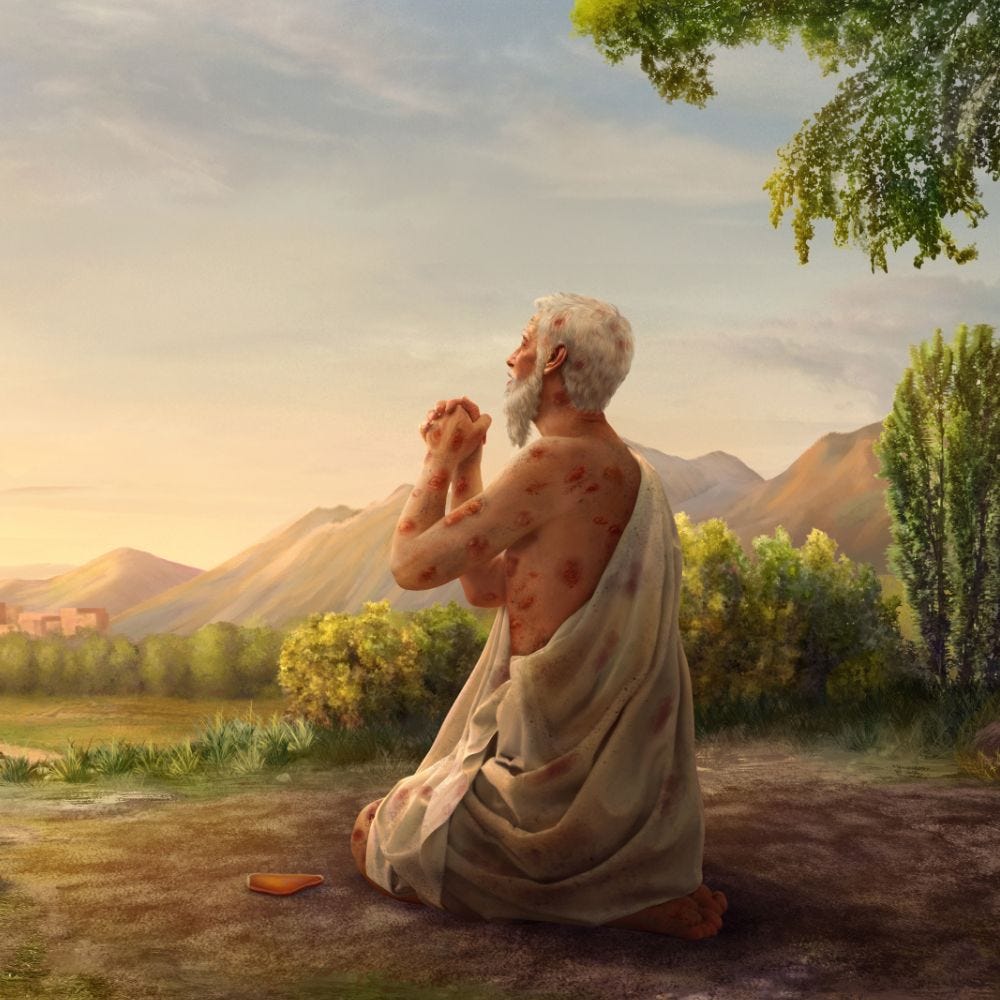
The Book of Job offers three options for viewing pain and suffering:
-Pain and suffering sometimes come as a punishment for wrongdoing.
-They can also be the natural consequence of a broken and disordered world.
-God himself assigns suffering to test allegiance or to strengthen faith already present.
Only the second one ties to evil, specifically natural evil. “Natural evil” is the label given to flaws in creation produced by the Fall. When everything collapsed in the Garden of Eden, corruption spread through the entire cosmos to the most microscopic level.
Punishment and testing are justice against evil. Correction for wrongdoing and the building up of faith in the eternal Good are the only ways to combat sin and death, entropy.
Because of our current limitations and the distance between creature and Creator, we cannot fully see the divine plan. Which is what makes it difficult to discern which type of pain and suffering we are experiencing. That’s what most unsettled Job.
His greatest grief was not his loss of possessions, family, or health. It was the inability to understand why. The same lack of understanding that drives most of our distress in suffering.
Job’s friends try to comfort him by bringing empty or accusatory words, pretending to know the internal state of his and God’s relationship. But their responses never address the underlying concern: lack of purpose.
When God responded to Job, he didn’t offer any special revelation. Instead, he told Job that he didn’t need to know everything. What Job already knew was enough.
He knew God is good
He knew God is transcendent
He knew God made everything
He knew God rules over everything
From that knowledge, trust was expected. The foundation Job already had sufficed to support further belief and greater dependence on God. Total clarity had no bearing on the pain and suffering Job faced and would not solve it.
Why do we struggle to accept this truth? Would it not be better to surrender fully to God’s good and glorious ways than resist the Maker?
An Eternal Uphill
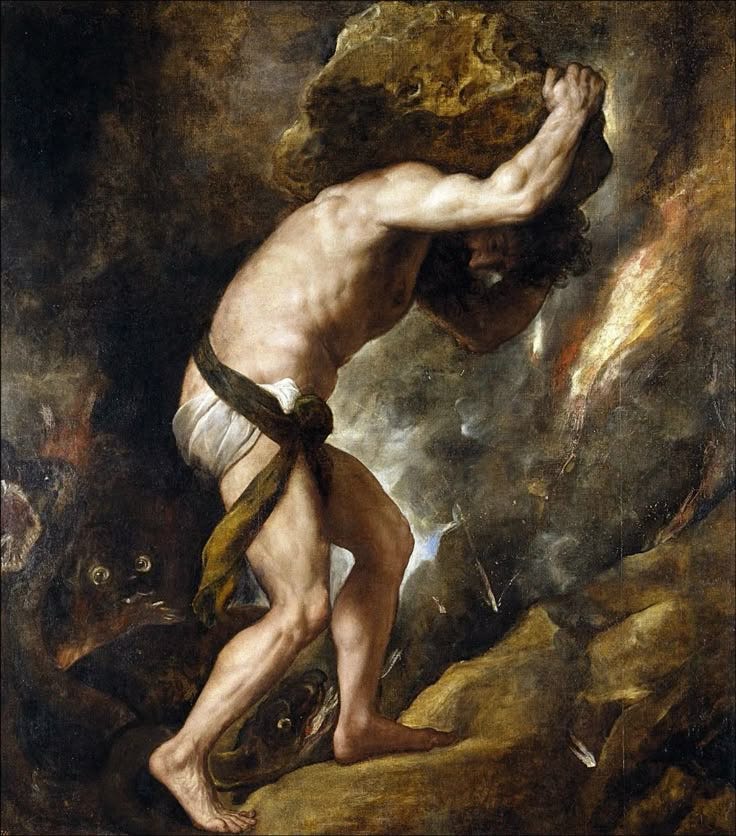
What hinders total surrender for most people is they see themselves as trapped, much like the Greek figure of Sisyphus.
In Homer’s account, Sisyphus was the father of Odysseus, the founder of the Isthmian Games, and king of what is now Corinth. But he is most remembered for the curse placed on him by Zeus.
After Sisyphus snitched on Zeus for kidnapping Aegina, the gods condemned him to eternal labor. Though he cheated death for a time and died of old age, punishment awaited Sisyphus in the underworld.
For eternity, he was forced to push a massive boulder up a hill. Each time he reached the top, the boulder rolled back down, and the cycle began again.
The torment wasn’t the task itself but its futility. There was no meaning, no goal, no satisfaction in what he did. Just empty effort.
Get the most from X with Tweet Hunter. Track analytics, schedule posts, search a library of viral posts, get AI rewrite ideas, and much, much more.
The eternal God, the transcendent Creator of the cosmos, does not behave like Zeus. The storm god was violent, chaotic, and driven by selfish passions. He used his power to abuse and cared little for justice. The entire family of gods in the Greek pantheon often behaved in the same way.
The Lord God Yahweh, however, is entirely different. Yahweh wove meaning and purpose into the universe. He placed humanity within that purpose, imbued us with meaning, and gave us roles in his grand story. The universe was made for us and declared very good. And he never punishes humanity out of petty vengeance.
Why It All Went Wrong

Disruption of the very good design arose when humanity broke the boundary God set to keep chaos and disorder away. The tree of the knowledge of good and evil was a blockade sustaining the separation between nothing and something, between order and chaos. When Adam and Eve ate from it prematurely, that boundary was destroyed.
At that moment, God could have erased us from existence and been right to do so. Yet instead of annihilating us for betrayal, he delayed final judgment. He chose patience over destruction because he doesn’t desire our eternal ruination.
His love for creation and for humanity explains why Job found it so difficult to understand the sudden catastrophes in his life. Job knew God was not a cruel tyrant. As Job said again and again to his friends, God isn’t a vindictive bully.
In the end, Job’s testimony was vindicated. God restored everything taken from Job many times over. Satan’s accusations against him proved invalid. Job’s pain and suffering revealed meaning, even if keeping some mystery.
Our limited perception magnifies our anguish. Struggles bring us low. But nothing that happens in our lives is meaningless. Nothing that causes pain or suffering is beyond explanation, even if the explanation eludes us.
Unlike Sisyphus, the follower of Christ pushes no stone uphill without end, because the living God chose a different path.
Pain and Suffering to the Rescue
Job’s story points forward to Christ himself. Job’s cries for justice and comprehension are finally answered in the cross.
The Son of God stepped into human history and chose to suffer. Unlike Job, he had no sin to confess and no need for discipline. Yet he carried the weight of our sin and bore the judgment we deserved. The judgement God delayed from us, he saved for himself.
His pain was not pointless.
His suffering was not empty.
It was the restoration of the proper design first mutilated by our rebellion.
The best community of entrepreneurs on social media. Learn how to brand, persuade, and profit from the biggest accounts online. Build and grow your own business today!
On the cross, Jesus entered the depths of human anguish. He was betrayed, abandoned, mocked, beaten, and crucified. He cried out, “My God, my God, why have you forsaken me?”
He experienced the complete rawness of Job’s question. By his wounds we are healed; by his death we live; by his resurrection our hope is secured.
Christ shows us that suffering in God’s plan always bends toward glory. Job’s glimpse of restoration when God gave him back more than he lost is nothing compared to the splendent reinstatement of eternal order birthed by the resurrection.
Blessing or Barrenness

The Gospel is not only true; it’s the only source of healing for everyone. In the cross, every loss is reversed, every sorrow comforted, and every tear wiped away. Nothing we face is in vain. For those in Christ, suffering leads to eternal joy.
Unless we try to take the easy way out.
Comfort and ease are the actual weapons of evil, keeping us trapped in the chaos of confusion. Absent or misplaced purpose in the things of creation lead only to emptiness and misery. Had Job put his faith in his wealth, he would have suffered much greater, and by his own hand, slogging forever uphill with no aim, like Sisyphus.
Christians aren’t Sisyphus, though. There is no condemnation to endless futility. Instead, more than Job, we live as followers of Christ, whose own suffering secured the end of suffering itself.
The story has been written
The ending is scripted
Victory is sealed
Our task is to trust, endure, and keep faith in the God who endured wrath for our sake and now forever reigns. No matter the temporal consequences, following the one who conquered sin and death ensures everlasting reward and the permanent annihilation of every pain, every suffering, and every grief.
Let him wipe every tear from your eyes and fill you with immeasurable peace and joy.
Share this message with others, so they too can learn about the King of kings, Lord of lords, and Destroyer of all evil.
Leave a comment with your thoughts. We would love to hear from you.