


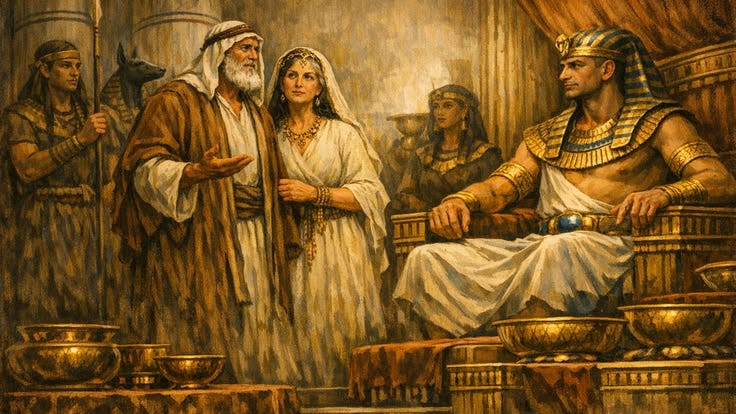
A cowardly husband calls his wife “sister” and hands her over to a foreign king to save his own skin.
Sounds like a soap opera. Or some ridiculous Bravo TV show.
Yet it happens in the Bible. Twice with Abraham, once with Isaac.
Feminists carry Genesis 12:10-20 and chapters 20 and 26 around in their Gucci bags as fodder to beat down men, destroy the family, and castrate God’s church.
Bible defenders squirm. Critics sharpen their pens. And the whole fiasco gets filed under “proof the patriarchs were horrible men God should have fired.”
But such a reading misses about 90% of what is happening. Buried inside three of the most uncomfortable passages in Genesis is a prophetic architecture so precise it should stop you cold.
These stories aren’t just about human failure. They’re about which nations would spend centuries trying to destroy Israel, why they failed, and how God embedded the entire trajectory of that conflict into a series of domestic scandals before the nation of Israel even existed.
To prove that where humans fail, God redeems.
Abraham lies. Isaac repeats the lie. God protects both of them anyway because the promises he made required it. And the foreign kings caught in the middle? They walk away from each encounter knowing something unsettling: There’s a force at work in this family the world can’t outmaneuver.
What follows is a close look at all three episodes, what they share, where they diverge, and why the details most readers skim over paint the picture of a God who cares, fights for, and defends his own…including you.
This is a preview of our weekly paid article for Allegiant Faith VIPs. Become a paid subscriber and get access to the full article and more:
Courageous Chris’s “30-Day Evangelist: How to Share, Defend, and Live Your Christian Faith in a Secular World”
2 posts every week, on Wednesday and Saturday (give or take)
Access to our full archive of articles
An exclusive subscriber chat
Your support means the world to us and helps us continue to grow online.
Click below and upgrade!
The Doom Cycle of Fear
It’s easy to fixate on what Abraham and Isaac did to their wives in Egypt and with Abimelech. Calling them sisters and handing them over as if they were property to be traded.
It was wrong. No one’s defending it.
As noted, skeptics, especially those of a feminist persuasion, love to use these passages to portray men as patriarchal oppressors and blame God for not stopping Abraham and Isaac. Before they betrayed their wives and almost caused international meltdowns.
Their criticism is understandable on the surface. But it requires ignoring context entirely.
We know their behavior was despicable because we live post-Christ, in a world revolutionized by Christian morals. Abraham and Isaac lived in a radically different time.
It wasn’t uncommon for humans to participate in acts God would later reveal as sins.
Ancient kings had a tendency to kill foreign men and take their wives and children as slaves. Violence everywhere, all the time, a continuance of pre-flood bloodshed. It was enough to instill fear in even the most courageous of men.
So, the fear of the forefathers was understandable. The choices made? Not so much.
Abraham and Isaac had God Most High, Creator of heaven and earth on their side. That intimate connection with the eternal Maker should’ve butched them up.
Instead, they folded like unwrapped Slim Jims. And nowhere does God endorse their deceptions. He doesn’t applaud Abraham for his cunning or reward Isaac for following his father’s playbook.
What he does instead is intervene at the precise moment the lies threaten to dismantle his holy mission through total loss of his elected children.
God bestows grace.
Human fear, left to its own devices, drifts toward self-preservation at someone else’s expense. And God moves to protect Abraham, Isaac, and the nations from the fallout of one man’s fear.
The Allegiance of God Most High
There’s a theological current running through all three stories, and once you see it, the individual episodes feel less like embarrassing footnotes and instead reveal a deliberate pattern.
