


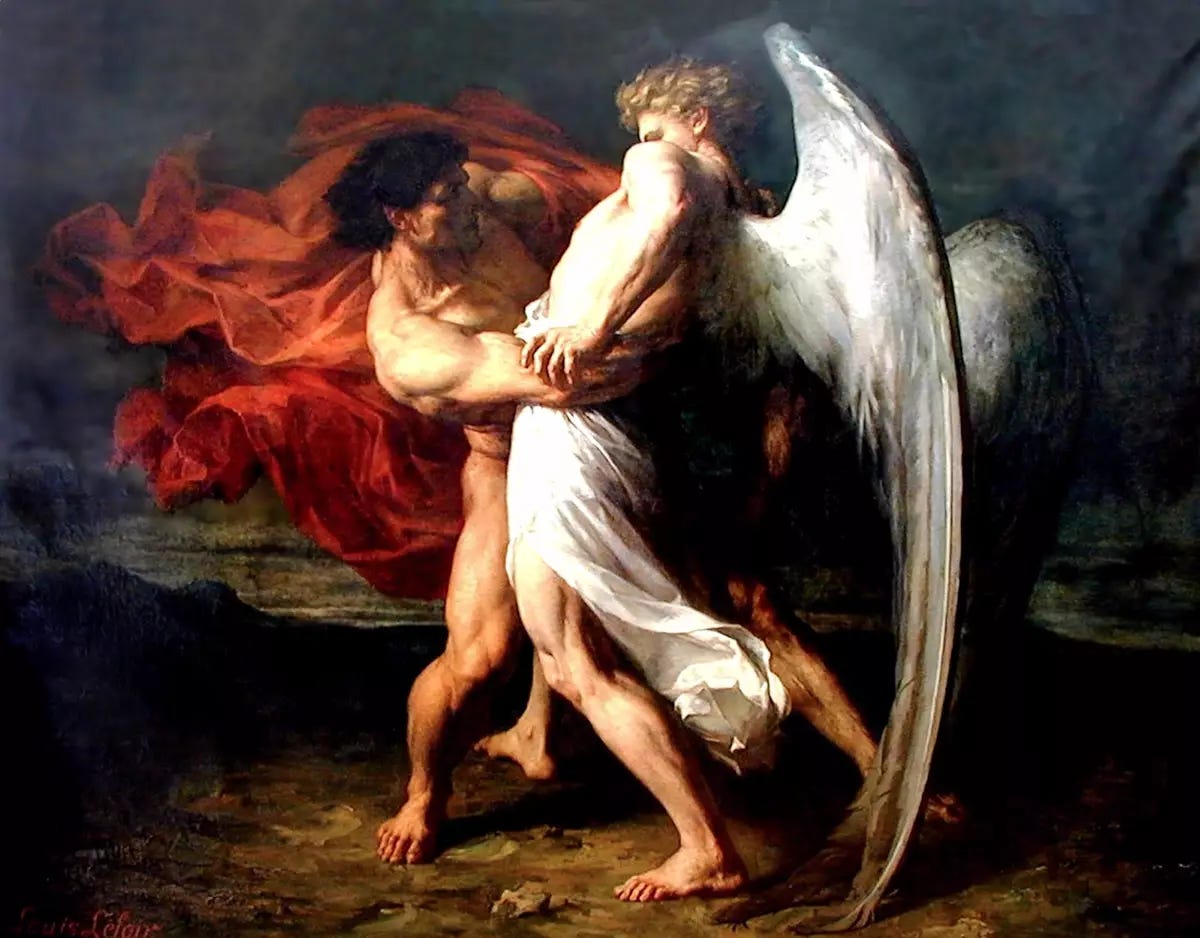
Jacob Wrestles Angel, Alexander Louis Leloir
Atheists and liberals conditioned you to treat the Bible as meaningless fiction. But even today, it resists their hostility.
Its interconnections between millennia of documentation always form a coherent story of God on a rescue mission to save humanity and creation from certain sin and death. Verified by external witness and archaeology.
No other collection of documents compares.
And the stories of Jacob seeing the throne room of God and wrestling with God in human form stand as a precipice, where the interconnections of the Bible converge and root God’s loving salvation in a prophetic lineage that stands the test of time.
Long before Moses views the burning bush, stands on the mountain of God, face shining, tablets in hand, a desperate fugitive receives something more astonishing: Two distinct, overwhelming encounters with the living God. A breathtaking vision of a massive stairway bridging heaven and earth, angels traversing its massive steps, and a fierce, all-night battle in darkness with God himself, who loses…on purpose.
Jacob sees and feels God, receives the covenant promises in fresh power, renames the very ground beneath his feet for God, and walks away forever marked…a new name and a lifelong limp. As God’s chosen one.
What begins in fear, deception, and midnight struggle unfolds into the blueprint for Israel’s election, the coming of the true Israel, and the final victory over sin, death, and the powers of darkness through the Son of Man.
Jacob’s story fuses together the election of God’s own nation with the sacrifice of Christ Jesus, God-made-flesh, in incredible ways you’ve never noticed before.
Allegiant Faith Network is a reader-supported ministry. Become a paid subscriber and get:
Courageous Chris’s “30-Day Evangelist: How to Share, Defend, and Live Your Christian Faith in a Secular World”
2 posts every week, on Wednesday and Saturday (give or take)
Access to our full archive of articles
An exclusive subscriber chat
Your support means the world to us and helps us continue to grow online.
Click below and subscribe!
Forgotten Prophet
Many traditions name Moses as the first prophet. The Jews saw him as the father of prophecy, and his encounters with God at Sinai cemented the reputation across generations.
But Moses wasn’t the first. Jacob was.
Throughout the Old Testament, prophets receive visions of God and the heavens. Abraham comes close to qualifying. He met the Godhead in person shortly before the destruction of Sodom and Gomorrah, a face-to-face encounter of extraordinary weight. But Abraham received only a personal visit, with no vision of the highest heaven.
Jacob receives both. A vision of God’s throne and a separate, physical encounter with God in human form. Two distinct modes of divine contact, two separate occasions.
After each one, he names or renames a specific location in Canaan, the same creative task God assigned to Adam in the garden: Name creation and rule the earth with God Most High.
No other figure in Genesis gets double interactions with God akin to Jacob’s, and the implications of this must be fleshed out.
God’s Anointed Stairway
The vision most people call Jacob’s ladder was not a ladder. The Hebrew word evokes a stairway. And the most immediate parallel from the ancient world is a ziggurat, the massive stepped temples built to connect heaven and earth, with priests ascending toward the gods. Jacob most likely saw a symbolic ziggurat linking the heavens to the ground beneath him.
Two points of meaning emerge from the image, and they pull in opposite directions.
The first connects back to Babel. When humans built the great ziggurat at Babel, they were attempting to reach the heavens by force. Temples across the ancient world were understood as intersections between the divine and the mundane, and movement within and about them almost always ran in one direction.
Humans ascended toward the gods. The gods did not come down.
Jacob’s vision reverses the pattern. The angels in the vision don’t just ascend, they also descend.
God Most High dispatches spiritual beings into the world to carry out his purposes. He sends his loyal messengers wherever he requires, from both the unseen and the seen world.
Melchizedek is one example from the seen world, stationed in Salem, the city of peace and future Jerusalem, known as priest of God Most High, famous for breaking bread and drinking wine with Abraham long before the Last Supper of Christ.
The God of Jacob sends his representatives down, and the question of why any god would choose descent over making us come to him continues to be an awkward puzzle for the world.
Don’t forget to subscribe and support Allegiant Faith. You’ll get articles like this one right in your inbox, and if you upgrade to paid membership…so much more.
Click below and subscribe!
His Holy Throne Room
Jacob’s vision has a direct parallel to Isaiah 6. Placing the two encounters side by side reveals something incredible.
In Isaiah’s vision, the throne room of God opens before him. Seraphim circle the throne and issue continuous praise, covering their faces against the brightness and holiness radiating from the One seated overhead. Isaiah’s immediate response is to bend beneath his own inferiority. An overwhelming recognition of his smallness and sin in the presence of sheer perfection.
Said awareness arrives naturally, a direct consequence of proximity to God’s holiness. You stand near something entirely without flaw and feel the distance.
The Hebrew word seraph means “fiery one” or “shining one.” Depicted as serpentine figures in the ancient world, tied to the nachash of Genesis 3. With dual possibilities of nachash (serpent) or nochesh (diviner), the creature who deceived Adam and Eve is most likely a seraph.
The serpent of the garden, later identified with Satan, fell and corrupted creation, whereas the others Isaiah witnesses retain their status as throne room guardians of the highest heaven, loyal to God Most High. And Jacob saw them too.
Jacob’s experience at Luz follows the same arc as Isaiah’s. He sees what are seraphim moving up and down between the physical and spiritual realms. God grants him access to himself and the highest heaven at close to their full intensity, and he survives. Stamping into reality the eternal significance of the covenant promises, upon Jacob’s mind and soul.
A fugitive, a man driven out by his own failures the way Adam and Eve were driven from the garden. From his homeland.
God restores and resolves what is lost.
From Stars to Dust
When God speaks to Jacob at Bethel, he introduces himself as the God of Abraham and Isaac and repeats the covenant promise. The land and its inheritance belong to Jacob’s children who will bless all nations. With one crucial change.
God told Abraham his descendants would outnumber the stars (shining ones, aka the sons of God). In the ancient world, stars were widely understood as representations of divine beings, celestial powers, the gods themselves. The promise to Abraham was vast and celestial, focused on the spiritual and physical resurrection and realignment of the cosmos.
To Jacob, God says his descendants will be like the dust of the earth.
The shift from stars to dust isn’t a demotion. Dust points toward the land itself, the ground of Canaan and the physical substance from which man himself was formed and fashioned into the image of God. Where Abraham’s promise pointed everywhere, Jacob’s points downward and outward, into and from the soil (from dust you were made and to dust you shall return).
Jacob’s descendants will become not only numerous but embedded in the earth as God’s representatives, his priests unto the whole world, through whom salvation will arrive. Upon the ground beneath his feet, salvation for all creation from sin and death is to come.
Jacob wakes, anoints the stone on which he slept, and names the place Bethel (“house of God”).
Archaeologists has identified the Bethel in northern Israel, west of the Sea of Galilee and south of the former city of Dan. Close to Nazareth, where Jesus would one day enter the world, and the exact location of Jacob’s Well, where Jesus sat with the Samaritan woman in John 4 and declared himself the “living water.”
Promises of the covenant become prophecies of the Savior.
Abraham and Isaac staked God’s claims in the south and middle of Canaan divine providence. The anointed stone at Bethel extends the claim northward. And the promised land is surrounded by God, stone by stone, infused with the grand mission of cosmic rescue.
And then comes the dogfight with God…
Dogfight With God
The Jabbok River runs 60 to 80 miles through the central Jordan basin. Its banks are dense with vegetation, its waters blue and severe as the river winds like an angry snake between the Dead Sea and the Sea of Galilee.
It splits the Gilead highlands: Israel to the west, Jordan to the east. Along its length, multiple fords narrow the river enough to cross, and archaeologists have identified two twin mounds called Tulul adh-Dhahab as the strongest candidates for Peniel (ash-Sharqi) and its sister camp, Mahanaim (al-Gharbi).
Because the Jabbok offered the most accessible crossing of the Jordan River, it served as the same route when Joshua later led the Israelites from Transjordan into Canaan. The Ark of the Covenant ahead of them, Jericho waiting on the other side.
Jacob arrives at the Jabbok in fear, after years away on northern Mesopotamia. He sends his family ahead into Canaan toward what would become Mahanaim, dividing his camps because he’s terrified of his brother Esau. The man he wronged years before. His mother Rebekah helped him steal Isaac’s blessing through deception, a pattern echoing what Eve set in motion with Adam in the garden, but this time in a mother-son dynamic.
Jacob never faced Esau again after the theft. He stands now on the eastern bank, alone, between the life he built and the reckoning he avoided for years.
At Bethel, Jacob was a young man in flight, a fugitive shaped entirely by deception. Years in Paddan-Aram, the region of northern Mesopotamia/Assyria, changed him. He served under his uncle Laban, was deceived by his own kin, endured loss after loss, but came out the other side with wealth and something much more valuable: Wisdom earned through suffering.
He wrestled with men and won.
Now, at Peniel, God initiates a new encounter. In human form. Struggles with Jacob the entire night until daybreak. This time Jacob secures blessing not through deception but through refusal to quit. Sheer, exhaustive endurance.
He doesn’t know who he’s fighting. He asks the man to tell him his name, and the question is met with a question in return: Why do you ask? The man’s question implies Jacob should already know. Because he’s already seen God before. But he doesn’t know. Jacob likely believed he was facing an angel. One of the messengers (seraphim) who descended the stairway. Which, while still unnerving, lessened the impact.
Darkness conceals the full nature of the battle. Until God opens his eyes. Where he learns the real identity of his attacker.
God renames Jacob Israel. Because now he has struggled with God and with humans and has overcome. The name (“he who wrestles with God”) serves as the badge of his election, the everlasting namesake of God’s mission of redemption. And Israel’s third and final forefather names the location Peniel (“face of God”).
Jacob’s descendants would spend generations like their forefather, falling and returning, wrestling with the God who chose them from the nations. And the face of God (Peniel) would one day enter the world through his people.
God strikes Jacob’s hip and leaves a permanent mark. A limp that will not heal. Evidence the election of God’s own nation through Jacob will be the permanent vehicle by which he intends to rescue the rest of the cosmos after intense pain and torment.
He (God) shall struggle with humanity and lose, yet emerge victorious…
God Lost…On Purpose
The wrestling match at Peniel raises an obvious question: If God is all-powerful, why did God not simply overpower Jacob?
Atheists love to read the text as evidence of divine limitation. God wrestled Jacob and did not win outright. Therefore God is weak, beatable, and worthless. But that reading ignores everything established before the match began.
At Bethel, God arrived to a young fugitive’s campfire. At Peniel, God arrived to a strong, wise man bred from years of overwhelming toil and struggle. The logic of both events is identical. Jacob saw, fought, and conquered, just as God would latter see, fight, and conquer through the Son of Man. Allowing Jacob to win was the point of the encounter and no concession to Jacob’s strength.
God works with cause.
Jacob had to feel the weight of his election in body and soul, not merely in understanding. The permanent limp he carried afterward was the physical sign of the real fight, in flesh and bone, that had taken place and would resurface when Christ again wrestled in the final victory against gods and men.
Jacob’s descendants would feel the weight of their election through centuries of struggle, defeat, exile, and return, culminating in a full overcoming of the forces of darkness in the seen and unseen realms. God would again lose on purpose, lay down his own life, and rise again to destroy forever the stranglehold of sin and death, chaos and corruption, and re-establish access to the Tree of Life for all creation.
A full-fledged restoration of Eden.
With Peniel east of the Jordan and Bethel to the north and Abraham’s and Isaac’s markers in the south and middle, Canaan was now surrounded. God’s stakes covered every side. The cosmic conflict between the God of Israel and the fallen sons of God who held ancient claim to the land and all nations would center on this people (Israel) and this territory (Nephilim land).
His Everlasting Salvation
In the dust of Bethel and the midnight shadows of Peniel, a forgotten prophet rises, and the entire story of redemption snaps into focus.
Jacob’s story is no footnote. He stands as the first to receive both a heavenly vision and a physical encounter with God Most High. A towering stairway where angels descend at God’s command (reversing the arrogant climb of Babel), a throne-room glimpse of fiery seraphim striking fear and awe, and a weary wrestling with God himself after years of conflict with humanity.
From stars to dust, the covenant promise shifts from celestial vastness to earthly embedding. Jacob’s descendants will take root in the soil of Canaan as priests for the world. He anoints stones, renames places, and leaves markers across the land that prophetically encircle the future battlefield of cosmic rescue.
God then “loses” on purpose so Jacob can gain the name Israel (“he who wrestles with God”) and a lifelong limp as proof God’s election is forged through struggle, not comfort.
We are made witnesses to God’s divine strategy through his story. Meeting a deceiver on the run, transforming him through suffering and perseverance, and staking claim in the very ground where the Son of Man would one day walk, become living water for outcasts, and finish the fight against sin, death, and the fallen powers and principalities of darkness.
Each of us lives in this story because it belongs to us.
Divine election works through weakness and makes it strength. The same God who sent angels downward still descends to meet you in your wilderness. The permanent limp of struggle becomes the badge of belonging. And the promises made over dusty ground still stand.
God embeds His people in broken places to bring blessing to the nations. When life feels like an endless night fight, perseverance wins the blessing. When you feel unseen or unworthy, the God of Bethel still opens heaven over ordinary stones.
Without him, there’s no purpose. No way. No meaning. Only hopeless, pitiful randomness and annihilation. We all know it, even though so many pretend they don’t.
But for those who hold fast to Christ, God-made-flesh entered the world through Israel, took on gods (the fallen sons of God) and men, defeated sin and death, and brought to completion what the covenant, law, and prophets foresaw. A full resurrection of the cosmos to eternal life.
The war behind the war at Peniel became your salvation.
Don’t forget to subscribe!
We love writing for you and for our Lord Jesus Christ. All to Him we owe. And you can help keep us in the good fight.
If you’re already a free subscriber, consider upgrading to a paid membership.
Paid subscribers, whether $8 a month or $80 a year, get additional perks:
Courageous Chris’s $35 e-guide, “30-Day Evangelist: How to Share, Defend, and Live Your Christian Faith in a Secular World,” and any future publications.
Access to every single article we’ve ever written since we started in June 2025.
Exclusive lessons every Wednesday (give or take) explaining why you can believe in God with conviction and/or how to live for him with courage, OR deeper dives into Scripture, theology, or apologetics.
An exclusive subscriber chat to get real-time fellowship with Courageous Chris and other like-minded Christians and discuss doubts, evidence for God, and much more.
The humble feeling of knowing you are supporting a growing marketplace ministry with a mission to spread the good news of Christ to a dying generation.
Join us today!