


The Bible is the true Word of God.
But the Bible is also weird, strange, confusing, and challenging. What are we to do with the passages that utterly baffle us?
Pay close attention.
As the late Hebrew scholar Dr. Michael Heiser said, “If it’s weird, it’s important.”
Over the next several months, we’re going to travel through the weirdest parts of Scripture to explore what they mean and why they matter, so you can gain a better understanding of God’s Word and how it applies to your own life.
Beginning with Genesis 3:9 and the question of God’s knowledge:
“[T]he Lord God called to the man and said to him, ‘Where are you?’”
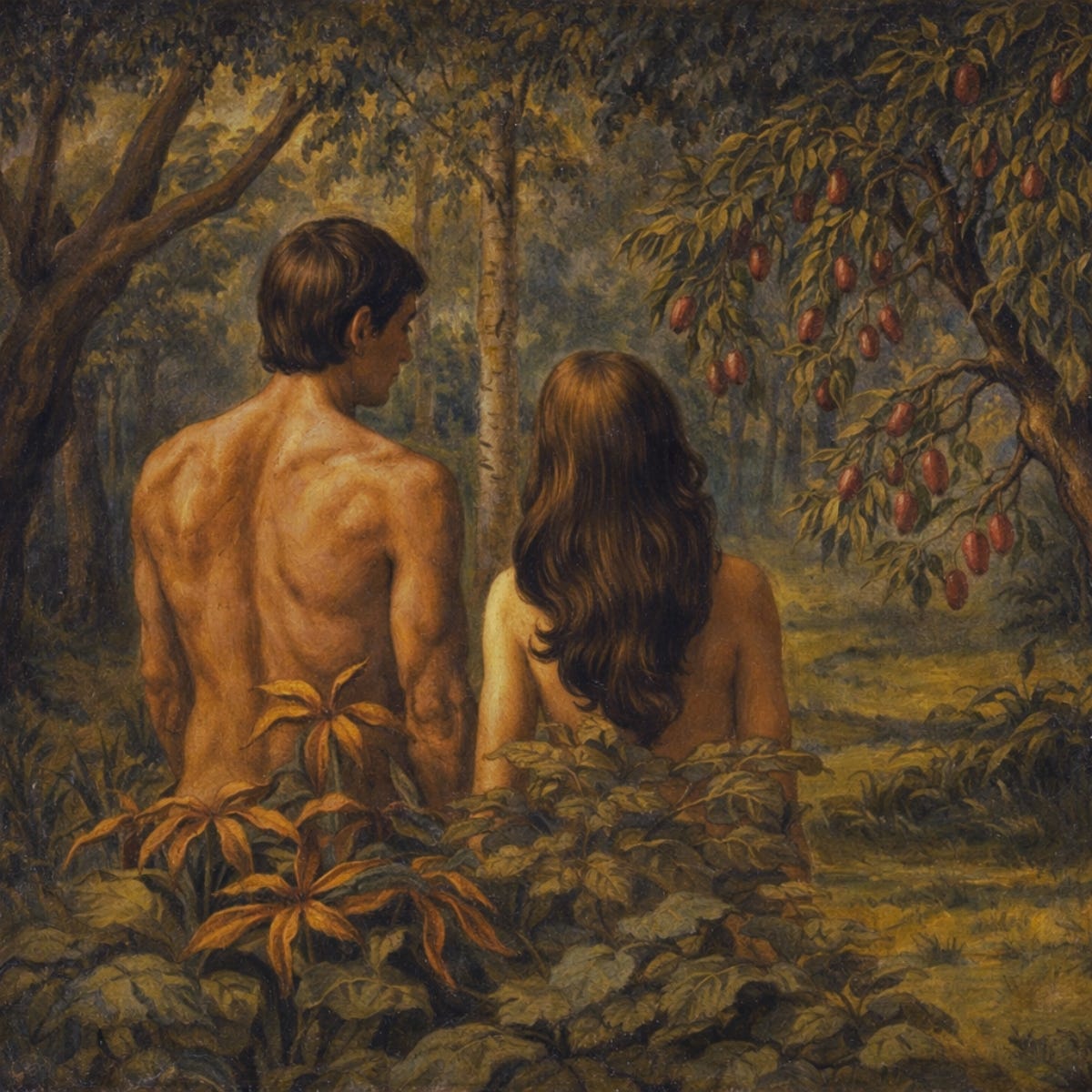
So many commentators, Jewish and Christian, have dealt with the question of God’s omniscience in Genesis 3:9 through the ages…it’s almost annoying we are still puzzling over it.
Yet, the verse is popping up again. Particularly in the withering weeds of modern atheism.
Just yesterday I saw an atheist on X argue the verse was a sign God is not all-knowing.
But is it REALLY?
I want to take you through a deep dive of the verse, its surrounding context, and language to show you it has never and will never show God as an ignorant fool.
What’s the Context?
Anytime we’re dealing with a verse or passage in Scripture, we must first consider context.
For Genesis 3:9, context is particularly important. I wrote in depth about the full context of Genesis 1-3 in a recent article:

For our sake now, below is a brief summary.
Genesis establishes God as the eternal, transcendent Creator. In the beginning, there was God, and there was nothing else until God spoke everything else into being.
By that definition, it’s impossible for him not to know everything since he transcends everything, including knowledge. He’s the Source.
Humanity was made in his image in this world and given three commands:
Be fruitful and multiply
Rule over the earth and subdue it
Don’t eat from the tree of the knowledge of good and evil
The last command came with the consequence that they would surely die if they ate of the tree.
The serpent, who came to be known as Satan in Second Temple Jewish tradition, tricked Eve into eating the fruit by promising she and Adam would not die but would become as gods.
When Adam and Eve both ate, a slow death ensued:
Erosion of human-divine and human-human relations
Erosion of human-creation relations
Erosion of divine-creation relations
The curses from God reflect a collapse of creation and the original commands. I called them inversions in the previous article, but they are really perversions.
The serpent’s curse is a perversion of proper design
Adam’s is a perversion of the command to tend to and rule over creation
Eve’s is a perversion of the command to be fruitful and multiply
Adam and Eve gaining knowledge isn’t the problem. The way they went about it is because they disobeyed the eternal Creator, their Father, and violated established boundaries put in place for their own safety and the safety of creation.
Safety against the nothingness. To keep it from encroaching on and consuming God’s very-good creation.
That brings us to Genesis 3:9...
Before you go on…
Learn how to write epic articles like this one and build a business online by joining our partner, Masterclass.
The founder, Art of Purpose, built one of the biggest followings (350,000 and counting on X; 14k subscribers on Substack) from scratch within five years, from 2020-now. He’s made millions online and helped others do the same.
And he put together 1000s of hours of resources and a group of the best entrepreneurs, businessmen, ministers, creators, influencers, and more in Masterclass. We will help you:
Identify your ultimate purpose
Create offers people want to buy
10x your reach in less than a year
Write viral content at will
These are only a handful of the benefits you’ll get. You’ll also be surrounded by powerful friends who have your back and want to see you succeed.
Right now, we’re running free trials for a limited time.
7 days
No strings
Nothing to lose
Yesterday, 3/13/2026, was our 5-year anniversary. Most mastermind groups die off in a year, but we’re holding strong.
And right now, those who choose an annual plan also get a special $1000 package for only $459:
One Year of Masterclass: Full access to the community, weekly calls, and resources. ($459 value)
Free Ticket to Content Academy: Our upcoming writing cohort focused on long-form content, threads, articles, and storytelling that grows an audience. ($250 value)
A 1-on-1 Strategy Call With Our Founder, Art of Purpose: He’ll review your account, positioning, and growth strategy together to set you up to win in 2026. ($400 value)
AoP’s Private Content Frameworks - The exact frameworks he uses to generate ideas and write viral content. ($100 value)
Creator Spotlight Feature - Selected members will be featured on his account and introduced to his audience of around half a million followers. Value: Priceless
Time is running out for this deal. Click my link and join the best group on planet Earth.
A Walk Through the Garden
Immediately after eating the fruit, Adam and Eve make a foolish attempt to hide from the presence of God.
The verses directly preceding verse 9 illustrate their foolishness in a comical way.
They hear God walking through the Garden and realize their nakedness (a symbol of their exposure, which was previously good but now bad because of their sin), they attempt to create a design but it comes out faulty (their makeshift clothes from fig leaves), and, here’s the key, they try to hide from the presence of the eternal God.
If God wasn’t around and didn’t know what was going on, that last reaction is odd. Adam and Eve had all the knowledge in the world at their fingertips and could’ve tried to outwit God.
That they hid implies they were overwhelmed by the knowledge received, knew any attempt to outwit God was futile, or still had an attachment and hunger for the perfection and safety of the Garden.
I’m guessing it was a combo of all three, but Genesis doesn’t tell us.
Anyway, God comes walking through the Garden. In human form. Meaning he made himself accessible to his creation.
Also implied by context is that God was enjoying the fruits of his labor, per the seventh day in Genesis chapter 1.
Up to this point, Adam and Eve were without the immediate presence of God. God gave them leeway to enjoy the Garden and enact their designated duties to tend and rule over the creation. And to enjoy each other.
That God picks the exact moment after they sinned to show up means he already knew what happened. The text doesn’t leave another option. Any others must be speculated.
God deliberately seeks Adam and Eve out because he knows what they did, and intends to confront them, as any good Father would do for his children.
So, when he says, “Where are you?” it’s being used as a rhetorical device. Like if my son did something bad, I knew it, and found him hiding behind the couch to escape the consequences. I might say, “Where are you?” to give him a chance to respond and come clean, even though I know full well he’s guilty.
The context of Genesis 3:9 doesn’t bear this interpretation out alone. Analysis of the Hebrew language supports it too...
Ayekah: An Emotionally-Packed Pun
The Hebrew word used most commonly for general locational inquiries is the neutral eiphoh. But that’s not the word God uses in Genesis 3:9.
Instead, he uses ayekah, derived from the adverb aye. And it shares consonants with the exclamatory word eichah (”How!”) used mainly in lamentations over sorrows. Aye itself also carries a nuance of anguished expectation or lament.
Put together, God’s question is more precisely rendered, “Where have you gone when I expected you here?” or “Why have you hid from me?”
Bearing the emotional punch of mourning.
And if God had no clue what had taken place and where Adam and Eve had actually gone, there would be no need for mourning until the disobedience was discovered.
So, God is far from ignorant in Genesis 3:9. He knows what Adam and Eve did and seeks them out in good faith, while devastated by their choice to defy him and follow the creation instead of their Creator, their heavenly Father.
The above revelation also explains the subsequent questions in verse 11: “Who told you that you were naked? Have you eaten of the tree of which I commanded you not to eat?”
The conversation isn’t one to determine unknowns; it’s one to give Adam a chance to make his case. To take accountability for his own actions, which he fails miserably. Blaming his wife instead, who then blames the serpent.
So, God doesn’t heap curses upon them and the serpent haphazardly. With a heavy heart, he distributes the curses because the consequences were promised, and God will not violate his own Word. And he hates every second of the trial.
But as the loving Father he is, he also slips into the curses a promise that he will keep fighting for them. The promise there will be enmity between the serpent and the seed of the woman, and though he bruise man’s heel, man will crush the serpent’s head and emerge victorious.
That promise is considered the first Messianic promise, alluding to the coming Christ Jesus, who would restore the relational bonds perverted by the fall in the Garden.
In other words, the cross and resurrection reversed and overcame the consequences of sin and death.
The necessity of the cross is further signified by God pushing death off onto two animals instead of letting it overtake Adam and Eve. In an act of mercy, he slaughters a lesser creation to preserve his own imagers and then clothes them in the skins of the slain.
Blood was shed to cover the shame of sin. A prelude to the sacrifices in the Law of Moses, which would be fully satisfied in the final sacrifice of atonement through the body and blood of Jesus upon the cross.
Benevolence, not Ignorance
When atheists argue God was ignorant, they must deliberately misinterpret the text of Genesis through surface-level reading.
The language and context make plain that God is no fool reacting to cards as they’re dealt. He owns and knows the table, is surprised by nothing, and works to secure the victory, even in the face of seemingly horrible odds.
God’s invested in us and creation, not just intellectually but emotionally. He loves all he made and hates that divisions were born between us and him, us and creation, and him and creation.
But he’s also a God of his Word. And since we were made with free will to make our own choices and disobeyed despite knowing the consequences, he would’ve been dishonest and dishonorable not to hold us accountable for our crimes.
No amount of kicking and screaming alters the above revelation from Genesis. It only continues the blame game begun by our predecessors and reveals the underlying condition of the perverted human heart.
Our corruption requires a Savior. And Christ bore the penalty we couldn’t bear in order to reverse the curses Adam and Eve so ignorantly unleashed upon us all.
Really good! I love the parent analogy. There are plenty of times as a parent when I’ve asked questions of my kids that I already knew the answer too.
It’s done to give the opportunity to build their own character. Put into that perspective, it’s very easy to unpack why God would do the same for us.
It’s for our benefit not His. I also love the Hebrew breakdown. That’s not something I knew, so really appreciate it.
I have thought of the verse as a parent too, asking the question to allow the child to confess. The additional questions God asks are prompting Adam and Eve to admit, to come clean.
I have also thought of it as God asking not where they are physically, but where their heart is.
Realizing what you’ve allowed in your heart humbles you and allows you to accept the discipline you need, and work toward returning your heart to where it belongs.