


Evolution is false. And most are waking up to its failure as a narrative of natural history. So how did it become the only “scientific” theory taught in schools?
For much of the 20th century, many Americans not only disagreed with Charles Darwin’s theories. They despised them. Knew his theories presented an invalid history of the natural world.
Hard-fought battles were waged against them, as people recognized the threat to foundational truths about creation and humanity’s place in it.
Resistance remained well into the early 20th century. When atheist materialists and eugenicists in America, such as Margaret Sanger, Leon Whitney, and Madison Grant, vied for Darwin’s theories to eradicate Christian mores, their drivel was rightly disregarded, since it was openly racist and false.
These figures promoted ideas of racial superiority and population control, masking their bigotry and evil intents with the guise of scientific progress and Darwin’s “survival of the fittest.”
However, Americans’ dismissal of their foolishness wouldn’t last. Evolutionary theory was eventually forced upon the public.
Below is an account, from Rene Descartes to modern America, of how deep-rooted anti-Christian agendas propelled this flawed worldview into mainstream culture.
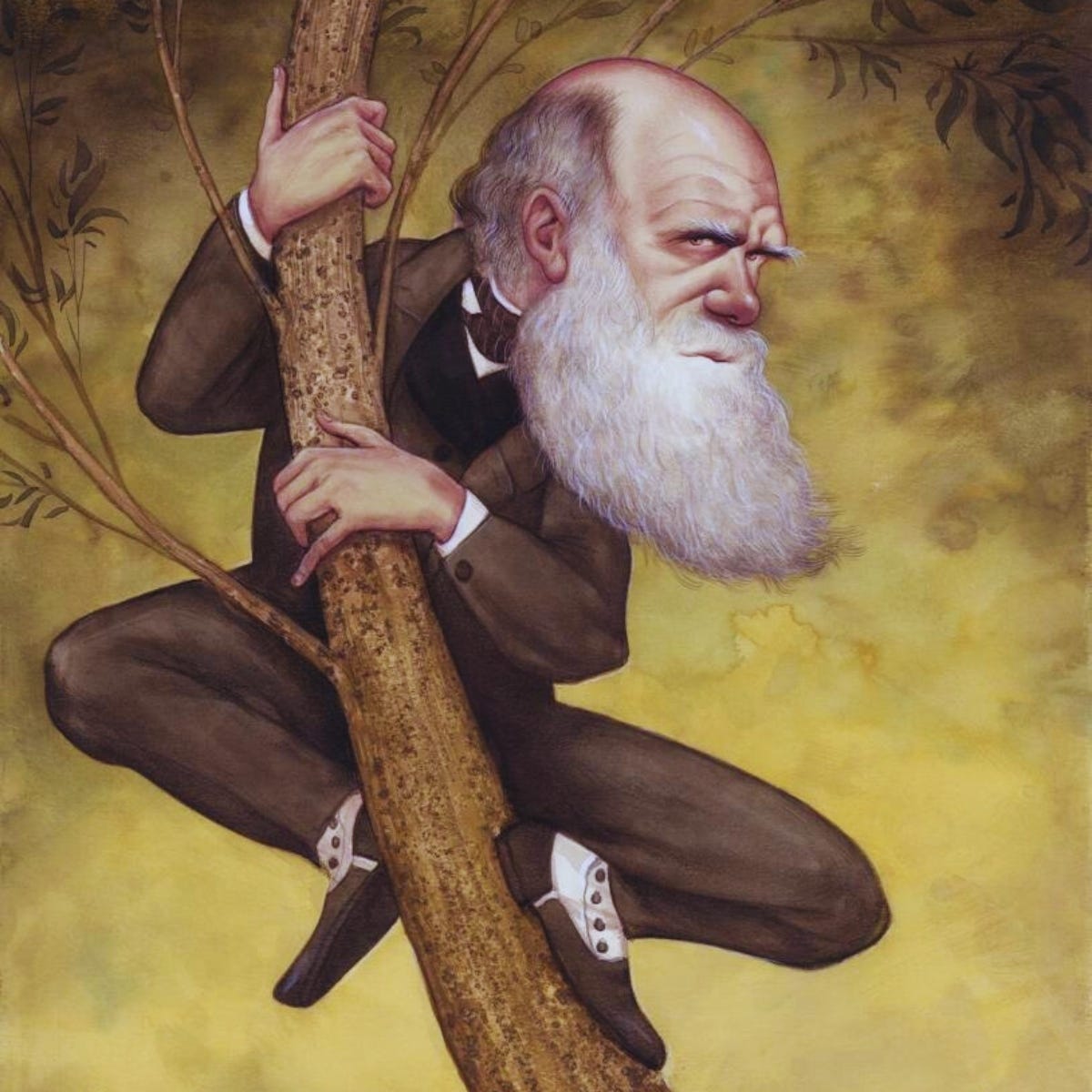
So-Called “Enlightenment”
Universities were created for theological study, and the different subjects like history, philosophy, and science were subsets of that study. Without Christianity, modern education systems never would have been founded.
The roots of higher learning trace back to Christian monasteries and cathedrals in medieval Europe, where monks pursued knowledge to better understand God’s creation.
After the Thirty Years’ War (1618-1648), the Church was blamed, even though conflicts arose between European nations for various reasons, ranging from religious, territorial, political, and commercial. “Enlightenment” ideals (a prior minority), detached from God in Christ, slowly rose in popularity.
Rene Descartes, often hailed as the father of modern philosophy, was a devout Catholic who sought to defend Christianity through rational inquiry. His famous dictum, “I think, therefore I am,” aimed to establish certainty in knowledge, including the existence of God, within a Christian framework.
However, Descartes’s emphasis on reason and doubt inadvertently paved the way for secular “rationalism,” which later rebelled against religious authority.
His emphasis on radical dualism also separated mind and body, influencing a mechanistic view of the universe which reduced everything to material explanations and sidelined divine intervention. Later popularized by Immanuel Kant as the phenomenal (natural) and noumenal (spiritual). A new Gnostic revolution.
Baruch Spinoza, a Dutch philosopher of Jewish descent, went further than Descartes in challenging organized religion. Excommunicated from his Jewish community, Spinoza’s pantheistic views equated God with nature and denied a personal deity, miracles, and biblical revelation.
In his Tractatus Theologico-Politicus, he critiqued the Bible as a human document filled with inconsistencies, advocating for its interpretation through “reason” alone to promote tolerance. Undermining its divine authority.
Spinoza saw Christianity, particularly its dogmatic forms, as superstitious and oppressive, favoring a secular society where religion was privatized and clergy power limited.
These ideas fueled Enlightenment skepticism toward Christianity. And sparked the bloodiest revolution and church persecution in 18th century France…
This is a Wednesday paid for our most cherished subs.
If you’re enjoying it, become a paid subscriber to unlock the rest.
Upgrade to get these awesome benefits:
Exclusive lessons every Tuesday explaining why you can believe in God with conviction and/or how to live for him with courage, OR deeper dives into Scripture, theology, or apologetics.
An exclusive subscriber chat to talk Courageous Chris and other like-minded Christians about doubts, evidence for God, and much more.
The humble feeling of knowing you are supporting a growing ministry with a mission to spread the good news of Christ to a dying generation.
The French Connection
Charles Darwin’s theories only made headway in the 1800s due to secular philosophy. Evolutionists exaggerate his views were popular. They were popular mainly in French circles where like-minded “scientists” were rampant after their own secular revolution.
During the French Revolution’s “Reign of Terror” in the 1790s, radicals sought to eradicate Christian influence:
Church lands were seized
Priests mass slaughtered or exiled
A “Cult of Reason” replaced traditional worship.
And from that “anti-religious” socialist climate emerged Jean-Baptiste Lamarck, a French naturalist. He laid the groundwork for evolutionary thought decades before Darwin.
