


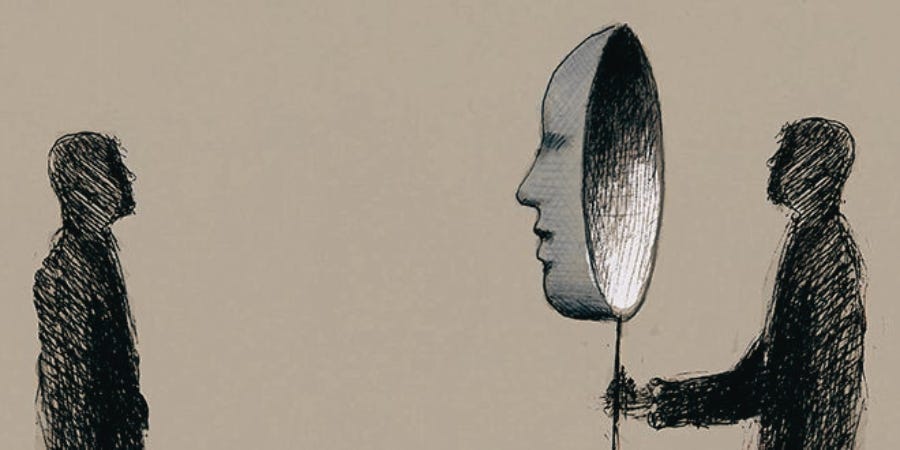
On 8/11/2026, I posted a meme of Willem Dafoe showing atheists just make stuff up when it comes to morality, since they have no standard outside themselves.

One guy in the comment section on X lost his mind. Accused Christians of making up stuff too.
He went on and on about the many interpretations of the Bible. Said Christians invent things, since our standard, the Bible, gets read a dozen different ways by a dozen different people, which he thinks means the Bible can’t be the ultimate, holy standard. God’s righteous revelation.
The Bible can’t even be understood, according to him.
What you see with his argument isn’t what you get. It’s clever and tricky, but so detached from reality that, like with most atheist accusations, it shrivels like a dead, dried-up worm as soon as you think about it for five seconds.
I already dismantled his line of thinking in The Atheist Conversion Manual, and in a long conversation with him on X, but let’s do it again.
If disagreement disqualifies a source from being true, then nothing is true.
Historians argue over evidence.
Scientists question the meaning of data.
Philosophers spent centuries fighting over what knowledge even is.
Then there’s the nature of human memory. Ask five witnesses to describe a murder, and you’ll get five different renditions of what happened. Can’t be avoided.
So, if competing interpretations erase truth, the whole exploration of reality crashes into oblivion.
But there’s more to it than that.
In this article, we’re going to walk through why interpretation can’t defeat the Bible, can’t be a standard for defining what is true, holy, and good, and why atheism, left with only human interpretation and nothing else, gets utterly annihilated.
Allegiant Faith Network is a reader-supported community. Become a paid subscriber to help us keep up the good fight for Christ for ages to come and get:
Courageous Chris’s “30-Day Evangelist: How to Share, Defend, and Live Your Christian Faith in a Secular World”
A digital copy of Courageous Chris’s The Atheist Conversion Manual: 17 Cases that Destroy Secular Religion, Prove God, and Show You the Way to Eternal Life.
A bi-weekly “Defenders of the Faith” book club.
Copies of all future published works.
Access to our full archive of articles.
An exclusive subscriber chat.
2 articles every week.
Your support means the world to us and helps us continue to grow online.
Click below and upgrade!
Memories of Mishap and Messiah
Let’s start with a car accident analogy.
500 people witnessed a 30-car pile-up. Word spreads. Some tell the story straight. Some retell what they heard from a friend who heard it from someone else who heard it from a witness, and a little interpretive flair gets added in along the way.
Does any of that retelling change whether the crash happened?
No, because you have the original witnesses, and first responders are trained to document all details from as many as possible as soon as they arrive on scene, when memory is fresh for everyone present.
At most, ongoing interpretation means the event happened and was assessed by those who heard about it through their own perspectives, which resulted in some embellishment or distortion via false interpretations. But THAT the event happened isn’t in question.
What would put the event into question would be perfectly aligned witness statements from those who allegedly saw everything.
If the 500 witnesses gave word-for-word identical reports, the identical wording would be a red flag. Real witnesses prioritize different aspects of an event in their minds.
One remembers the colors of the cars
Another remembers the sound of screaming victims
A third remembers the drivers’ bloodied faces and limbs
A fourth remembers nothing but flames and the smell of burnt rubber
A fifth remembers the chain snapping on the 18-wheeler that started the accident
Natural variations combined with rock-solid agreement on the core facts prove them valid witnesses, whereas perfect alignment between each story suggests rehearsal.
Some of you already know where I’m going with this: The former is what we find when we examine the Bible.
Jesus was crucified.
Three days later he rose.
Over 500 people saw him alive and well again.
Record of their witness was written down early.
He appeared to individuals fully restored, to small groups who had known him for years, to skeptics whose doubt disintegrated the moment they touched him, and to family who had questioned him his whole life. The stories they shared of their encounters align in core details while diverging in interpretation and on minor aspects, signs they are telling the truth.
Then those who heard the stories first recorded them into creeds and later into the Gospels.
Here’s where the guy on X thought he had me: If the witnesses shared the story, others heard the account, retold what they heard, filtered the retelling through their own perspective, doesn’t that mean we only inherited interpretations of interpretations and no one knows what they’re talking about?
No.
We inherited the witness statements themselves, gathered and preserved in the gospel accounts and across the New Testament, collected as early as humanly possible in the ancient setting of the Greco-Roman period. Within living memory. When the witnesses were still alive and around to correct any errors!
The letters may not match on every detail, but they were never supposed to because they’re real, and their central claims agree across every page.
Crucifixion under Roman authority. Burial. An empty tomb. Bodily appearances after the fact.
Small stuff shifts the way independent testimony always shifts, but the meat and bones retain their place and shape. Real testimony looks exactly like what we find in the Gospels.
Theology came after witness…
1 Story, 40 Writers, 17 Centuries, 3 Continents
Later writers further fleshed out the theology and Christology of the Messiah based on the inherited witness statements and interpretations from witnesses themselves.
Deeper reflection on who Jesus was, what his death and resurrection accomplished, how his story connects back through everything that came before.
None of their reflection, however, changes the ultimate fact that Jesus really rose from the grave.
Sin and death lost. Beat to a pulp by God Most High. Which the earliest churches determined by noticing how everything in the Old Testament pointed forward to the Savior.
Atheist treat the Bible like it’s one book, but it’s a vast collection of interrelated writings by 40-plus authors across at least 17 centuries (source material for the writings stems much earlier, some arguably as early as 3000+ years ago), on 3 different continents, and every page maintains the same coherent story from beginning to end.
God Most High made creation
We ruined creation with sin and death
Jesus, God-made-flesh, resurrected us and creation
One day he’ll return as God Most High to restore the paradise of Eden
Different centuries. Different cultures. Different literary styles. Same storyline, start to finish, weaved through every…single…book.
Coherence like that doesn’t happen by accident when so many hands are involved over such an astounding length of time.
On top of that, divergence in interpretations has centered on the nature of God and the church’s role in the eternal story of salvation, but what remained accepted since before and after the inception of Christianity is the story of salvation itself.
One day God Most High would rescue this fallen world via his Messiah, and did so through the death and resurrection of Christ Jesus. No church denies that! (Except so-called “progressive Christians,” who are really atheists that co-opted the Christian name in order to form a community and have a “sense of belonging” without surrender and adherence to the Christ of the Bible.)
Disagreement takes place over the little things…
Debating all the Little Things
Anyone who reads the whole Bible sees that overarching story of salvation. Interpretations that skip past it, dilute the message, or argue it away (mainly from atheists, not Christians) misread the text, often intentionally, so as to distort and/or distract from the meaning of God’s Word.
Plenty of smaller issues do stay open for debate (like what should baptism look like, when should baptism happen, what is the role and directive for church leadership, what should the church even look like, can salvation be lost, what role do works play in salvation if any, etc.), but creation, fall, savior, redemption, restoration…that big picture never changes.
It’s good to be cautious because humans carry our own perspectives into every text we open, sacred or not. But because of that, multiple interpretations are an asset, not a hindrance.
Working through different readings sharpens your understanding of what God revealed. Testing one interpretation against another, alongside the inherited text itself, is how anyone deepens their understanding of any complex body of writing.
That’s how people read Homer, Plato, Aristotle, Epictetus, Marcus Aurelius, the Church Fathers, Shakespeare, and so on and so forth.
Weed out readings that damage the central message. Keep the ones that clarify, enhance, brighten, and bring the picture to life.
This is how truth gets refined.
And here’s where the atheist on X walked straight into the trap he built for me…
Everyone Interprets, Even Scientists
As I point out in The Atheist Conversion Manual, without a standard above humanity, atheism is left with nothing but human consensus, and consensus isn’t truth. Claiming the majority view as truth has been a logical fallacy forever. Known as ad populum, or the “bandwagon fallacy.” Following the crowd.
“Would you follow your friends if they walked over a cliff?” No doubt your parents issued that question in some form when you were younger.
Because they wanted you to see that following your peers without second thought is dangerous.
Crowds have been catastrophically wrong throughout history because comfort feels better than accuracy. We tend to lead with emotion. If morality and truth is reduced to whatever the current majority prefers, nothing is ever right or wrong. Just popular. And popular views flip-flop in split seconds.
Take this argument one step further, and science gets gobbled up too.
A scientist runs an experiment, generates results, makes observations, and then has to interpret what the observations from the results mean. INTERPRETATION NEVER GOES AWAY!
“What best explains what we find?”
Scientists disagree with each other constantly. Consensus forms sometimes, but even then, dissenters push back with other explanations. The history of science reads like one long parade of accepted interpretations getting overturned with better data or better analysis, yet none of that zigzagging ever meant the original observations were fake or that reality itself is unknowable.
Just like with interpreting the Bible, each and every explanation for available evidence gathered via scientific experimentation, basic observation, historical documentation, etc. has to be evaluated using logic and reason, tools which belonged first and foremost to (and still belong to) the realms of philosophy and theology.
Also, if we apply the atheist’s own standard against biblical interpretation (the idea that multiple interpretations hinder truth) consistently, the entire exploration for human knowledge becomes reduced to absurdity because humans never agree. On anything. Ever.
History? Gone.
Science? Gone.
Philosophy? Gone.
Common sense? Gone.
Reduced to rubble all because people read the same evidence or sources differently.
Unless there’s a standard beyond humanity to determine and define truth and morality, reality itself becomes incoherent and absurd beyond recognition.
Reject Absurdity
No one can escape being a theologian. Everyone has a worldview, everyone evaluates reality through their worldview and via logic and reason, everyone develops rites and practices based on their worldview, so everyone is religious. Even atheists.
To be religious is to think thoroughly about reality, find a master, and follow that master, even if it’s yourself.
Only one Master makes sense, though. God Most High. Christ Jesus. Because a perfect Being that transcends this reality and originated it is necessary for any level of coherence.
Atheists demand you embrace the absurdity of a world without God while at the same time saying you can’t have an opinion because differing opinions amount to falsity…even though that very demand is an opinion and, therefore, self-defeating (gotta love the law of non-contradiction).
They would rather destroy the whole enterprise of intellectual exploration than acknowledge the existence of the One who makes it possible. Let that sink in.
Interpretation was never the enemy of truth. Disagreement is the bedrock of truthful inquiry, the search for knowledge and meaning, and that search has revealed ultimate truth is a Person.
500 witnesses saw the Risen Savior and shared what they saw, in their own words, from their own angles, with as many people as they could, and their story revolutionized the face of this Earth for the better. Brought dead men to life.
I don’t have enough faith to be an atheist.
Neither should you.
We love writing for you and for our Lord Jesus Christ. All to Him we owe. And you can help keep us in the good fight.
For just $0.26 a day, you can get additional bonuses:
Courageous Chris’s e-guide, “30-Day Evangelist: How to Share, Defend, and Live Your Christian Faith in a Secular World,” soon to be a full course with video lessons and outlines ($50 value).
A digital copy of Chris’s The Atheist Conversion Manual: 17 Cases that Destroy Secular Religion, Prove God, and Show You the Way to Eternal Life ($20 value).
Access to all future publications.
Access to our full vault of resources that will help you defend the Truth of Jesus Christ.
A bi-weekly “Defenders of the Faith” book club where we read and study apologetics books of your choosing together (comes with outlines and study notes).
Exclusive lessons every Wednesday explaining why you can believe in God with conviction and/or how to live for him with courage, OR deeper dives into Scripture, theology, or apologetics.
An exclusive subscriber chat to get real-time fellowship with Courageous Chris and other like-minded Christians and discuss doubts, evidence for God, and much more.
The humble feeling of knowing you are supporting a growing marketplace ministry with a mission to spread the good news of Christ to a dying generation.
Click and upgrade!
Funny enough, I am writing about something similar (we are always in sync). The timing is good as you have a really good quote in this article I am going to cite.