


Whenever you say the Bible is true online, you always get that one liberal who thinks he’s clever:
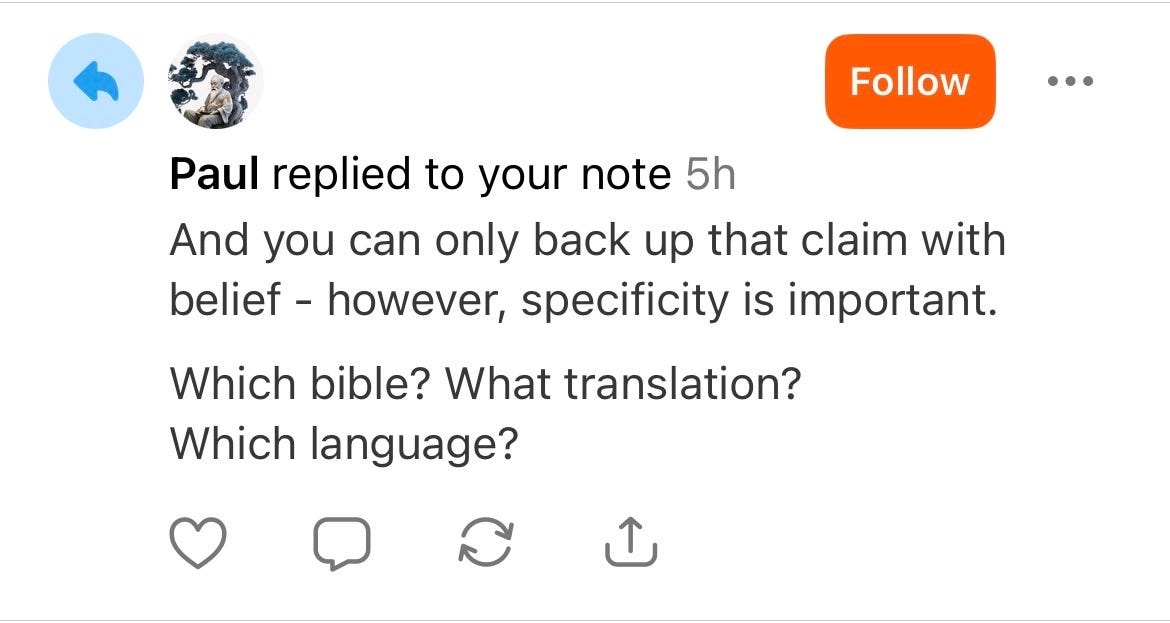
“Which Bible?”
“Which translation?”
“Which language?”
One recently spouted those at a post I made, right after saying there’s no way to prove the Bible is true without belief.
I thought about responding, but to answer those questions takes a lot longer than a comment under a post. So, I thought it would make a good article. Allegiant Faith subscribers agreed.
Here you go.
It just so happens I already dealt with the issue of the Bible’s reliability in my new book, The Atheist Conversion Manual. And I can tell you whenever an atheist, liberal or otherwise (though 98% of the time anyone who poses those questions to tear down trust in the Bible is liberal), they haven’t considered in depth conservative Christian defenses of the Bible’s authenticity and reliability.
I’m going to answer each of Mr. Paul’s questions in kind, starting with what we consider to be the Bible, so you can see God’s Holy Word is authentic, reliable, and true.
Allegiant Faith Network is a reader-supported community. Become a paid subscriber to help us keep up the good fight for Christ for ages to come and get:
Courageous Chris’s “30-Day Evangelist: How to Share, Defend, and Live Your Christian Faith in a Secular World”
A digital copy of Courageous Chris’s The Atheist Conversion Manual: 17 Cases that Destroy Secular Religion, Prove God, and Show You the Way to Eternal Life.
A bi-weekly “Defenders of the Faith” book club.
Copies of all future published works.
Access to our full archive of articles.
An exclusive subscriber chat.
2 articles every week.
Your support means the world to us and helps us continue to grow online.
Click below and upgrade!
What is the Bible?
For the sake of this article, I’m only going to focus on the 66-book canon because it contains the books that are accepted by Protestants, Catholics, Orthodox, and Ethiopian alike, providing a solid, united ground to work from.
Before we go on, it should be noted that the books not included in the 66-book canon are not left out because they’re inauthentic or untrue. They’re actively debated to this day as to whether they are divinely inspired. A different question entirely because even uninspired texts can contain truth.
The 66-book canon is divided between the Old Testament (Hebrew Bible) and New Testament (Greek Bible), and the former also includes some sections of Aramaic because the Israelites lived near Aram, were eventually exiled into Babylon with the Arameans, and later had to learn how to cohabit the land of Israel with Arameans when they returned from exile, per release by King Cyrus and then the defeat of Persia by Alexander the Great.
Liberal scholars love to argue that the Hebrew Bible was written during the Exile, and for a time, they got away with that faulty view…until the Dead Sea Scrolls were discovered.
Prior to the Dead Sea Scrolls, all we had was the Masoretic Hebrew Old Testament from c. 1000 AD and the Septuagint or LXX (the Koine Greek translation of the Hebrew Bible).
After, a wealth of fragments from the copies of the original Hebrew Old Testmanent were discovered, most of which pre-date the Exile. The BIGGEST find was an entire copy of Isaiah, which has been estimated to have originated in 700 BC.
Huge problem for skeptics with that Isaiah Scroll is that Isaiah references other parts of the Old Testament and names specific kings found in the Books of Kings and Books of Chronicles. That gives us multiple attestation and indicates the other books of the Old Testament, or at least the ones referenced, existed in or prior to 700 BC.
If that is the case, as it most assuredly is, then the Law (which the Israelites used to refer to the whole Pentateuch or “five books of Moses” - Genesis, Exodus, Leviticus, Numbers, and Deuteronomy) and the prophets existed before or around 700 BC, along with other books mentioned in Kings and Chronicles that kept records of the history of Israelite kingdom since the time of Samuel and Saul.
As far as we can tell, the whole Hebrew canon was written and compiled from around 1400 BC-400 BC, give or take. Meaning it wasn’t written during the Exile, but put together into its final form, which was then translated into the Greek Septuagint sometime after Alexander’s defeat of Persia.
The Pentateuch (first 5 books of the Bible) includes poems and prayers that date even earlier than 1400 BC, suggesting the source material stretches far earlier, possibly to 3000 BC or before.
New Testament books were all written during the early Roman Empire and are dated to within or just shy of the first century AD, within living memory of Jesus. 5800 manuscript fragment from copies of the original documents or quotations have been found (more than any other documents in history, and that’s not including fragments from translations into other languages) which text critics have been able to use to piece together to within 98% accuracy what the original New Testament Gospels and letters said.
So, when talking about the 66-book canon, this is what everyone means (or should mean, otherwise any talk about the Bible is skewed from the start because it’s not actually talking about the Bible).
What About Translation?
The argument that multiple translations are a problem for the truth of the Bible only became popular because of scholar Bart Ehrman, who is staunchly anti-God and, like other liberal scholars, saw any variations in texts as confusing the message of Scripture.
Ehrman also popularized the theory of late dating for the New Testament documents, which is by no means accepted by all scholars.
The idea they (Ehrman and other scholars like him) most adore is the claim that memory of Jesus was passed on in oral form (by verbal transmission) a long time before being written down.
A game of phone tag became their most popular analogy. One kid passes a message on to another in a long line, and as the message goes on it gets filtered through what each person thinks they heard with small changes over time until the message is completely warped from what the original message said. Applied to the the New Testament, if true, it would mean that the final form of the New Testament is not what the early church read and not what was written in the original documents.
In my book, The Atheist Conversion Manual, I address the above objections in detail.
(1) Late dating for the original manuscripts is not the only option. Early dating remains viable, and strong cases have been made for it. There’s not enough space here to make a detailed argument, although I do so in my book.
Furthermore, (2) whether you pick early dating for the New Testament or late dating, you still end up with documents that were written within living memory of the witnesses to Christ and his life. That fact alone destroys the phone tag argument.
Note that in the analogy, the first kid to speak the message is around the entire time. He doesn’t drop the line and then vanish. He sticks around to play the game and watch how the message transforms, and when he sees it change, he is there to make corrections.
Same for the New Testament.
The original manuscripts were written while witnesses to Jesus were still alive and could correct any alterations in the message that may have ruined it. The earliest churches could consult said witnesses to make sure what they’d been told was accurate, and they did.
Such was the case for the first century of Christianity, and the only language used was the Greek for the original documents. (There is rumor of a Hebrew version of Matthew, but it hasn’t been found by historians in any of the manuscript fragments.)
It wasn’t until the second century that the need for a Latin translation arose because Christianity spread deeper into Northwest Africa and Europe, where the dominant language was Latin. And Jerome, who translated the Old and New Testaments into the Latin Vulgate, took tremendous care because he saw his mission as a sacred one. He wanted to preserve the whole of Scripture in a word-for-word match. The translation he produced had such accuracy.
But even if it didn’t, the Hebrew and Greek testaments were maintained in Israel and across the Eastern Roman Empire, which would later become the Byzantine Empire (stretching from the Mediterranean coast up into Russia, eastward into Asia, and southward into Saudia Arabia and Africa, namely Egypt, Sudan, and Ethiopia).
The Orthodox did a splendid job of keeping the Bible and Apocryphal texts from disappearing from existence, as scrupulous as the Ancient Hebrew scribes who copied and preserved the Law and Prophets.
Liberal scholars neglect the historical fact that the Israelites and Christians revered the words of Scripture and discerned the mission of translating and copying its words as the holiest of vocations.
Everyone who translated the Bible was meticulous.
What About Vernacular Translations?
Vernacular means “common” or “main” language. Whatever is spoken the majority of people in a specific nation or region.
For a time, since everyone spoke Latin and that was the main language of the Western church, no one worried about translating into other languages. Same in the East with Greek.
Plus, the Catholic Church adopted the top-down hierarchical model it still employs today, where bishops from the Pope downward served as the readers and interpreters of Scripture for the people. The only other readers of Scripture were monks in monasteries, who coincidentally read everything, not just the Bible. They preserved via painstaking copy many ancient texts that we would not have today. (Think Plato, Aristotle, Homer, and much more.)
Around the 1300s, citizens all across Europe began to realize entrusting full interpretive rights of the Bible to church leadership alone left them not knowing what the Bible actually said. They just took bishops’ word for it, which wasn’t problematic when bishops could be trusted.
But toward the 15th century, the turn of the Renaissance, the Catholic Church became corrupted by a love of money like no other, and political actors from the outside crept in using bribes and power plays until the Church was ruled for a time by secular humanists pretending to be Christians. Usury became a chief complaint from many Catholics and then Protestants, from Luther and beyond.
The populace of Europe realized that the laity needed to be able to read Scripture. Not just to check the interpretations of church leadership, but also to experience the full beauty and wonder of the Word of God for themselves.
William Tyndale, who is most famous for being burned at the stake for making the first English translation, stated that he would make “the boy that driveth the plough” know more of Scripture than many learned clergy. Thereby displaying the motive.
And like those before him who translated the Hebrew Old Testament into Greek and the full Hebrew and Greek testaments into Latin, he took the job seriously, worked on a word-for-word match between the original languages and vernacular. A translation that cost him everything.
As the Protestant Reformation got well underway in the 16th century and beyond, other translators all over the West eventually took up the task of making other vernacular translations at risk of their own lives and also saw the task as sacred. Again and again, the emphasis on translation as a holy vocation resurfaced.
The only translation that was deliberately requested by a king to be written to give him ultimate authority over everyone (even above God in some senses) was that attributed to James I of England.
While the King James Version is adored by many, and is a beautiful translation (I don’t care what anyone says, Victorian English is spectacular), it has errors in it that go beyond mere spelling errors or grammatical issues. It has errors that alter the meaning of the text in spots because of the fact that its translators were enlisted by James I to tickle his fancy, not to administer an accurate word-for-word translation into English.
While they relied on Tyndale’s prior translation for much of the work, 80-90%, they didn’t use the same fastidious care applied by prior translators who transitioned the Bible into vernacular forms out of overwhelming divine calling.
What About Modern Translations?
The Renaissance and Reformation both sparked a desire for academic study unseen in the Middle Ages.
That’s not to say the Middle Ages were dark. They most certainly were not. Many a great philosophy and thought came out of the Middle Ages, despite “Enlightenment” fanatics trying to paint it as a time of vast ignorance.
But with the hunger for translation came the hunger for learning, which spread far and wide, and concern for accuracy increased.
Text criticism became a field of study to ensure that any and all texts from history are translated and matched their original languages and original documents, to the best of our ability. We’re talking years and years of lovers of history who spent centuries in ancient texts, especially the Bible, many of whom had/have the whole Bible memorized in the Hebrew and Greek, translating and retranslating the original languages to get as accurate as possible vernaculars.
The result is a wide array of translations, yes. But that’s not a bad thing.
A vast collection of translations exposes the nuances in the original documents of the Bible and forces us to study God’s Word closely. Ensures anyone and everyone can get a clear understanding of the Bible if they spend time in and cherish it, let it speak for itself, by comparing and contrasting and asking questions.
So, to the questions of “What Bible? What translation? What language?” I say don’t read just one. Read many, and study, don’t just read.
Also, make sure they are word-for-word translations and not paraphrases. Paraphrases are Bibles mixed with personal commentary.
Wednesday in our weekly paid article I will provide multiple translations I use that I think are best because of their integrity, and also tell you of some you should avoid.
We love writing for you and for our Lord Jesus Christ. All to Him we owe. And you can help keep us in the good fight.
For just $0.26 a day, you can get additional bonuses:
Courageous Chris’s e-guide, “30-Day Evangelist: How to Share, Defend, and Live Your Christian Faith in a Secular World,” soon to be a full course with video lessons and outlines ($50 value).
A digital copy of Chris’s The Atheist Conversion Manual: 17 Cases that Destroy Secular Religion, Prove God, and Show You the Way to Eternal Life ($20 value).
Access to all future publications.
Access to our full vault of resources that will help you defend the Truth of Jesus Christ.
A bi-weekly “Defenders of the Faith” book club where we read and study apologetics books of your choosing together (comes with outlines and study notes).
Exclusive lessons every Wednesday explaining why you can believe in God with conviction and/or how to live for him with courage, OR deeper dives into Scripture, theology, or apologetics.
An exclusive subscriber chat to get real-time fellowship with Courageous Chris and other like-minded Christians and discuss doubts, evidence for God, and much more.
The humble feeling of knowing you are supporting a growing marketplace ministry with a mission to spread the good news of Christ to a dying generation.
Click and upgrade!
The "gotcha" question of "Which Bible? Which translation? Which language?" proceeds from a fundamentally false premise, which is that any one translation is intrinsically and substantively different from other translations and from the original.
This is not so.
As we have seen with the recent online controversy over Christopher Nolan's "The Odyssey", which is presumably based on Emily Wilson's translation of Homer's epic poem, a faithful and accurate translation of a work is inherently perceived as being that work. The many criticisms of the Emily Wilson translation arise principally from what are presented as errors in her work—yet her translation is still viewed as of a piece with Homer's original epic poem.
Every translation of Scripture is Scripture. Scripture in every language is Scripture.
The distinction implied by the question does not exist. To argue otherwise is to deny the fundamental reality not of Scripture, but of translation.
I really enjoyed this article. I have also written an article about the same topic. I would be honored if you would read it...It's entitled "The King James Version Question: Lost In Translation Or Not - My Opinion."
It is so refreshing to encounter someone who is open minded...Thank you for a thoughtful article 🙏