


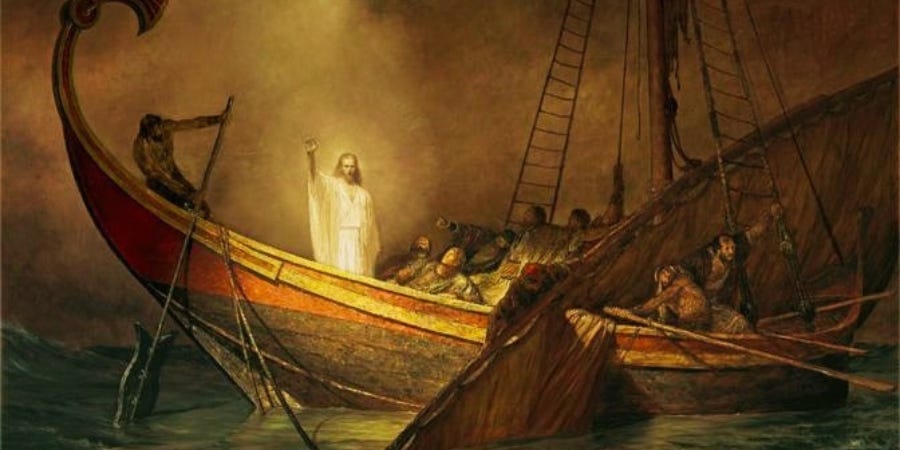
Miracles happen and change the world. I’ve been sharing stories of them all October. But what are they? And what’s their value for the Christian faith?
These are questions too few ask these days, beyond philosophical circles.
The Bible calls miracles signs and wonders of the Creator, and that’s a crucial starting point because if miracles occur, we know they aren’t haphazard. They have a purpose.
Signs point to something or convey a message about something. Sometimes both. Wonders take our breath away and make us want to investigate deeper into a curiosity, an anomaly.
Together we’re going to explore what a miracle is, why atheist objections to them don’t work, and how their ongoing enactment in our world today serves as a substantial resource for defending Christianity as the truth of reality.
Before you go on, Allegiant Faith Network is a reader-supported community. Become a paid subscriber to help us keep up the good fight for Christ for ages to come and get:
Courageous Chris’s “30-Day Evangelist: How to Share, Defend, and Live Your Christian Faith in a Secular World”
A digital copy of Courageous Chris’s The Atheist Conversion Manual: 17 Cases that Destroy Secular Religion, Prove God, and Show You the Way to Eternal Life.
A bi-weekly “Defenders of the Faith” book club.
Copies of all future published works.
Access to our full archive of articles.
An exclusive subscriber chat.
2 articles every week.
Your support means the world to us and helps us continue to grow online.
Click below and upgrade!
Special Act of God That Disrupts Nature
Norman Geisler defined miracles in the best way I’ve seen: “A miracle is a special act of God that interrupts the natural course of events.” A supernatural singularity that never would have occurred had nature been left to its usual course.
The miracle itself can involve a change in nature (think the sudden shift in east wind for the parting of the Red Sea; healings) or have nothing to do with nature at all (think Jesus’s transfiguration or the appearance of angelic messengers).
If the theistic God exists, i.e. the eternal, transcendent Creator, then miracles are possible because He already created the cosmos from nothing (the first miracle) and established the expectation that He can and will act. So if God exists, miracles are both possible and probable in reality. The only way to disprove miracles would be to disprove God.
For Christians, miracles are particularly important because our faith is built on them. God used miracles to prove His name, character, and mission to rescue lost creation from the clutches of sin and death by healing, restoring, bringing back to life, conveying His will, vindicating Himself, and much, much more. The greatest miracle is the creation of the cosmos from nothing, acknowledged at the beginning of the Bible and written into the fabric of creation, but the most essential miracle is Christ Jesus’s resurrection because through that one sin and death were stripped of all power over anyone who would believe in, repent, and follow Jesus, God-made-flesh and eternal Lord.
Miracles must be rare, otherwise they would become the regular course of nature and no longer awe us or get our attention. Yet, the resurrection miracle has the eternal ongoing effect of establishing the final promise that one day Christ Jesus will return, eradicate all evil, and restore creation through the permanent establishment of His everlasting kingdom.
Most atheists have this straw man idea that God is a genie in a bottle out there to grant our every wish, and when He doesn’t act as their slave, that means He doesn’t exist.
That argument is shallow enough you can see the absurdity. The eternal God is beyond us all and subject to no one, so He acts as He wills, subject to no one else but Himself, since He transcends everything. He doesn’t have to do a thing for you and owes you nothing. If and when He does act, it’s because He chose to of His own accord. Such is a perfectly rational explanation for the absence of God’s action in a particular instance, so the absence of evidence in the case of God’s perceived inaction cannot be evidence of God’s actual absence (or nonexistence).
But there are some other sophisticated arguments against miracles atheists have come up with that it’s important you and I extinguish...
McKinnon: Natural Law Objection
The most infamous objector to miracles is David Hume. I reserve a special future article for him. But other philosophical atheists have lobbed what they thought were clever arguments against miracles. One is Alistair McKinnon.
McKinnon took the common misconception that natural laws are unbreakable and posited this argument:
Natural laws describe the actual course of events.
A miracle is a violation of a natural law.
But it is impossible to violate the actual course of events (what is, is; what happens, happens).
Therefore, miracles are impossible.
Several worthy apologists, including C.S. Lewis, have debunked this particular argument, since it is riddled with problems.
First, as Norman Geisler points out in his Big Book of Christian Apologetics
“If McKinnon is correct, miracles cannot be identified in the natural world, since whatever happens will not be a miracle. If whatever happens is ipso facto a natural event, then of course miracles never happen. This, however, simply begs the question; this definition of natural law is loaded against miracles. No matter what happens within the natural world, it will automatically be called a ‘natural event.’ This would eliminate in advance the possibility of any event in the world being a miracles. But this fails to recognize even the possibility of that not every event in the world is of the world. for a miracle can be an effect in nature by a cause that is beyond nature. For the mind that makes a computer is beyond the computer, and yet the computer is in the world.”
Furthermore, natural laws are not descriptors of what is always the case. They describe what happens on a regular and predictable basis in the natural world when left to its own devices. Any interference from an outside source that disrupts the regular, predictable course of events would by definition be irregular and unpredictable and therefore not natural.
For example, say you walk into a jungle that’s never been visited by human ever before. Any creatures unfamiliar with humans will behave in ways against the natural course of events because until that point they never had a human in their presence, and their new behaviors in response would be unnatural.
At the quantum level, physicists run into this issue with certain particles that always behave differently when interacted with from outside sources, some so erratically that a so-called “natural” state for said particles can only be guessed at.
Miracles too are irregular and unpredictable at minimum, which means natural laws cannot rule them out.
Geisler also notes that atheists like McKinnon make a category mistake when suggesting natural laws negate miracles because miracles are singularities and natural laws are regularities. So we’re talking about two different categories of things. This isn’t to say all singularities are miracles, but miracles reside within that category of events.
Atheists fall into this category trap because of their obsession with empiricism. The majority will only accept evidence that is repeatable, but not all evidence is repeatable, as I note in The Atheist Conversion Manual.
Singularities are onetime events that can only be witnessed and documented. History, for example, is composed of singularities. Every war, famine, act, rite, etc. committed by humans and other creatures is onetime. Never happens the same exact way again. Sometimes similarities occur between singularities, but it is so rare as to be near impossible to for there to be an identical events without even minor changes twice in the history of life. And even when identical repetitions do occur, each individual occurrence is its own unique event and thus comprise singularities.
So, McKinnon fails, but that hasn’t stopped atheists from taking other avenues.
Flew: Theists Beg the Question
Well-known atheist Anthony Flew takes a different route from McKinnon. Instead of attacking miracles themselves, he admits miracles are possible, but they have no apologetic value in determining the existence of God.
His argument goes like this:
A miracle must be identified (distinguished) before it can be known to have occurred.
A miracle can be distinguished in one of two ways: in terms of nature or in terms of the supernatural.
To identify it by reference to the supernatural as an act of God begs the question.
To identify it in reference to the natural even robs it of its supernatural quality.
Therefore, miracles cannot be known to have occurred, since there is no way to identify them.
This argument from Flew is a clever way to attempt to shut down the conversation before it ever begins. The presumption is that we cannot know miracles to have occurred, even though they may be possible, so any conversation about miracles is dead on arrival.
But by taking the epistemological approach (how we know what we know) instead of the ontological approach (the study of what actually is), Flew shoots himself in the foot. His argument no longer pertains to the actual, so it doesn’t affect the reality of miracles in any way. In fact, by admitting miracles are possible in reality, he leaves the door open for the existence of God and His actions in this universe.
An astute apologist can swoop in with St. Anselm’s ontological argument and say that since God is the Maximally Great Being, who is the transcendent Uncaused First Cause, and such a being is possible in reality, then God must exist, or else He is not the Maximally Great Being, because it is greater to be actual and not just possible, and if God is actual, then so also are His actions, meaning miracles are actual. So, whether or not we know miracles to have occurred and can identify them is a moot point. They must exist.
You could counter by saying, “Well, God may not have moved, so miracles could still be impossible.” But we know this to be false based on reality because since God is the Uncaused First Cause, the Unmoved Mover, of the cosmos, He has already clearly moved and is capable of doing so. By moving, He also demonstrated a desire to move, to act, so His actions are expected in this reality. Therefore, miracles are actual actions of God in this cosmos.
It gets worse for Flew, though, because his epistemological argument doesn’t even hold up. As Geisler points out, naturalists beg the question too when they presuppose the natural world is all there is and everything that occurs is natural. If we’re to maintain consistency without hypocrisy, then it’s only appropriate that theists get to presuppose God and the possibility of a supernatural explanation for certain singularity events. And Flew can’t object that he knows all events have a natural explanation because he doesn’t know that. No one does. Such a stance is one of faith in naturalism.
All Flew has done is shown that humans at every level can’t escape operating on faith in someone or something and never touched the reality (or lack thereof) of miracles.
The Reality of Miracles
The fact is miracles do happen, many don’t have possible natural explanations, and plenty of witnesses have recounted their stories, from the poorest of the poor to the richest of the rich, from the dumbest of the dumb to the smartest of the smart. And the only way to discount a story is to prove beyond a reasonable doubt it could not have been a miracle.
Here’s all the stories we’ve covered so far:
And there are a ton more to come.
If even a single one of these is a true miracle, then God exists, the supernatural is real, and He is still moving in reality. But we don’t even need them to tell us He is real and moves since the universe itself testifies to its Creator and is already a miracle. They just bonuses.
Miracles are a valid testament to God’s existence and power.
That doesn’t mean every miracle claim is legitimate. All must be evaluated. But there are valid miracles out there, and they serve as signs and wonders in our world for us to exhibit the glory, will, and ongoing action of the eternal King.
We love writing for you and for our Lord Jesus Christ. All to Him we owe. And you can help keep us in the good fight.
For just $0.26 a day, you can get additional bonuses:
Courageous Chris’s e-guide, “30-Day Evangelist: How to Share, Defend, and Live Your Christian Faith in a Secular World,” soon to be a full course with video lessons and outlines ($50 value).
A digital copy of Chris’s The Atheist Conversion Manual: 17 Cases that Destroy Secular Religion, Prove God, and Show You the Way to Eternal Life ($20 value).
Access to all future publications.
Access to our full vault of resources that will help you defend the Truth of Jesus Christ.
A bi-weekly “Defenders of the Faith” book club where we read and study apologetics books of your choosing together (comes with outlines and study notes).
Exclusive lessons every Wednesday explaining why you can believe in God with conviction and/or how to live for him with courage, OR deeper dives into Scripture, theology, or apologetics.
An exclusive subscriber chat to get real-time fellowship with Courageous Chris and other like-minded Christians and discuss doubts, evidence for God, and much more.
The humble feeling of knowing you are supporting a growing marketplace ministry with a mission to spread the good news of Christ to a dying generation.
Click and upgrade!