


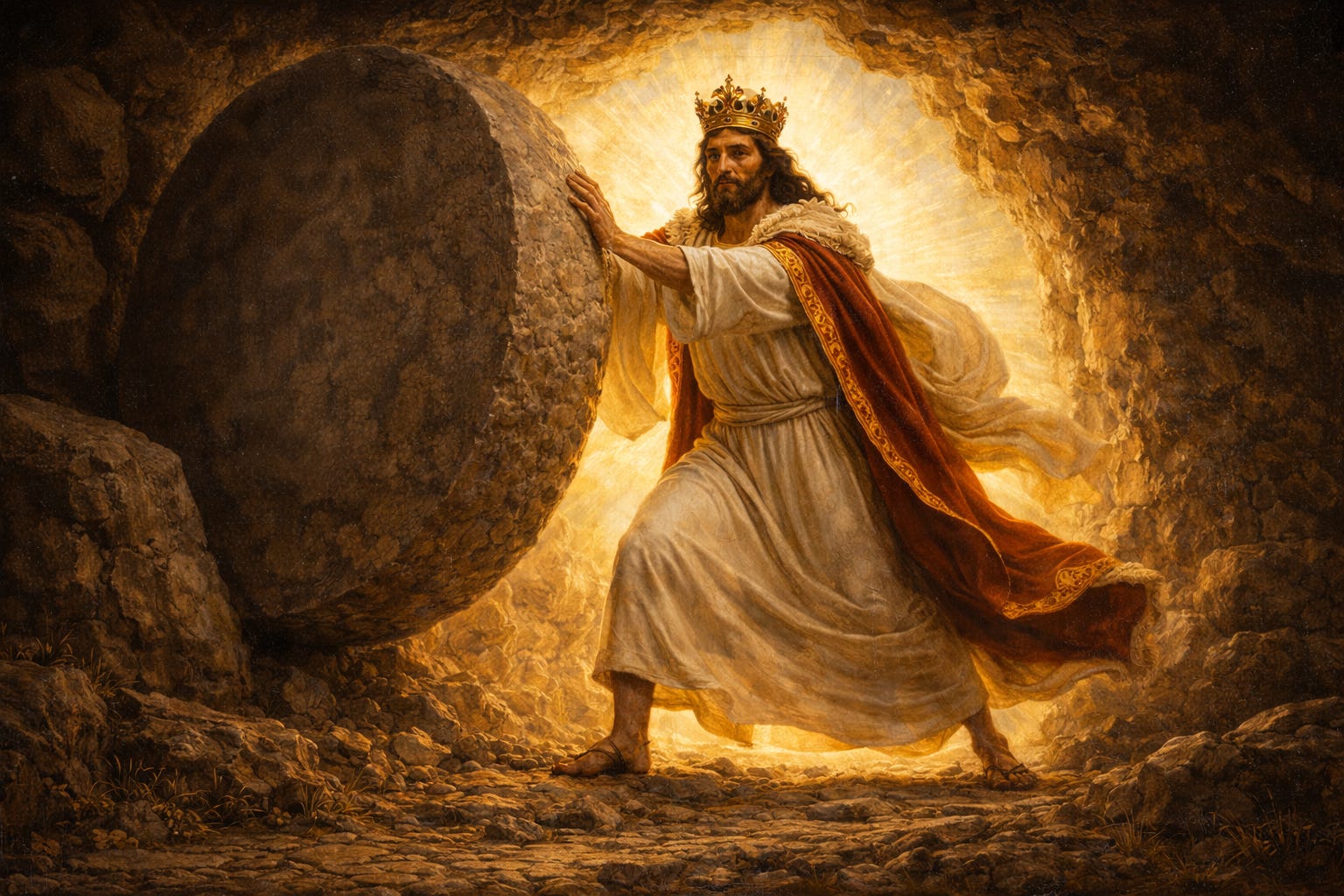
You’re told to treat the resurrection like a comforting story.
Because skeptics want to keep their own comforting illusion of meaningless existence alive and well.
But a dead man walking out of his grave is a claim that breaks history open and challenges everything built upon it.
Nothing comforting about that.
If Christ remains buried, then Christians are most to be pitied. We’ve either been duped by a lie or participate in the most scandalous event the world has ever known.
So what really happened three days after the cross?
Below are 7 reasons you can and should trust your Savior lives.
Allegiant Faith Network is a reader-supported ministry. Become a paid subscriber and get:
Courageous Chris’s “30-Day Evangelist: How to Share, Defend, and Live Your Christian Faith in a Secular World”
2 posts every week, on Wednesday and Saturday (give or take)
Access to our full archive of articles
An exclusive subscriber chat
Your support means the world to us and helps us continue to grow online.
Click below and subscribe!
1. Brand New World
Christianity did not spread through comfort or power. It moved through pressure, loss, and resistance.
Where it took root, things radically changed.
A God who loves. A moral law grounded in something higher than preference. The idea that every person has value. Systems of thought that led to freedom, scientific pursuit, and the abundance of art and beauty.
These grew out of a worldview centered on Christ. Remove his root and the fruit withers.
Bad ideas decay. Good ones produce order and life. And the Christian vision has shaped societies in great ways no competing system has matched.
Throughout history, societies built on it’s foundation saw the development of institutions that cared for the vulnerable, hospitals that treated the sick regardless of status, and legal frameworks that emphasized justice rooted in the dignity of every individual.
The emphasis on a personal relationship with a loving God encouraged exploration of the natural world as something orderly and discoverable rather than chaotic or arbitrary. Such perspectives contributed to environments where inquiry could flourish and creative expression could reflect both human struggle and divine order.
The lasting impact of Christ remains visible in social stability, charitable work, and intellectual advancement emerging where the Christian message took hold and endured.
Because he rose again.
2. The Savior’s Roadmap
Jesus told his followers what would happen.
He spoke of suffering.
He spoke of death.
He spoke of rising again.
When he was crucified, every expectation should have collapsed. It did for other Messianic movements in the Second Temple period. Their leaders died, and they disbanded.
The same started to happen with the disciples. Every one of them, except John, disappeared when the Pharisees’ guards arrested Jesus and put him on trial, for fear they would be next.
Their teacher was executed in the most shameful way known to the Roman world. A cursed man nailed to a tree. Movements built on men like that do not survive.
Yet this one did.
Not slowly, not through careful rebuilding, but through sudden conviction. The same men who fled in fear began speaking with certainty that their leader had risen from the grave.
They believed he kept his word.
The pattern of prediction followed by fulfillment stands out because the events unfolded exactly as described. Even when contradicting every cultural expectation of victory or earthly power.
Rapid change in the behavior of those closest to Jesus points to an experience that overturned their despair and replaced it with bold proclamation.
The promised outcome emerged as foretold.
3. Master of Life and Death
Before his own death, Jesus raised others. Lazarus is the most notorious example. Dead for well over a day, and then walked out of the grave upon hearing the Savior’s voice.
These resurrections weren’t secret acts. They happened in front of witnesses, in public settings where doubt would spread fast if anything felt staged.
The disciples saw it. Others saw it. Jesus demonstrated his everlasting power over death.
So when he later died, the idea of him rising again didn’t come as a surprise. Overwhelming and incomprehensible, but not a surprise. They’d already seen what he could do.
Public demonstrations of authority over death created a foundation of observed reality instead of abstract hope. Witnesses from different backgrounds could easily challenge any exaggeration. The consistency of the reports and the continued presence of those who experienced them firsthand reinforced the credibility of the later claim.
The disciples noted not only the restoration of life but the immediate return of Jesus’s body to normal functions, removing any suggestion of temporary revival or illusion.
Imagine he walked in on them still torn apart, bleeding all over the floor. Clinging to life by a thread.
They would’ve thought him insane and sent to get him medical attention. Which would’ve tipped off the priests’ guards and then the Romans. And the latter would’ve finished the job, since they’d receive the death penalty themselves if word got out someone had survived the cross.
But they saw him fully revived and returned to his pre-cross state, minus the scars from the nails.
The prior resurrections and his glorious appearing (healed and whole) made the resurrection claim a logical extension of what had been displayed openly and defies reduction to invention.
4. No Reason to Lie
If the resurrection was invented, the question becomes simple.
What did they gain?
The disciples followed a man the world cursed. They preached a message many found offensive or foolish. They refused to back down. For that, they were mocked, beaten, imprisoned, and slaughtered.
People lie for power, wealth, and/or to protect themselves. Christ’s first followers achieved none of those.
Yet they retained the Gospel message. Preached his resurrection wherever they found the opportunity.
Instead of recanting under threat, they maintained their testimony even when it led to loss of social standing, physical harm, or execution.
Fabricated stories designed for personal advantage collapse when real costs arrive. Here the opposite occurred. Commitment only strengthened under pressure, suggesting the claim rested on something actually experienced, not invented for gain.
The absence of any material benefit or protection, combined with the willingness to endure hardship, stands as strong evidence that their persistence came from genuine conviction.
Hallucination theories are the only alternative, but each of them begs the question: How does a large group of people experience the same hallucination in detail and insist in its truth under pressure?
Eventually, someone will fold and recant. Play it off as mistaken identity or delusion.
But no one among the earliest followers of Christ (the ones who were in a position to know the truth, have it verified or torn apart by other witnesses) recanted. They chose to die instead.
Because Christ had risen from the dead restored and revealed himself to them.
5. Attached to Real Life
The accounts of Jesus and the resurrection appear early. Not generations later after legends had time to grow.
Within reach of the events themselves.
Some creeds describing Christ’s crucifixion and resurrection trace back close to the time of the crucifixion. Scholars think one creed Paul cites in 1 Corinthians dates back to a few weeks or months after April 5th, 33 AD, the date the resurrection of Christ is thought to have occurred.
The timing of the written records places them close enough to the original events that many who lived through them or knew those who did could still verify or challenge the reports.
Extra-biblical sources also align with key details.
Jewish customs required burial before the Sabbath. The timeline in the Gospels reflects that urgency.
A member of the Sanhedrin, Joseph of Arimathea, takes responsibility for the body and places it in a new tomb.
We know it was new because it was a single chamber, likely the beginning of a tomb Joseph was carving for his family. Wealthier Jews would fashion such tombs into the rocky hills with multiple chambers to fit the dead for their whole families, and Joseph was wealthy enough for such a project.
He forsook his family’s grave to honor Christ.
And the involvement of a known public figure of Joseph’s statue adds a layer of specificity that would’ve been easy to disprove if inaccurate.
The women returned early the next morning to complete mourning the practices, under known customs. Which is why they were the first witnesses. Aside from the priests’ guards who fainted when the stole rolled away on its own.
Any fabricators would’ve known to remove the women as the first witnesses because their testimony wouldn’t be credible in the eyes of the Roman world. So, the only reason the writers would keep them in the story is if it were true.
The empty tomb and the repeated insistence on personal encounters with the risen Christ form the unchanging core of resurrection testimony from the beginning.
6. Men Who Thought for Themselves
The disciples may not have been elites, but they were still men with brains. And highly intelligent, even if allegedly illiterate.
Practical men accustomed to evaluating evidence in everyday matters of business, family, and community life.
They lived in a world full of competing ideas. They worked, traded, and made life or death decisions daily. And as Jews, they were required to attend synagogue (where readings of the Old Testament were performed and discussed on the regular) and make periodic trips to the Temple Mount for festivals and sacrifices.
As fishermen, they also had to know the common languages of the Roman world for trade.
In their Jewish and Greco-Roman environments, resurrection wasn’t the easiest answer available. It was the hardest one to accept.
Yet they embraced it.
Then there’s Paul. A trained Pharisee. Educated. Influential. A man who opposed the new Way movement with bloody zeal.
Are we to suppose he just drifted into belief in Christ?
No. He turned after an encounter he could not dismiss. A sharp and overwhelming experience of the risen Christ that permanently altered his reality forever.
In a diverse intellectual environment filled with many philosophies and religious options, the apostles chose a path that brought them in conflict with prevailing expectations. Their decision required them to rethink long-held assumptions about power, victory, and the nature of God’s work in the cosmos.
None of the above could happen unless Christ Jesus really beat the grave.
7. Our Only Hope Against Suffering
Every person faces the same end as the disciples and Paul. Has craved for immortality since the earliest eras of history.
We know something is wrong but are powerless to overcome.
No one succeeded in eating from the Tree of Life. We were banished from it for our rebellion. Cursed with the plague of evil and entropy.
Suffering. Death. Loss that no human effort can reverse.
Human failure brought sin and death into the world, and no system built by human hands has resolved that destruction.
The resurrection, however, does.
It says death is defeated. Not symbolically, but in reality. Tangible. It offers a future where what was broken is restored.
That’s either coincidence beyond reason or a truth worth facing head on.
Your Savior Lives
Don’t let doubt shaped by culture or pressure wear you down. Your Savior walked out of the tomb.
It’s empty.
If he were still inside it, you are most to be pitied. Because your faith is false. But the evidence resounds with affirmation that Christ Jesus left the grave.
You were not placed here by accident. You were not called to blend in with a world crushed beneath its own iniquities.
In Christ Jesus, you are made new. Sin no longer controls you, and death has lost its sting.
When you follow the Savior, you join a movement that has revolutionized everything for the better. The kingdom of God on earth as it is in heaven.
And while the powers of darkness still rage and war, you can rest assured that your victory is sealed. Because the cross and resurrection solidified their fate.
They are destined for eternal hell. You for eternal life.
Don’t forget to subscribe!
We love writing for you and for our Lord Jesus Christ. All to Him we owe. And you can help keep us in the good fight.
If you’re already a free subscriber, consider upgrading to a paid membership.
Paid subscribers, whether $8 a month or $80 a year, get additional perks:
Courageous Chris’s $35 e-guide, “30-Day Evangelist: How to Share, Defend, and Live Your Christian Faith in a Secular World.”
Access to every single article we’ve ever written since we started in June 2025.
Exclusive lessons every Wednesday (give or take) explaining why you can believe in God with conviction and/or how to live for him with courage, OR deeper dives into Scripture, theology, or apologetics.
An exclusive subscriber chat to get real-time fellowship with Courageous Chris and other like-minded Christians and discuss doubts, evidence for God, and much more.
The humble feeling of knowing you are supporting a growing ministry with a mission to spread the good news of Christ to a dying generation.
Join us today!
The historical evidence for Christ is amazing. It’s honestly what grounds me when I have struggles working through philosophical or scientific mysteries.
Resurrexit, sicut dixit, alleluia!
https://www.facebook.com/share/r/1BEBCqrLRo/?mibextid=wwXIfr