


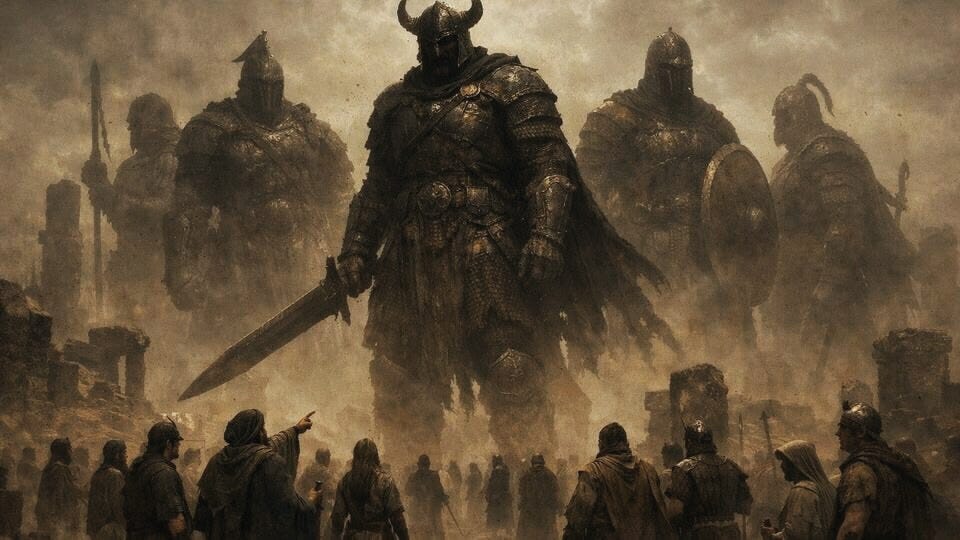
Modern scholars try to pawn off the Nephilim in the Bible as heroes because of the way they’re described in Genesis.
But ancient Jewish writings agree that the Nephilim are the corrupt giant offspring of the sons of God. And they were FAR from friendly. In fact, they’re a main cause for the Great Flood.
If you’re unfamiliar with the story, it’s found in Genesis 6:1-4. Here’s what we’re told:
“When man began to multiply on the face of the land and daughters were born to them, the sons of God saw that the daughters of man were attractive. And they took as their wives any they chose. The the Lord said, ‘My Spirit shall not abide in man forever, for he is flesh: his days shall be 120 years.’ The Nephilim were on the earth in those days, and also afterward, when the sons of God came in to the daughters of man and they bore children to them. These were the mighty men who were of old, the men of renown” (Gen 6:1-4).
No other part of Scripture has been discussed more in recent times than this passage.
Because, rightly understood, the story of the Nephilim explains most of the mysteries in the Bible.
And that raises important questions: Who were they? Why were they unfriendly? Were they just humans or more? Who were their fathers, the sons of God? Why did they cause the Great Flood?
We’re about to answer these questions with a look into Genesis 6:1-4, other biblical texts, and extra-biblical sources that formed the Hebrew worldview, and construct a narrative to help you understand the Nephilim, their importance, and your place in the story of God.
Get ready for a wild ride.
Sons of the Sons of God
It’s hypothesized that Nephilim comes from the Hebrew word naphal (”to fall”). Other possible words of origin are nephel (”miscarriage”) and/or pala (”extraordinary”).
I personally think it’s derived from a combo of all three because of who fathered the Nephilim.
The bene ha’elohim (sons of God) are divine beings in Genesis 6:1-4, and there’s no way around that.
The only two alternatives of any popularity in recent years have been the Sethite view and Divine Kings view. Both suffer from the same flaw.
Proponents of the Sethite view (which used to be my view) say the sons of God were the descendents of Seth who remained loyal to God, whereas the daughters of men were the descendents of Cain, who had been severed from God because of the murder of his brother Abel.
The former co-mingled with the latter, and that led to human corruption.
Only problem is, Cain was human just like Seth and both were sinners, whether or not one had an additional curse of banishment. There is no violation in Seth’s descendants mating with Cain’s descendants, not even incest, since there was less genetic variety in their world (see our last Wednesday article on Cain and Abel).
A Stone's Throw Between Brothers

If you’re like me, you’ve read the story of Cain and Abel a thousand times. If not, what follows will be new to you.
Furthermore, Cain’s ultimate curse was separation from the Spirit of God, mirroring the serpent’s own banishment. God remained with humans after the fall, but not with the serpent, the devil. Because he murdered God’s creation, unleashed sin and death upon it through deception.
Divine kingship suffers the same flaw as the Sethite view. Even if the sons of God were divine kings, elected by God, they were still human at their core, and their mating with human women wouldn’t have been against God’s design. Yet, as noted, ancient Jewish writings saw the Nephilim as corruptions by their nature and association with the sons of God. In fact, they’re considered abominations in Second Temple writings.
That goes beyond human sin.
God considers certain acts, like homosexual behavior, abominations in the Bible, but never humans themselves. Because abominations directly dissolve God’s design.
The only viable conclusion is the sons of God were spirit beings created by God in the heavens. Part of God’s divine assembly, which appears throughout Scripture. The heavenly host. And the Nephilim were their demigod children.
While the nations honored them as great warriors, biblical and extra-biblical evidence suggests they were unruly, cannibal giants. A blend of the bloodlines of the heavens with the bloodline of man. Causing corruption of mind, body, and soul…
Twisted Demigods: A Quick Mythological Detour
How could spirit beings mate with humans?
Simple. They took on human form. In the ancient world, there’s plenty of precedent for human-god mating.
Of Titans and Men
A prime example from Greek mythology is Zeus. He took many forms, sometimes not even human, in order to mate with women he found desirable. His two most famed demigod offspring are Hercules and Perseus, but many of his demigod children became abominations.
Perhaps that’s why when Greek became the chief language of the Mediterranean Basin after the conquests of Alexander the Great, and the Old Testament was translated into Greek, the translators found an easy parallel between the Greek demigods and the Nephilim giants.
The Titans especially. They, even in the Greek stories, were perversions led by their youngest and most unhinged brother, the evil god Kronos.
Son of earth (Gaia) and air (Uranus), Kronos castrated his father and led a rebellion against the most ancient gods to take control of the heavens and the earth. A long war ensued, and Kronos was defeated by his son Zeus, who soon proved to be another form of chaos, just as vile. As was his brother, Hades.
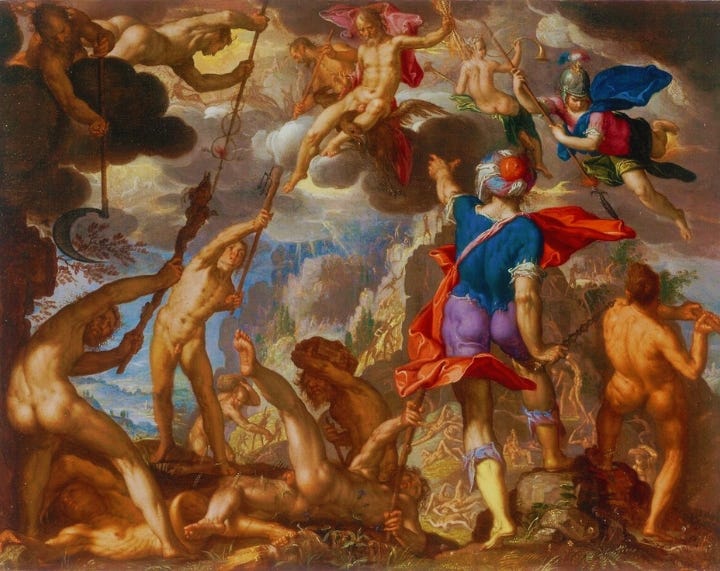
What’s important is the overthrow of the heavens by the Titans, led by Kronos (symbolized by a serpent), resulted in the production of perversions of creation on earth, monstrous deformities among whom were giants (gigantes).
Before you go on…
Allegiant Faith Network is a reader-supported ministry.
Consider subscribing. If you’re already a free subscriber, consider upgrading to a paid membership.
Paid subscribers get these awesome benefits:
Exclusive lessons every Tuesday explaining why you can believe in God with conviction and/or how to live for him with courage, OR deeper dives into Scripture, theology, or apologetics.
An exclusive subscriber chat to get real-time fellowship with Courageous Chris and other like-minded Christians and discuss doubts, evidence for God, and much more.
The humble feeling of knowing you are supporting a growing ministry with a mission to spread the good news of Christ to a dying generation.
Cosmic Conflict in Canaan
The story of the Titans comes from even more ancient roots.
It stems from the Phoenician/Canaanite stories of El (the creator god) and Baal (storm god; lord of all). All the major figures from Greek mythology find matches in the more ancient context:
Kronos/El
Zeus/Baal
Poseidon/Yamm
Hades/Maat
In Phoenician mythology, a great war ensues when Baal fights Yamm and then seeks to strip the throne of the gods from El. Maat (death) beats Baal for a time until he’s revived by his sister and overthrows Maat. Throughout the saga, El grants Baal a luxurious palace and essentially hands him the keys to Earth, instead of fighting for rule.
The Egyptians saw Kronos as their own god Geb (earth) who was the father of serpents, separated from his sister Nut (sky) by their father Shu (air).
Geb was the father of Osiris, Isis, Seth, and Nephthys. They too, after a great war, fought each other and got into wars of their own, just like the Greek and Canaanite gods. Wars that extended from the heavens to the earth so there was only wickedness and violence everywhere (Genesis 6:5).
The above mythologies are important because there are thousands of flood stories from the most ancient societies across the globe, and many of them include great wars between the gods and depictions of giant abominations. Even some in Egypt, Canaan, and Greece.
Atlantis, for instance, is judged with a great flood after attempting to overthrow the whole Mediterranean to create an empire for Poseidon, according to Plato.
The Israelites understood the stories in the Ancient Near East as representations of a collective memory of actual past events repainted with differing cultural flares. And determined that the closest explanation for the Nephilim and the flood had its home in Mesopotamia, particularly Babylon, where post-flood humans converged at Babel...
A Mess in Mesopotamia
The two stories which captured their attention most were the Akkadian myths of the Apkallu (sages), the Enuma Elish creation myth, and the epic of Gilgamesh, which all have more ancient roots in 3rd century B.C. Sumer.
The ancient Sumerians understood the universe as born through battles with the dragons of chaos, living within the eternal primordial waters. (Apophis, the night serpent, in Egyptian mythology echoes those wars.)
Akkadian cosmology confiscated the dragon myths and told of two waters, Apsu (fresh) and Tiamat (salt), personified as serpent monsters. Yonge gods emerged from their essence and made lots of noise. Infuriated Apsu, who tried to kill them but was slain by Ea.
A massive conflict ensued when Tiamat was enraged, and another Baal figure, Marduk, defeated her. He then built the heavens and earth from her body and made humanity as slaves for the gods from the body of her servant Kingu.
The Apkallu are sage-gods fish-like bodies, sent from the most ancient gods to teach humans
temple-founding
city-building
mathematics
necromancy
agriculture
divination
exorcism
writing
crafts
law
And the order of the cosmos.
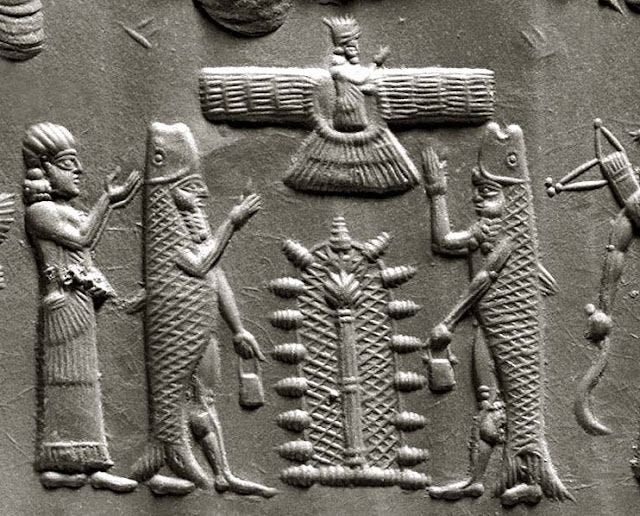
They mate with humans and have children of their own among them. Who become heroes in the eyes of the ancients.
But humans then make lots of noise and annoy the gods, so Enka sends a great flood to wipe them out. But Enlil spares one man with an ark.
The children of that man repopulate the earth, the Apkallu sages reteach humanity the secret knowledge, and then they leave, only their offspring remaining to preserve the wisdom from the heavens.
Gilgamesh in the Epic of Gilgamesh is one of these giant wise men who becomes another mighty hero. But he longs for immortality, so he seeks out the man of the ark, who is said to possess the secret.
The man from the ark points him to a plant/tree of life. Gilgamesh finds it, but while he sleeps, a serpent steals the tree of life away in the dark of night so no man can taste the immortality of the gods.
There are nuances to the story, as with all stories, modern or ancient. But the same themes appear:
There are eternal waters, no eternal god or gods
The most ancient gods and their children are power-hungry control freaks in endless battle
Humans if not accidents are made as slaves to the gods
The Apkallu (ancient sons of the gods) teach them the mysteries of the cosmos, the arts, and the sciences
The creator god, if there even is one, is like the other gods or a weak pushover (El)
Only chaos, no real order, and chaos is represented repeatedly by serpents
Humans eventually annoy the gods so they become a nuisance and are destroyed by flood
The great heroes are the giant offspring of the Apkallu (sons of the gods) who maintain the sacred wisdom
A serpent steals the tree of life
Within all these stories, the Israelites saw everyone had it backwards, traced the collective memory, and articulated an alternative history that is unique in the whole of human history...
The Hebrew Worldview
Genesis takes a different path. It starts with the serpent stealing eternal life through trickery.
There IS an eternal God who makes humanity in his own image, endowing them with divine purpose, to multiply over the earth and rule with him. And get their knowledge from him as his children.
But the serpent (likely a spirit being himself, a seraphim) convinces them to choose quick knowledge over life with God. Unleashing sin and death into the world through disobedience.
Rebellion sparked ongoing conflict between the heavens and the earth, between man and man, between man and creation, and between man and God.
Even so, God extends mercy, spares humanity from instant death, and allows his Spirit to remain with men (with the exception of Cain who murders his brother). They are at first only cut off from accessing the way to everlasting life.
But then, the sons of God see the daughters of men and take some as wives, merging the bloodline of heaven with the bloodline of earth.
Genesis doesn’t tell us the sons are the Apkallu, but 1 Enoch, written during the Second Temple period, aligns with the Akkadian story almost word for word and calls the Apkallu the Watchers.
They descended upon Mount Hermon, north of Israel, mated with human women and taught humankind the depths of secret knowledge, carrying on the work of the serpent. Their offspring became giant abominations, the Nephilim, who were vicious cannibals, slaughtering and feasting upon humans and creation.
Humans who bowed to them and envisioned them as mighty demigod heroes were spared and became their slaves. Soon, humankind took on the nature of their masters, and paired with the intelligence of the gods, began killing their own kind until there was no end to the creative violence.
Pre-flood humans were knowledgeable but had no wisdom because they didn’t follow God, and it ended in annihilation. As Wisdom says in Proverbs 8:35-36: “For whoever finds me finds life and obtains favor from the Lord; but he who fails to find me injures himself; all who hate me love death.”
Such was the condition of the pre-flood world.
The Global Flood wasn’t sent because humanity annoyed the gods with noise. God sent it to purge the corrupt bloodline of the Nephilim (the first and most grotesque sexual perversion in history) and end humanity, since their thoughts were evil all the time and there was only violence everywhere. And he imprisoned the original rebellious sons of God (Apkallu) beneath the Euphrates River.
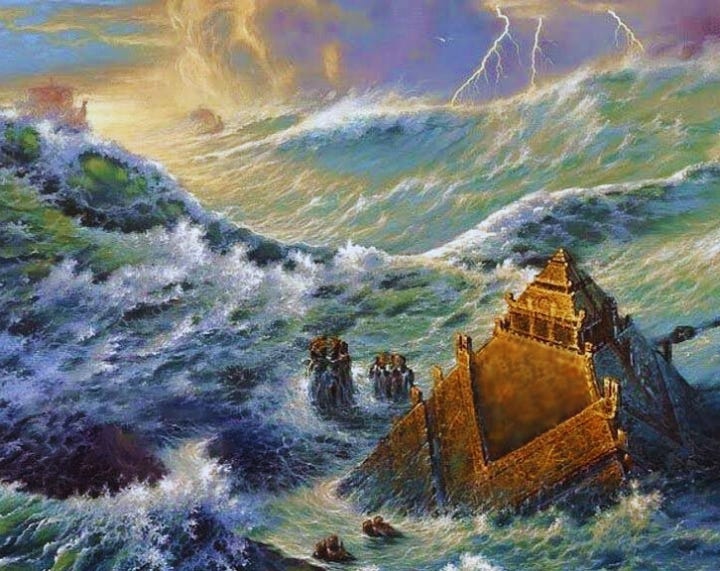
God spared Noah and his family because they were uncorrupted by the Nephilim bloodline and remained loyal to God. Never bowed to the Nephilim rulers…
As Above, So Below
Nephilim appear again after the Flood, and the Bible doesn’t say why. But the story of the Apkallu gives a clue:
Other sages (sons of God) returned to re-educate humanity in the lost knowledge. Followed the sins of their brothers. Which means they likely mated with human women again, created more “men of renown,” “heroes of old,” Nephilim.
Noah, knowing the old ways, should have put an end to it, to keep the cycle from repeating. But according to Genesis, he became drunk on much wine and fell into the same sins as Adam. Failed to lead his family to God.
Instead, he gorged himself on the land, forgot about Almighty God, was dishonored by one of his sons, and watched the world deteriorate in chaos again.
The only difference this time was God promised never to flood the earth again (Genesis 9:8-17). So, cataclysmic judgment, un-creating the creation, was out of the question.
But there would be a long history of God battling with the forces of darkness, the fallen sons of God, and destroying the descendants of the Nephilim from earth.
While most of humanity converged at Babel in Mesopotamia, ruled by some Nephilim, many Nephilim returned to Canaan, the land where the first sons of God descended upon Mount Hermon. It would become the headquarters of spiritual and physical war for ages to come.
When the Israelites arrive at Canaan in Numbers 13, the spies who survey Canaan are horrified because they encountered the descendants of the Nephilim. The enormous Rephaim, Anakim, Emim, and Zamzummim. And the land is consumed with bloodshed and cannibalism. A microcosm of the pre-flood world.
God commands them to wipe out the monsters to put an end to the Nephilim bloodline and its terror.
But that’s not the only puzzle pieced together by the Nephilim…
God’s Rescue Mission
As Christians, we’re in the middle of God’s ancient war. On the victorious side of it, since all roads lead to Christ.
From rebellious humanity, God selected a nation for himself through whom he would work to bring about victory over the seed of the serpent, destroy the power of the gods of the world (the fallen sons of God), and eliminate the bonds of sin and death for good.
From the heart of post-flood humanity’s central hub (Babylon), he brought Abraham into the land of the Nephilim (Canaan), gave him a stake in the land, and promised him his ancestors would purge Canaan of the evil of the Amorites (general descriptor for the inhabitants of Canaan). And Abraham’s seed (a Messianic promise) would bless all nations.
Egypt was a refresher of the war. God went down to face the gods of Egypt, the fallen sons of God who controlled that corner of the world, and began the battle anew. They thought the war was over, but God said, “Not today.”
He rescued Israel from their grip, made Israel a nation for himself, showed them a sacrificial system to deal with sin and death, and brought them back to the promised land of Canaan to become a nation of priests to humanity (Exodus 19).
God wanted them to be his holy vessel. But when they failed to eliminate the Nephilim descendants entirely and worshipped the gods of Canaan, even bringing those gods into his holy Temple, God brought judgment upon them.
Yet, through a holy remnant, the line of King David (who routed the final Nephilim, Goliath and his family of giants), he worked to bring about the arrival of his own Son, Jesus, as the final sacrifice of atonement and conqueror of sin and death. In the Nephilim backyard!
Since Israel forgot God, like Noah, and worshipped other gods, evil festered in Israel. Hermon became a stronghold for the fallen sons of God, ruled by none other than Satan. The Second Temple Jews, by the time the Romans took over, considered the land of Bashan (Galilee), where Mount Hermon towered over the North and Jesus spent most of his ministry, the “gates of hell.”
When Jesus faced temptation in the wilderness, Bashan is where the Spirit led him.
When Jesus was transfigured before Peter, James, and John, Bashan is where they went.
When Jesus performed exorcisms, most were done in Bashan.
Jesus, God-made-flesh, went to war with the headquarters of the fallen sons of God, and made sure they knew the time of their end was at hand. The world was about to be stripped from their grip forever. For the kingdom of God had arrived.
Where We Are Now
Because of Christ’s war, final sacrifice, and resurrection, we now live in the era of the kingdom of God. While the principalities of darkness, as Paul calls the sons of God in Ephesians 6, still fight for the souls of humanity (ours is becoming another world that hates wisdom and loves death), they are powerless against Almighty God because the victory has been sealed.
They’re permitted their raging folly for a time, storing up wrath for themselves in the Day of the Lord. In the final moments leading up to that day, John tells us in Revelation that even the sons of God imprisoned below the Euphrates will be released to wreak havoc, killing a third of mankind.
But nothing will compare to the wrath and justice of Christ to come. God will make all things right and new. Destroy sin, death, and their arbiters with such permanence, only eternal glory, beauty, and goodness will remain for his children.
Christ comes on his white stallion, his own mouth like a sword. No enemy against the eternal Creator shall prosper.
Order is to be restored.
The chaos serpents slain.
The gods defeated.
And the kingdom of God shall reign forevermore.
Great article. There has been a lot of discussion circulating today by learned scholars that the bloodline persists in modern day "giants".. ostensibly extra tall and large individuals like Robert Wadlow and wrestler André René Roussimoff ('Andre the Giant'). What are your thoughts on that? Or is it merely speculation?
I do wonder if the nephilim were the heroes of old like Achilles or Gilgamesh.
And did the Nephilim had a genetic altering aspect to them “son of the sky”
The mythology of the portrayed the “power hungry gods Baal Kronos etc “ greedy almost Luciferian and the serpent Allegory makes me wonder if the Nephelim had any demonic aspect to them