


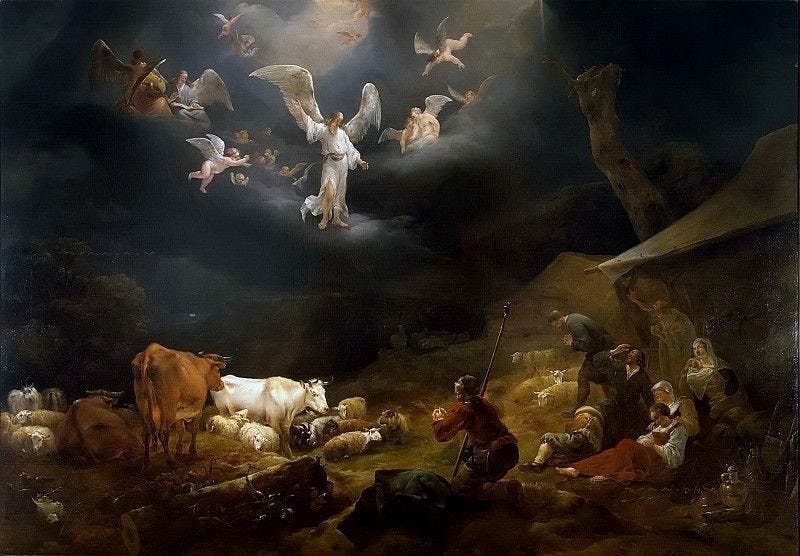
Nicolaes Pietersz Berchem’s Annunciation to the Shepherds
The most iconic story of Christ’s birth everyone remembers is the angels and the shepherds in the nighttime field. But few understand the depth of the encounter and its significance.
It was a prophetic anointing, akin to those received by the prophets sent to Israel during the time of the kings. Through the prophets, God warned Israel to leave the gods of the world, repent of their sins, and worship him alone to lead the nations back to him, lest they be destroyed.
They failed their mission, but God would not abandoned his.
The dawn of the Christ was to be a new age, where every holy obligation of the priests, kings, and prophets merged as a singular force, to reconcile the remnant of Israel and the lost nations to their ultimate King: The right hand of God Most High.
Shepherds seeing angels thrusts us deep into that epic saga and calls us home.
Before you go on…
Consider upgrading to a paid subscription.
Support our work and get theses awesome benefits:
Exclusive lessons every Tuesday explaining why you can believe in God with conviction and/or how to live for him with courage, OR deeper dives into Scripture, theology, or apologetics.
An exclusive subscriber chat to get real-time feedback from Courageous Chris and other like-minded Christians about doubts, evidence for God, and much more.
A lifetime 30% discount to our growing Gumroad store with how-to guides and courses on how to argue and live your Christian faith in a secular world.
The humble feeling of knowing you are supporting a growing ministry with a mission to spread the good news of Christ to a dying generation.
Rescuing Lost Israel
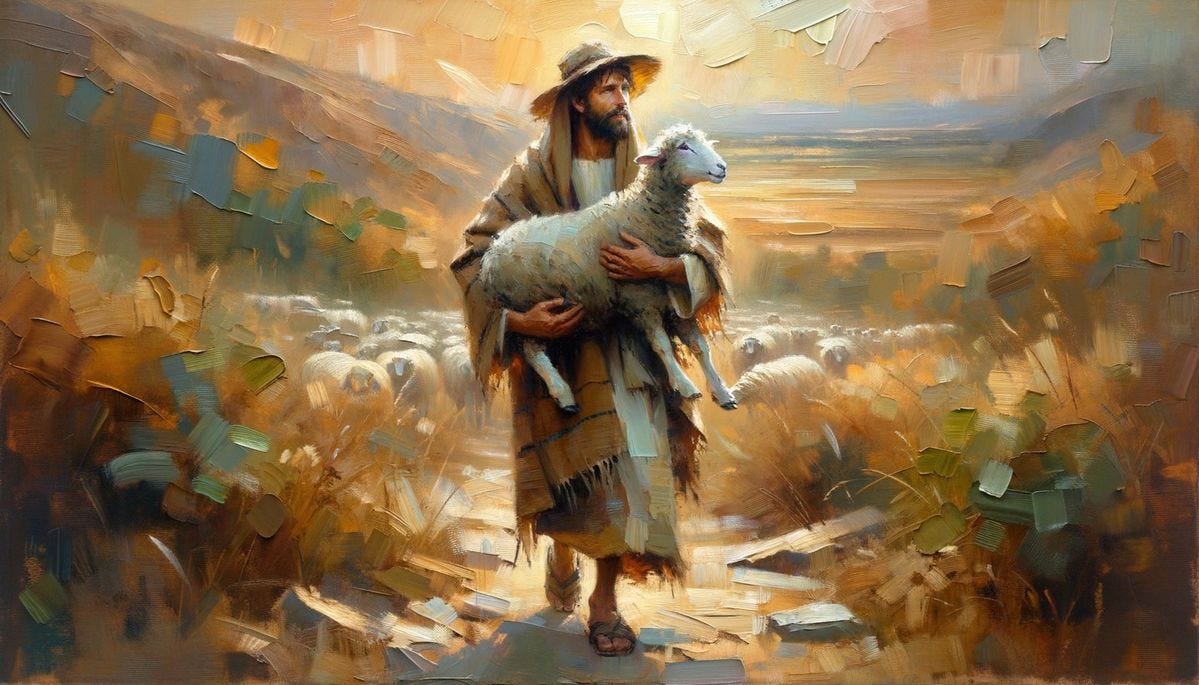
There are many Old Testament passages connected to the shepherds in the field. And because of their importance, it serves our interest to summarize each and its meaning.
Psalm 23
Everyone is familiar with this psalm in some capacity. David celebrates the Lord as the enduring shepherd who guides his every step.
God leads the king in “paths of righteousness,” contrasting the “valley of the shadow of death,” the perpetual state of this broken world. Filled to the brim with evil and darkness.
While on his journey, David can fear no evil because his enemies cannot overcome the Good Shepherd. His “goodness and mercy” follow wherever he leads his sheep. God’s anointed king overflows with support and protection at every step.
Psalm 80
The psalmist calls on God to give ear to Israel. He’s called “Shepherd of Israel,” and he is identified by his place upon the mercy seat, the Ark of the Covenant. He sits between the two cherubim, which mirrors God’s place on the heavenly throne surrounded by the cherubim and seraphim (the angelic guardians of glory).
Israel is in a moment of dire need. Their enemies mock and flank them because the Creator judged them for abandoning him and falling into sin.
The psalmist reminds God of what he did for them, bringing them out of Egypt and making them a “strong son” among the nations. And three times says, “Restore us, O Lord God of Hosts! Let your face shine, that we may be saved!”
The three pleas reflect (1) when Moses came down from Mount Sinai and his face glowed from meeting with God, and (2) the prayer in Numbers Aaron the high priest is required to pray over Israel (“May the Lord guide you and keep you and shine his face upon you…”). Wrapped within the pleas is this line: “But let your hand be on the man of your right hand, the son of man whom you have made strong for yourself!”
The psalm is Messianic, linked to the Exodus, and calling for a renewed act of rescue from the Good Shepherd through the son of man, his right hand.
Isaiah 6
All prophets in the Old Testament saw God and the heavens in some fashion when called. Isaiah’s is the most remembered because the heavenly throne room opened in a full and epic display of glory.
The seraphim with six wings soar around the throne, using two wings to fly and the other four to cover their face and feet. Stressing the power of God’s overwhelming holiness. Which is immediately reinforced by God’s voice resounding like an earthquake in the space. Their praises are drowned out.
Isaiah is terrified because he is “a man of unclean lips.” A seraph flies to him with a flaming coal, touches his lips, and tells him, “your guilt is taken away, and your sins atoned for.”
Holiness from God Most High infuses the stone. God replaces Isaiah’s guilt and sins with his own eternal purity and guiltlessness, and then sends Isaiah out to spread the message that Israel will be blinded and deaf until the land is laid waste. Then, and only then, will the “holy seed” arise.
Isaiah 40
Chapter 40 reads as if it picks up where Isaiah’s anointing ends. Israel has “received double for all her sins,” and now the time is at hand where her “warfare is ended” and “iniquity is pardoned.” Signaled by a voice crying, “In the wilderness prepare the way of the Lord” (John the Baptist).
The message from the voice is that the Lord is about to appear. All flesh shall see him and his glory. “The grass withers, the flower fades, but the word of our God will stand forever.”
Then comes the key passage (vv. 9-11): To Zion, to Jerusalem, to the cities of Judah, comes the arm of God, ruling for him. And he comes as a shepherd to his flock. His chosen people. They will experience the everlasting God as they never have before.
The incomparable One, who made and crafted everything from nothing without being taught knowledge and the nations cannot stand against, who “does not faith or grow weary” and whose “understanding is unsearchable,” comes to give power to the faint and increase the strength of him with no might. Until they can “mount up with wings like eagles…run and not be weary…walk and not faint” (vv. 12-31).
Ezekiel 34
Here, a contrast is set up between God and the priests of Israel. The priests are called “shepherds of Israel,” and they have led the sheep astray. The shepherds' failure caused the sheep to be ruined and scattered.
Bring back the strayed
Strengthen the weak
Bind up the injured
Seek the lost
Heal the sick
Instead, the “shepherds” ruled them with harshness, filled their pockets with wealth, and clothed themselves in the wool of the sheep. So, God is going to take matters into his own hands.
He declares he will come and be their shepherd, through “his servant David,” and do what the priests should have done from the beginning. Judge between the fat sheep (unrepentant sinners, symbolized by gluttony) and lean sheep (repentant sinners allegiant to God, symbolized by healthy bodies).
The Good Shepherd promises to “deliver them from the hand of those who enslaved them,” a New Exodus. God will make a "covenant of peace" with them, banish the "wild beasts" from the land, and shower everyone and everything with blessing. After he breaks “the bars of their yoke” and makes them dwell securely without fear.
Micah 7
Lastly, there is Micah. And there are tons of connections to unpack.
The Good Shepherd appears in v. 14, central to the passage. It’s very hinge. He appears while the writer waits for the Lord amid heinous evil.
Every which way he looks, humanity devours each other. “The godly has perished from the earth, and there is no one upright among mankind.”
The reference recalls Sodom and Gomorrah, when Abraham asked God to save the cities if at least 10 righteous people were present. This time, the whole world is as corrupt as they were or worse. None are righteous, not one (Romans 3:23).
They “all lie in wait for blood, and each hunts the other with a net.” The unprovoked prevalence of violence is also reminiscent of how the world appeared before the flood. Men worship the evilest of desires, and the turmoil is so intense that even within families there is dissent, disrespect, and contempt.
The Lord’s day is coming, dawned by the shepherd. The righteous who look to God and seek forgiveness among his people find it, and those among the nations are drawn to him. But those who persist in their evils, the nations who love wickedness, are “trampled down like mire in the streets.”
When the shepherd appears, an interesting promise is made: The nations “shall lick the dust like a serpent” The curse upon the original rebel was that he would crawl on his belly and eat the dust of the earth.
Since he was most likely a seraph in the garden of Eden, tasked with guarding the tree of the knowledge of good and evil, the judgment issued meant he was
Stripped of his former glory and beauty (see Ezekiel 28)
Cast from the heavens
Forced to suffer an eternal exile
That any rebellious humans are equated with him and promised they will “turn in dread to the Lord our God” and fear him, suggests the same eternal exile.
BUT for the “remnant of his inheritance,” those who love and remain loyal to God, the Good Shepherd pardons their iniquity and passes over their transgressions.
So, the Good Shepherd is the fulfillment of The Passover. Not only does he “pass over”; he tramples the iniquities of his loyal followers underfoot and casts their sins into the depths of the sea (v. 19).
And the covenant made to Abraham and Jacob becomes realized through him (v. 20).
Leading Their Flocks By Night
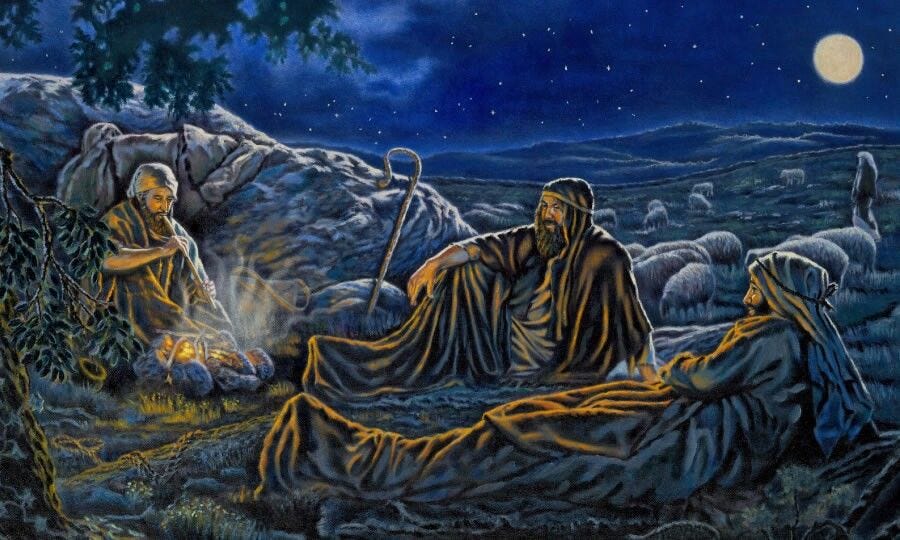
Rather than cite all these passages, Luke sees them fulfilled in the history of Jesus’s birth and paints their fulfillment through the scene of the shepherds and the angels.
Shepherds in Greco-Roman Israel were shifty sneaks. They had no boundaries, guided their flocks to graze wherever they wanted. They were the lowest of the low in the eyes of the Pharisees, Sadducees, and the people. Despite operating in the first occupation of Israel’s greatest king, David.
In this way, Luke sets the shepherds up much like David. He was the least among his brothers, the last to be considered, and while his brothers were home when the prophet Samuel came to anoint him as king, he was out in the fields, in the wilderness, defending the sheep from danger.
So too, the shepherds are ignored, exiled in the wilderness. Only their wilderness is consumed by darkness, the outer darkness (referenced elsewhere in the gospels by Jesus as “hell”), and they are dishonorable in their practices, more comparable to the priests rebuked by God in Ezekiel 34. Unlike David.
Why? To mirror Jesus’s later confrontation with the religious leaders of the Jews.
The shepherds are near the house of David (Bethlehem), but they are not of it. Both sheep and leaders of sheep, they circle its orbit while committing sins against the people of the land, leading the sheep astray. And for this, they and their fellow sheep are stuck in darkness. Prey to the “wild beasts” (nations).
One much better than them, one like David but sent direct from God, a “holy seed” with clean lips, must assume their role to break the yoke of the people and lead the sheep safely through the “valley of the shadow of death” to “green pastures.” Destroy not only the grasp of the nations, but also the serpent anew. The Good Shepherd and lamb of God, whose battle stretches across dimensions.
Cue the angels.
Heaven and Earth Collide
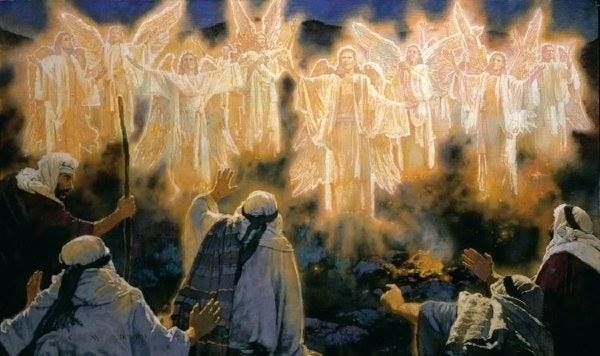
Darkness is suddenly pierced by light. A parallel to the instant of creation (Genesis 1), and recollection of Moses and Aaron. The people see a great light (Isaiah 9:2).
An angelos (messenger) of the Lord, member of the heavenly host, breaches the night in splendor so spectacular and fast that the shepherds are left terrified. Like Isaiah in the throne room of the highest heaven.
God has arrived.
No coal purifies them because they are about to meet God face to face and carry on his words to the people. The lowest of the low are made prophets, to announce the coming of the “right hand of God,” the “son of man,” and “holy seed.” Similar to John the Baptist after them (who had already jumped excitedly in his mother’s womb when meeting the expectant Savior), they are to “prepare the way for the Lord.”
The messenger, like the seraphim, declares not to be afraid. And then provides the “good news that will cause great joy for all people [not just Israel]. Today in the town of David a Savior has been born to you; he is the Messiah, the Lord. This will be a sign to you: You will find a baby wrapped in cloths and lying in a manger.”
Whereas the seraphim circle the throne and praise God before giving Isaiah his assignment, the sky becomes filled with “a great company of the heavenly host” singing, “Glory to God in the highest heaven, and on earth peace to those on whom his favor rests” after commanding the shepherds. The message ignites the praise.
A covenant of peace has come. The time of secure dwelling in the wilderness dawns. Hell is about to be stripped of power. And it begins with one babe in a small, forsaken town, former home of King David, lying in a manger. A feeding trough for animals.
Someone perspectively lower than even the shepherds. But who will purify like coal and sprout a great resurrection as the seed. Shedding his mortal shell to conquer death and come back from the grave, giving life. To rule over the ends of the earth and draw all nations unto salvation.
He will
Bring back the strayed
Strengthen the weak
Bind up the injured
Seek the lost
Heal the sick
What the priests failed to do for Israel and the rest of the world. Trample our iniquities, drown our sins, defeat the enemies of God Most High, and cause the children of God to “rise up on wings like eagles.” The Christ (Messiah), Jesus, is the Good Shepherd, the new high priest, the Lord who dwells among us.
Faith Like a Mustard Seed
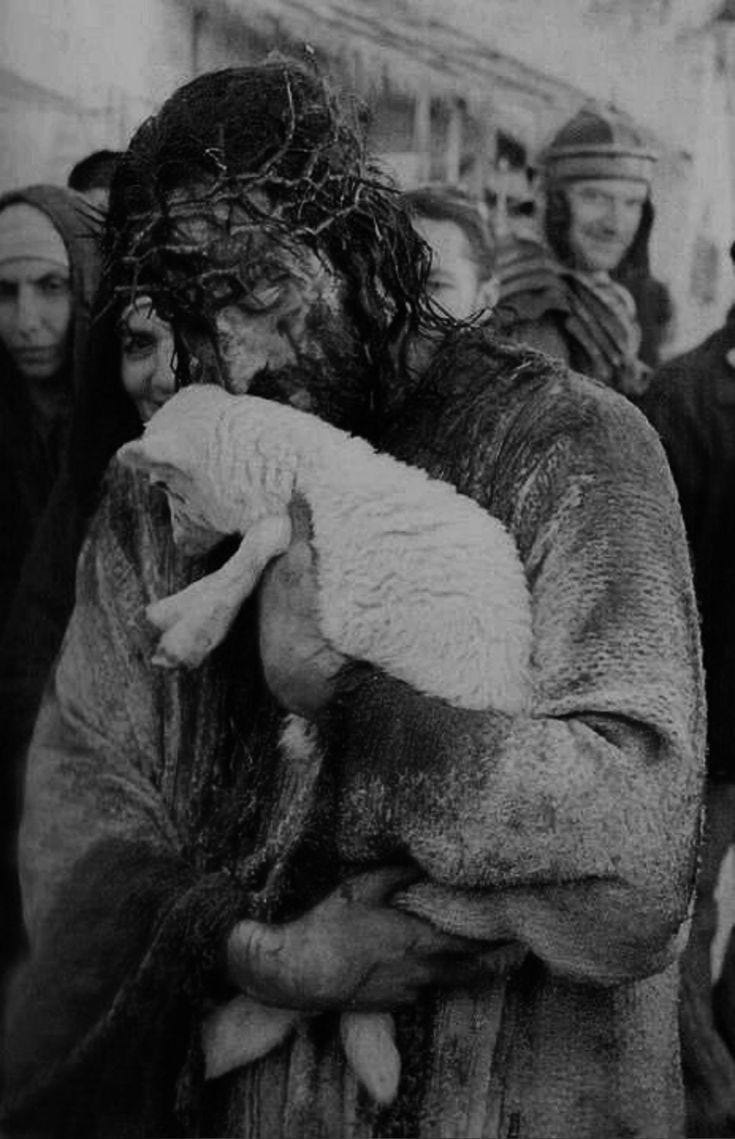
Without even getting into Jesus’s life, Luke sets the stage for the eternal significance of his ministry. There is no secret who this babe wrapped in swaddling clothes is. Any Jew or Gentile who knew the Hebrew Scriptures could ascertain immediately who Mary carried in her womb and labored into the realm of flesh.
Where Matthew uses a genealogy, a star, and wise men from the East, Luke repeats the pattern of God. The weak are made strong, the low are made high, and the least are called to greatness. The shepherds go and see the child and are instantly flooded with urgency to share what they witness with everyone they meet. All who hear are amazed and filled with wonder.
Because the new covenant and the new creation had entered the earth. Their words planted faith like a mustard seed which would grow and draw people from all walks of life to the King of kings and Lord of lords. And reshape reality forevermore by laying down his own life as a ransom for many.
This is our inheritance as followers of Christ and what we are reminded of each Christmas.