


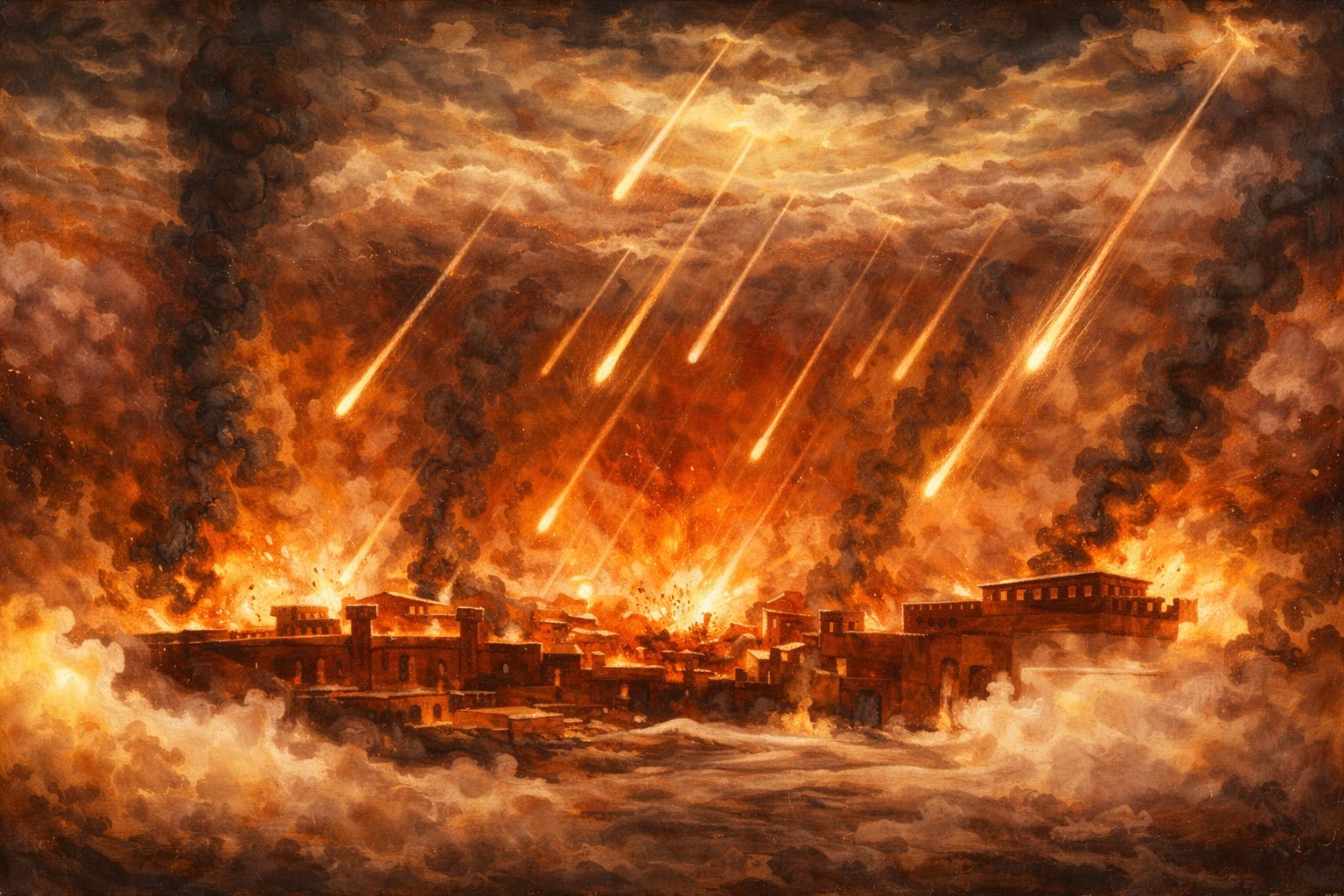
The story of Sodom and Gomorrah is one of the most epic tales in the Bible. Fire falls from the sky, a woman turns into a pillar of salt, and God decimates two wicked cities in a fit of divine wrath.
It’s one of the most retold and examined stories in history, and most people treat it as a settled, cautionary tale about sexual sin. End of discussion.
But there’s so much more.
The cities are real. The event that destroyed them was so violent it turned pottery into nuclear glass. And six major threads emerge from their demise that add significant layers to understanding God’s Word:
Who were the three men who visited Abraham in Hebron? Why does God warn Abraham of the destruction of Sodom and Gomorrah? Does God not know the evils they were committing and make a best guess? Why barter with Abraham over the righteous in the two cities? What was the major sin committed by the men of the cities? And how does the calamity link to the Passover?
These questions all have incredible answers. And you’ll love where they lead.
Allegiant Faith Network is a reader-supported ministry. Become a paid subscriber and get:
Courageous Chris’s “30-Day Evangelist: How to Share, Defend, and Live Your Christian Faith in a Secular World”
2 posts every week, on Wednesday and Saturday (give or take)
Access to our full archive of articles
An exclusive subscriber chat
Your support means the world to us and helps us continue to grow online.
Click below and subscribe!
Cities of the Plain
Scholars still like to debate the location of Sodom and Gomorrah. But it’s mostly opinionated bickering over minor details.
The chief candidate for Sodom is Tall el-Hammam, east of the Jordan River, directly north of the Dead Sea within the Kikkar Valley.
The site matches the biblical description and experienced an extraordinary cataclysmic event. Almost the entire plain was super-heated to 2,000 degrees Fahrenheit for a matter of seconds, decimating everything.
Scientists know because pottery shards found there fused into green glass on one side. Trinitite. The same glass discovered in the Mojave Desert after the Oppenheimer nuclear tests during World War II.
Tall el-Hammam went uninhabited for over 700 years after the catastrophe, while surrounding societies continued to flourish and grow. And Ancient Near Eastern sources describe the place as cursed, a wasteland of mourning.
No better explanation has been offered for the catastrophe besides divine conflagration.
The only dent in Tall el-Hammam is dating. Recent archaeological discoveries place the Israelites in Egypt prior to 1400 B.C., posing a problem for conventional timelines.
Scholars date the destruction of Tall el-Hammam to around 1700 B.C., but if the Israelites were truly in Egypt for 400 years after Joseph, that timeline collapses. The real timeline for the catastrophe in the plain would be sometime prior to 1800 B.C., likely around or before 2000 B.C.
The dating itself is what must be wrong, though, because the weight of the other evidence discovered there suggests it IS the site of ancient Sodom. Without question.
The cities are real, were destroyed as described, and their significance goes beyond archaeology…
Three Men, One Lord
The first two of the six threads found in Genesis 18-19…the identity of the three men and God’s revelation to Abraham…are intertwined.
Contrary to common critiques of Genesis 18, the men who visit Abraham aren’t separate figures from the Lord. They’re one and the same.
The opening verse functions as a blanket statement, the same literary move made in Genesis 1, where God creates the heavens and the earth without a timeframe or method.
All we’re provided is the general “what.”
Details come after.
In 18:1, “the Lord appears to Abraham” sets the scene. God, three-in-one, comes to Abraham in human form, familiar and accessible. Tangible.
The Trinitarian reading finds confirmation later in the chapter when two of the party leave toward Sodom while the Lord (the Father) continues speaking face to face with Abraham.
Genesis gives no number when they depart Abraham, but chapter 19 opens with only two men approaching Sodom, where Lot meets them at the gate. The narrative flows without interruption from the previous chapter, making plain that these two belong to the original group.
God grants Abraham a full vision of his unity. Why?
The visit occurs immediately after the formalization of the covenant and the granting of the covenant sign of blood: circumcision (Genesis 15-17).
Up to this point, God had revealed nothing of his plans to Abraham beyond the promise of a great nation and a blessing on all peoples. The covenant now sealed in flesh becomes the reason God grants Abraham deeper knowledge of the future. Abraham is God’s official elected lower-case messiah.
There’s also a dimension of witness in Genesis 18. When God pronounces judgment, he does so openly, with Abraham watching.
So, the question of the three men and the subsequent revelation is really about what kind of God shows up in human form, eats a meal at a stranger’s table, and then destroys two cities. Genesis doesn’t provide a comfortable answer…
Big Crimes Court
God’s phrasing in Genesis 18:20-21 confuses readers who move too quickly. Or without proper context.
Then the LORD said, “Because the outcry against Sodom and Gomorrah is great and their sin is very grave, I will go down to see whether they have done altogether according to the outcry that has come to me. And if not, I will know.”
Atheists think God speaks as though going down to see whether the reports match reality because he’s uncertain of their crimes…or reality…or both.
Wrong.
God knows full well the Sodomites’ crimes (and reality) and sets up a trial for their benefit. Because it’s his desire that none should perish.
God performs a similar operation in Job. There, the satan, a title meaning “accuser,” moves back and forth across the earth and reports on human affairs to the heavenly council. This figure witnesses and accuses, receiving limited power to enact tests where God permits. Despite God’s oversight and full knowledge.
In other words, God is communal. He seeks participation in his affairs from his creation. Especially its sentient members.
In Genesis 18, outcry against Sodom reaches God. A report rises from the heavenly council, an accusation lodged by an accuser(s).
God’s descent is the opening of formal proceedings. A chance at fair hearing.
God gives Sodom and Gomorrah one last opportunity before destruction, as he gave humanity time before the Flood. The Nephilim and their violent human counterparts pushed the world to a breaking point before God resorted to annihilation.
Sodom takes the same trajectory at smaller scale.
Involving Abraham in the last act of patience shows God’s communal desire stretches to the earth. Abraham enters the trial as the covenant elect. Lower-case messiah appointed by God. A position not earned. Witness and mediator.
Having dealt with Sodom before during the kings’ wars in chapter 14, Abraham also knows firsthand how bad Sodom is. Got a taste of their depravity. And is in a position to know the truth.
As messiah, Abraham must provide their defense…
Ten is the Lowliest Number
Atheists also read the bargaining between Abraham and God as evidence of divine uncertainty. But God is no more undecided here than he is unknowing of Job’s innocence or Sodom’s crimes.
The back-and-forth between Abraham and God is the courtroom proceeding itself. Abraham as advocate, God as presiding judge.
Abraham builds his case based upon the nature of God. He appeals to divine mercy and to God’s desire to uplift the righteous and destroy the wicked and successfully whittles the number down to 10 righteous men. The threshold that would prevent Godly destruction. Then stops there.
Genesis 18 offers no explicit reason. The implication is Abraham reached a threshold below which no argument for mercy holds. If ten righteous people are not found in Sodom and Gomorrah, the cities are consumed by demonic evil and will receive a just judgment.
Think about how vile and corrupt they must’ve been that they couldn’t even meet that requirement.
Yet the limitation set by Abraham isn’t as far as God will go.
What Abraham doesn’t know is God already accounted for the only righteous household in Sodom. Lot and his family were never going to be swept into the judgment (except Lot’s wife, who chooses to look back in disobedience and becomes a pillar of salt).
God protects his own.
Understood as courtroom proceedings, the bargain makes much more sense. It serves to contrast God’s own goodness and generosity against a kingdom so wicked not even ten righteous men compose its ranks.
Genesis 19 then solidifies their depravity and condemnation…
Sexual Perversion and Violence: A Pre-Flood Reversion
Lot is sitting at the gate of Sodom when the two men arrive. In the Ancient Near East, the gate was the seat of civic authority, the place where elders judged disputes and held influence.
A righteous man had standing in the most corrupt city of the Trans-Jordan, where decisions were made, and still the city was beyond saving. How deep the rot had to run for a righteous elder at the gate to change nothing.
He prevents the strangers from going to an inn at the town square because knows how grotesque and depraved the men of Sodom are. And like it or not, the number one sin highlighted is same-sex relations.
Not lack of hospitality. Not mere violence.
Same-sex relations. Specifically same-sex rape.
The men of Sodom demand to have sex with the two visitors. By force.
Other passages of Scripture verify that there were many sins the Sodomites committed, but only one is called “abomination” and/or “strange flesh” (see Ezekiel 16:49-50; Jude 7; and 2 Peter 2:6-8). God’s Law also names same-sex acts an “abomination,” the same category of language used for the sexual perversion and violence of the Nephilim before the Flood.
The connection is deliberate. Jesus himself, the ultimate Messiah, notes it in the Gospel of Luke:
For as the lightning flashes and lights up the sky from one side to the other, so will the Son of Man be in his day. But first he must suffer many things and be rejected by this generation. Just as it was in the days of Noah, so will it be in the days of the Son of Man. They were eating and drinking and marrying and being given in marriage, until the day when Noah entered the ark, and the flood came and destroyed them all. Likewise, just as it was in the days of Lot—they were eating and drinking, buying and selling, planting and building, but on the day when Lot went out from Sodom, fire and sulfur rained from heaven and destroyed them all—so will it be on the day when the Son of Man is revealed. On that day, let the one who is on the housetop, with his goods in the house, not come down to take them away, and likewise let the one who is in the field not turn back. Remember Lot’s wife. Whoever seeks to preserve his life will lose it, but whoever loses his life will keep it. I tell you, in that night there will be two in one bed. One will be taken and the other left. There will be two women grinding together. One will be taken and the other left (17:24-35).
Careless frivolity.
Sodom’s condemnation (and soon the world’s) goes beyond a single instance of wickedness. Like the pre-Flood world, they were consumed with twisted sexual perversions, chief of which was same-sex rape, and violence…all…the…time. Every second of every day.
An endless “party” in which the weak and innocent were the “plaything” of the strong and most brutal. Until they too became perverted by the same twisted desires.
The whole crowd of men comes to Lot’s door demanding the visitors be released to them. For forced defilement. Lot calls the act despicable, understanding the grotesqueness of what they are demanding. He offers his daughters instead, a disturbing move (a failure from fear he shares with Abraham and Isaac).
But nowhere near as debased as the Sodomites’ demands.
The men of Sodom want to use members of the Godhead as objects of sexual violence and degradation, a deliberate contempt for both God and his creation. “Demonic” is too small a word.
When the mob refuses to relent, the angelic visitors strike them blind. The sentence the city earned becomes visible in a single instant. And leads to an astonishing connection you never saw coming…
Bread Baked for a Fast Break
Lot makes bread for the two men when they arrive. No yeast. The text treats this as a practical detail: quick bread for unexpected guests. But it opens into something much larger.
Around 800 years earlier, Lot and his household are rushed from Sodom for the same reason Israel is rushed from Egypt. To escape slavery and live.
In Exodus, God commands the Israelites to bake unleavened bread on the night of the final plague, the death of Egypt’s firstborn. They eat in haste because they are about to be rushed from the land. Bread without yeast becomes the bread of urgency.
The Pharaohs, in their cruelty, enslaved God’s people and killed their children, threatening to obliterate them into oblivion until they ceased to exist as a people. Ruining God’s plans for creation.
Sodom and Gomorrah enact the same hatred on a more concentrated scale. A regime given over to crushing what God built and violating those God called his own.
The Passover carries the echo of Lot’s bread, baked without yeast, on the night the fire came down, and unites it with God’s later deliverance of his people through the death of the firstborn.
Both stories end with what comes after the fire. God’s patience and God’s severity work toward the same end. His glory and the rescue of the righteous.
From the world. And from themselves.
First with grace, then with power.
God protects his own.
The Paradox of Deliverance
In the smoldering ruins of Sodom and Gomorrah, where pottery fused into nuclear glass and an entire plain was scorched by heaven’s fury, we encounter the breathtaking complexity of a God who is terrifyingly just and relentlessly merciful.
The story is far more than a cautionary tale about sexual sin.
You saw real cities reduced to ash; you saw God step into history, sit down with his elect, speak face to face, then judge without error; you watched a courtroom unfold where nothing was hidden, where mercy stretched further than anyone expected, and where even ten righteous men could not be found; you followed the thread of corruption from private vice to a public system that fed on the weak and celebrated violence; and you traced the quiet detail of bread baked in haste, the quiet, unleavened bread linking Sodom’s daybreak destruction to Israel’s deliverance and the greater Passover to come.
Archaeology confirms the cities of the plain were real. The Bible reveals why they fell. And the living God shows us how he governs with both mercy and judgment in perfect wisdom. Never guessing, never uncertain, but always longing that none should perish.
Yet even as the fire falls and Lot’s wife becomes a pillar of salt, the story refuses to end in ashes.
The ruins of Sodom still speak.
They warn us. They humble us. They invite us to examine our own cities, our own hearts, our own desperate need for the God who saves the righteous while refusing to leave evil unchecked.
Perhaps most powerful of all, Sodom’s story leaves us hungry for the rest of the story.
It points forward. To a greater Messiah who would one day stand in the place of the guilty. A greater Deliverer who would break the bread of urgency with His own broken body. A final Day when the Son of Man is revealed like lightning across the sky, judges the wicked once and for all, and restores fallen creation.
God’s justice is real. His mercy astonishing.
And the best chapters of his dealings with humanity are yet to unfold.
Don’t forget to subscribe!
We love writing for you and for our Lord Jesus Christ. All to Him we owe. And you can help keep us in the good fight.
If you’re already a free subscriber, consider upgrading to a paid membership.
Paid subscribers, whether $8 a month or $80 a year, get additional perks:
Courageous Chris’s $35 e-guide, “30-Day Evangelist: How to Share, Defend, and Live Your Christian Faith in a Secular World.”
Access to every single article we’ve ever written since we started in June 2025.
Exclusive lessons every Wednesday (give or take) explaining why you can believe in God with conviction and/or how to live for him with courage, OR deeper dives into Scripture, theology, or apologetics.
An exclusive subscriber chat to get real-time fellowship with Courageous Chris and other like-minded Christians and discuss doubts, evidence for God, and much more.
The humble feeling of knowing you are supporting a growing ministry with a mission to spread the good news of Christ to a dying generation.
Join us today!
Pope Benedict XVI -
“The world offers you comfort. But you weren’t made for comfort. You were made for greatness.”
“Genesis doesn’t provide a comfortable answer”
Indeed.
If you find the Bible comfortable, if you aren’t convicted by it over and over, you need to check your heart.