


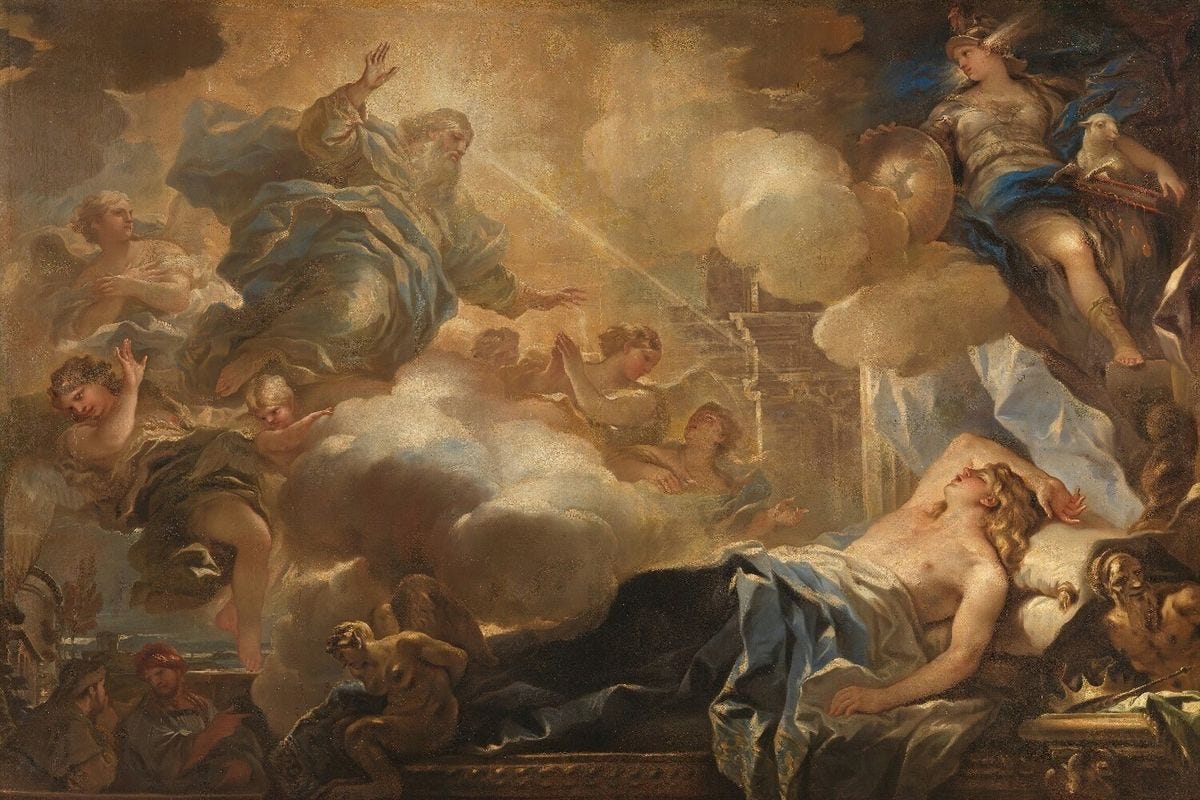
Dream of Solomon, Luca Giordano (c. 1694-95)
Much to the chagrin of all the God-haters out there, fascination with the divine is on an upward trend. So many people everywhere are curious about whether or not God exists and what he’s like.
They want to study him, get to know him, emulate him. Questions that revolve around God are taking precedence over the mundane, the natural, in this present world.
There’s a significant reason for that: God is abundantly more fascinating. He’s beyond everything this world has to offer.
Atheists don’t think so. Some on X recently said that God offers no explanatory power for anything, but that’s not what you find throughout history. Whenever the idea of God or even the very presence of God shows up, people are astounded, filled with wonder, overcome by awe, and physically, mentally, and spiritually changed in unprecedented ways. So much so that even in a cynical world like our own, the eternal and mysterious are etched into the forefront of our minds.
God is more fascinating.
Why?
We find two powerful answers for why God continues to be fascinating for us as human beings from G. K. Chesterton and Fyodor Dostoevsky.
Riddles of God
Chesterton celebrates what he calls the riddles of God. And he says that they are so much more powerful and bountiful than the solutions of man.
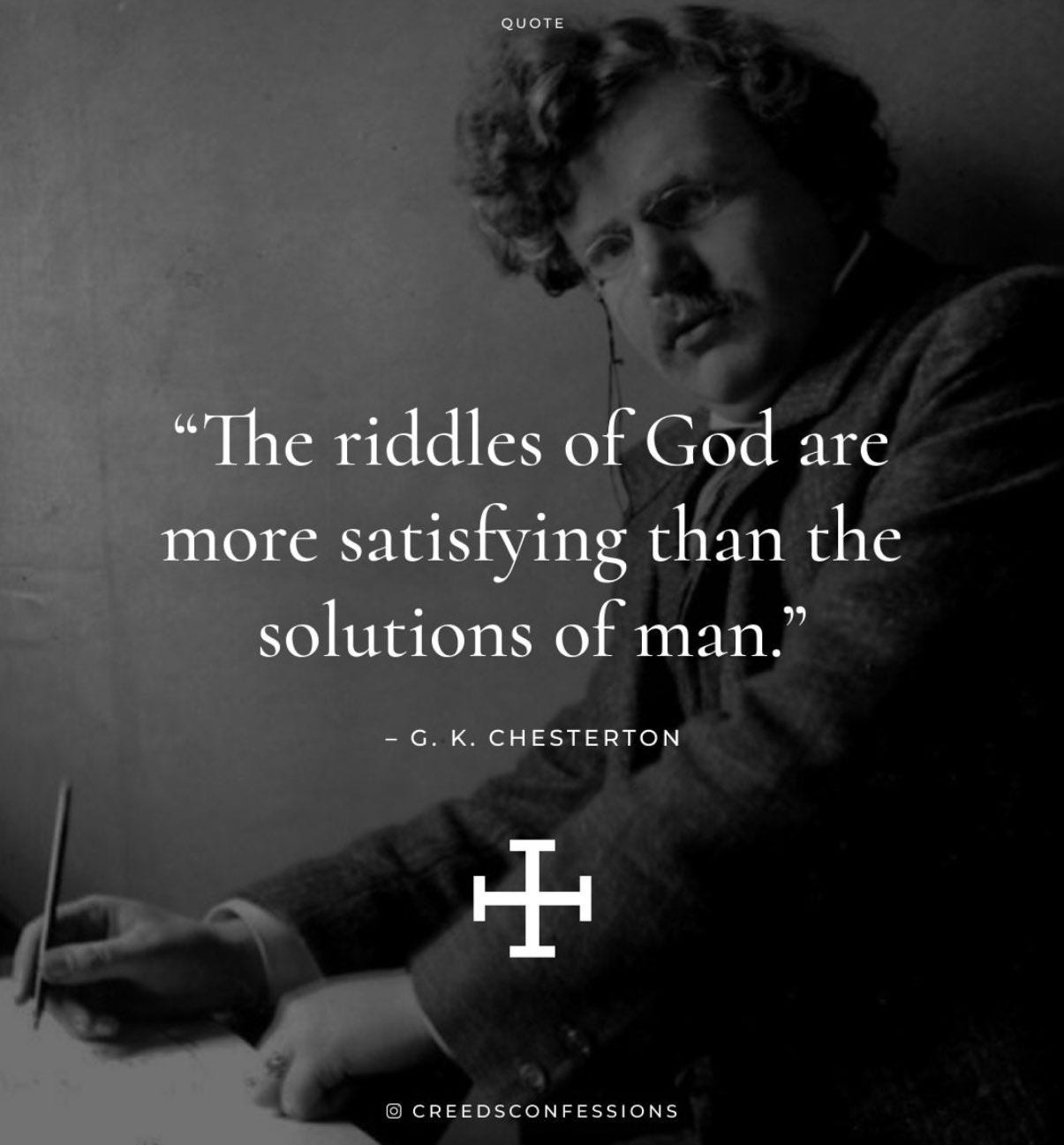
Identifying God as a riddler tells us so much about who he is. It tells us that he has deliberately made himself cryptic to us and enjoys testing humanity. God reveals just enough of himself to be touchable but not fully comprehensible.
For atheists, that’s a problem, but for the Christian, it’s not because we understand God has made himself mysterious because he wants us to explore him. He wants us to seek him out.
As part of the journey of faith, we must learn about God in Christ more deeply and conform ourselves to him because God is the ground of all being. He’s the definition of reality. He transcends all. Without him, there would be nothing.
A Being like that is hard for us to fathom because of our brokenness ever since the fall of Adam and Eve in the garden. The sin and death unleashed on us made us finite and forced the mysteries of the heavens to be shoved far from us. God moved them out of reach for our protection.
That doesn’t mean God doesn’t want us to know him or them. In fact, he encourages us to adventure. As Proverbs 25:2 says, “It is the glory of God to conceal things, but the glory of kings to seek things out.” We are made to explore. Made to adventure. Made to study not just the mysteries of this world, but the mysteries beyond it as well. It’s ingrained in the very code of our DNA to puzzle over God, to explore his mysteries.
Chesterton was clever by calling the cosmic mysteries “riddles” because riddles are problems to be solved, but they’re not problems that are detrimental to survival. They’re puzzles that enlighten and stimulate the mind, that grow the character and form it into what it was made to be. Mind stimulation and formation are why we enjoy doing puzzles like Sudoku and/or just plain puzzles, putting them together piece by piece to see the image it forms. Since we are made in God’s image from the beginning, inherently we seek to understand our purpose and our design. The higher things.
What gets in the way of that journey is our infatuation with ourselves and our infatuation with this world.
Unfortunately, there’s the tendency for us to idolize the creation and knowledge itself over the Creator, as Adam and Eve did. Hence the reason for God’s protection, his making the eternal mysteries harder to work for. Scripture warns about our idolatrous potentiality all the time and tells us to steer away from it with every fiber of our being, because it doesn’t just corrode the soul, it corrodes the mind and body as well. It strips away your capacity to appreciate the mysteries of God.
If all we have is this physical world, the creation, then the very pursuit of knowledge itself has no standing. It’s not really mysterious per se. Just unknown.
But when God is in the picture, there really is a universal riddle with a glorious prize at the end. The puzzle doesn’t just stop in this world. It’s not a problem here to solve. We’re not mere survivors. We’re thrivers, and we’re meant to comprehend a kingdom greater than our wildest imaginations.
Sin and death and depravity don’t want that for us, for us to thrive, because Satan is trying to usurp the throne of the kingdom. God’s kingdom. The devil knows at this point, because of the cross, that he’s lost the battle ultimately, but if he can chip away at the kingdom piece by piece and lower its numbers, he thinks he can still prevent it from becoming everything the Creator wants it to be: an eternal kingdom filled with the goodness, justice, grace, love, power, and enlightenment of Christ.
You have the opportunity to prove him wrong.
But not just anyone can grasp the mysteries of God and stand up to the devil. Dostoevsky tells us the one person who is most capable of grasping the mysteries of the Divine, and you’ll never guess who it is…
This is a weekly paid article for Allegiant Faith VIPs. Become a paid subscriber to get access to the full article and more:
Courageous Chris’s “30-Day Evangelist: How to Share, Defend, and Live Your Christian Faith in a Secular World.”
An eBook copy of Courageous Chris’s The Atheist Conversion Manual: 17 Cases that Destroy Secular Religion, Prove God, and Show You the Way to Eternal Life (releasing 7/18/2026).
Copies of all future published works.
Access to our full archive of articles
An exclusive subscriber chat
2 articles every week
Your support means the world to us and helps us continue to grow online.
Click below and upgrade!
