


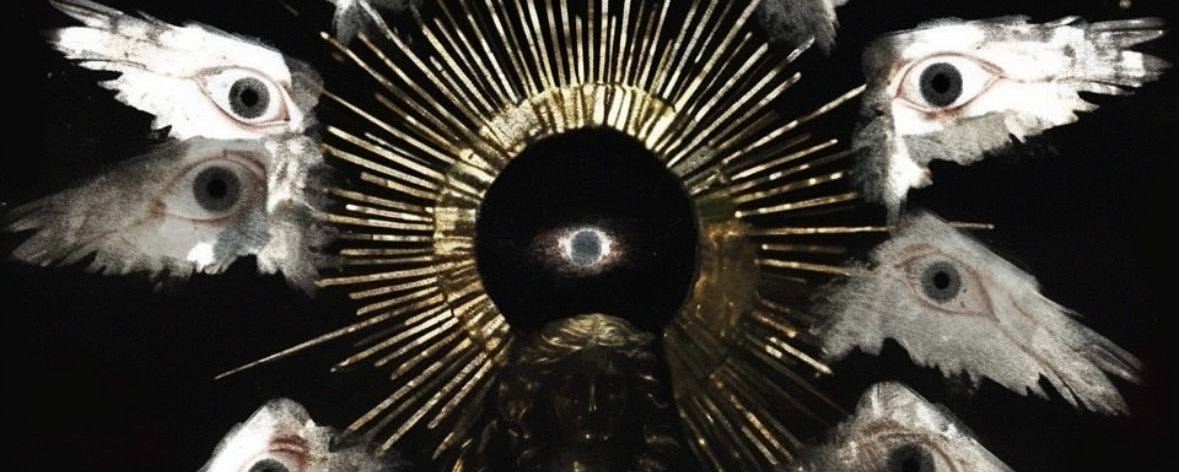
Religion is integral to humanity. Your beliefs and how you react to them are inseparable.
Your entire life is driven by thought and reaction, and you craft rites and rituals based on your beliefs.
You can’t escape religion.
Yet many bend themselves into pretzels trying to separate religion from reality. When you look deeper, though, you quickly learn religion is more complex than realized.
Definitions exist to distinguish, categorize, and explain identities. And the best definition for religion that fulfills all three roles is:
Religion is worldview put into practice.
Atheists hate this definition because (1) they think it’s not specific enough and (2) it keeps them from elevating their own beliefs above everyone else’s.
It also doesn’t let them elevate themselves above everyone else as if they have a monopoly on intelligence.
And, to be fair, scholars have not settled the definition of religion. They continue to debate and debate and debate. I know because I’m a graduate of religious studies from a liberal arts university. I also went to seminary. And I’ve heard every definition of religion in the books.
Let me tell you, it’s all a bunch of goodwill conversation devolved into muddled confusion and nonsense.
The ONLY clear theme that keeps rearing and bucking in every debate is worldview put into practice.
From my definition you can go further and distinguish between personal religion (individual beliefs/systems around which personal rites and rituals are formed and practiced) and collective/organized religion (communal beliefs/systems accepted by a crowd around which rites and rituals are formed and practiced).
Yet “worldview put into practice” still acts as the foundation.
And rather than befuddle, religion as worldview put into practice provides the best available understanding because of what we already know about the world and human psychology.
Everyone craves to and will worship something.
I state the above definition after years of thinking over the complexities scholars, both conservative and liberal, saw in the term “religion.” And I know it will help you grasp what religion is, why it’s everywhere, and why it matters to everyone, including you.
So let’s explore it deeper…
Allegiant Faith Network is a reader-supported ministry. Become a paid subscriber and get:
Courageous Chris’s “30-Day Evangelist: How to Share, Defend, and Live Your Christian Faith in a Secular World” ($50 value)
Copies of any and all future books and published works
2 posts every week, on Wednesday and Saturday
Access to our full archive of articles
An exclusive subscriber chat
Your support means the world to us and helps us continue to grow online.
Click below and upgrade!
Worldview is Destiny
Everyone has a worldview. You do. I do. It’s the collection of beliefs and preconceptions one uses to interpret reality.
No matter how much you might try to avoid having a worldview, such lenses are inescapable.
The wise man accepts this fact and keeps his worldview open to reshaping. Instead of attempting to do away with worldview, he considers available evidence and subjects his worldview to rigorous testing and re-testing.
If his worldview seems inadequate, he changes it to align with his findings. He does so repeatedly, even if that means discarding elements of his worldview he adores and hates parting with.
A fool clings to his worldview, his religion, regardless of counterevidence. And this applies to everyone, not just a select few. Anyone can become so obsessed with his worldview that he loses any sense of self-critique.
The practices one performs under his worldview (the choices he makes, his rites and rituals of worship) form his religion. And just like everyone has a worldview, everyone also has practices they perform in servitude to that worldview.
Some atheists have argued this means anyone who has an opinion is religious. But that’s not the case.
Anyone who has an opinion is a believer in something. So, the existence of opinions proves we can’t escape beliefs. But only worldviews (the systems of beliefs/preconceptions we each use to analyze reality) about the cosmos (its origin, how it works, and our purpose within it) that lead to corresponding behaviors, rites, and rituals in accordance with said beliefs qualify as religious.
We all meet that criteria in some way, shape, or form, which means...
…everyone is religious.
Despite how obvious all the above is, atheists still revolt...
The Divinity Mistake
Atheists refuse to call religion “worldview put into practice” for several reasons.
One is because they falsely assume religion must involve a deity or the supernatural. But that’s also not the case. There are plenty of examples of religion not involving gods or the supernatural.
Here are three primary world religions from history without gods or the supernatural:
Buddhism
The central tenets of Buddhism are about escaping the world. One sheds off earthly existence to escape suffering and find peace, though meditation and willful detachment. The result is merging with the eternal energy or Nirvana, also known as “enlightenment.”
No gods are involved. In fact, Buddhism suggests that true enlightenment transcends the supernatural, as in the Hindu gods and religion.
Confucianism
Confucius constructed an honor cult. He argued Heaven is sacred moral principle, not supernatural, and one attains Heaven by practicing the 5 virtues: sincerity, wisdom, propriety, righteousness, and benevolence.
The gods, if they exist, offer no guidance and no salvation.
Taoism
Adherents of Taoism sought to unite themselves with the Tao, which was defined as an endless state of flux underlying reality, similar to Buddhist Nirvana.
The world and universe in Taoism are a relative and random illusion.
One becomes united with the Tao through meditation, astrology, qijong, feng shui, and internal alchemy. Cultivating the self and the Tao and seeking harmony were the end goal.
These examples all exclude the supernatural from their religion, yet people and scholars consider them among the chief religions of the ancient East.
Ergo, religion does not require gods or the supernatural.
But you know that doesn’t stop atheists. They still resist...
Just One Among Many
Another reason atheists refuse to accept religion as “worldview put into practice” is most of them think they’re the elite arbiters of reason. They pretend to hold a monopoly on factual knowledge.
To be considered a religion would, in their minds, link them to delusion.
Atheists, from this vantage, are immersed in an illusion of power they refuse to relinquish. Like Dorian Grey, they obsess over their feigned superiority, while suppressing truth. And whenever challenged, instead of dealing with the content of any proposed objections, most of the time their immediate reaction is to consider their opponents stupid or less educated.
An atheist who told me my definition of religion isn’t complex enough is a case in point. He wanted me to “educate myself.” Another one under a clip from an interview I did said I was “unusually stupid.”
Not only is that disrespectful, derogatory, and demeaning, it’s also what’s known as an ad hominem, attacking the person rather than the argument. A logical fallacy modern atheists enjoy immensely.
To be fair, the one who called me stupid did accompany his ad hominem with a meme dealing with my arguments, to which I responded. But afterward, when he continued to curse and demean me, I refused to go further.
Acting like animals is part of their rites and rituals because in their worldview, their collective religion, which relies heavily on naturalism or the theory of evolution, we humans are just animals.
Thankfully, we don’t have to play their games because atheists ARE NOT the arbiters of factual knowledge.
Philosophy and theology are where all other modes of knowledge originated. Factual knowledge began as belief. People tested beliefs logically with data, they regularly retested it, and at every level the findings had to be interpreted through the tools of logic and reason provided by philosophy.
Worldview leads to religion leads to knowledge. The best explanation for reality is whatever best aligns with logic and reason and properly interprets all available data, and atheism has to live up to that standard if it’s true.
Defining religion as “worldview put into practice” forces atheists to look at their portrait and deal with their poor choices.
Do you think they do that? No, they most certainly do not...
Denial
Pure and utter denial is another reason atheists don’t enjoy defining religion as “worldview put into practice.”
I encountered an example of such denial recently. An atheist said this:
“The important difference is that my ‘lack of belief in god’ is not the foundation of my worldview in the way that your belief might be for yours. Many Christians don’t seem to understand this. It’s just a thing I don’t believe, it’s not the anchor of how I see life”
The argument presented in this quote is quite common. Atheists honestly think they just “lack belief in gods.”
But all negatives have implied positive opposites.
Their negative “lack of belief in gods” is the opposite of the positive belief that “the gods are made-up fictions and the material universe is all that exists.”
There are no real atheists. Only materialists, or naturalists, as philosophers call them.
Since every negative is the opposite of a positive, everyone needs to prove every claim beyond a reasonable doubt to consider it factual knowledge. There’s no getting around a claim by stating, “It’s just a lack” or “You can’t prove a negative.”
The atheist above doesn’t understand how his own positive belief that the gods are made up and the material universe is all there is affects every single decision he makes. His interpretation of reality determines how he operates just as much as every other human on the planet.
He lives based on what he believes. Ergo, he is practicing his worldview, making it his personal religion, derived from the collective religion of atheism.
Still, atheists fight and gnash their teeth...
Nihilism
The last major reason atheists won’t acknowledge religion as “worldview put into practice” is because deep down they know there are serious flaws with their materialist worldview.
Materialism taken to its honest end leads to nihilism, the belief that nothing matters and when we die, that’s it. Poof. Gone.
The effects of nihilism are hopelessness and depression from lack of purpose and mission. Nihilism has eroded and destroyed more lives than any other belief on the planet because it’s amoral. If nihilism is true, then anything goes. It’s an every-man-for-himself world. Dog-eat-dog.
Most atheists realize if materialism is true and leads to nihilism, then one of them must be false because of how horrific an end nihilism is. So, they take one of two routes to cope:
Steal from God
Many adopt Christian morals and then claim a materialist world produced them through millions of years of human communal evolution.
Problem is, humans throughout the ages have never aligned on anything. Certain cultures think it’s good to eat other humans (still today), rape and pillage, and do any other number of heinous acts. And from a communal evolutionary perspective, if those acts work for those societies, then those acts are “good.”
So communal evolution is a very poor explanation for morality.
Also, “good” and “bad” are nouns, nominative, meaning they’re objects, and that is the case in every language. If they are objects, what are they? What specifically is being described?
Every offer from atheism to answer those questions has come up wanting.
Just the Brute Facts, Bro
Prominent figurehead atheists like Friedrich Nietzsche and Richard Dawkins have taken the brute facts road by claiming that materialism and evolution are just brute facts, and you have to get over it.
Nietzsche was at least honest that nihilism is the end product of atheism, and it abhorred him. But he didn’t want God to exist, so he refused to recant from atheism.
Dawkins is also honest about nihilism, but he tries to play both sides. For him, atheism is true. But it’s also true that society needs Christianity and its moral principles to function and thrive.
In other words, Christianity isn’t true, but it IS good, if that makes any sense.
There’s another factor to consider with point two. “Just the facts, bro” is exactly the same as a Christian saying, “The Bible says it, so I believe it, and that settles it.”
Neither of the two routes provides any solid ground for atheism to stand on. Defense of the atheist position is merely deflected and/or dodged, while materialism and evolution are clung to as gospel.
And by stealing from God or saying, “It’s just the facts, bro,” atheists only prove that they follow a faith-based position. A religion.
Top of the Hill
Religion is worldview put into practice. That definition stands strong because it best incorporates all faith-based systems and their practitioners, is simple, and holds up to scrutiny.
As seen, objections to the definition have been offered from emotion and not by reason. Atheists don’t want religion to be worldview put into practice because then they can’t escape being grouped in with other religions and will be forced to admit they have no monopoly on factual knowledge. And to admit they are human interpreters just like everyone else.
Accepting the definition would also mean they must grasp with the deficiencies of their own position and provide adequate defenses in order to claim it true. They would rather mock and deride opponents, cancel them, or force them to defend their own positions, while pretending atheism is self-evident or “just a lack of belief.”
Nevertheless, they have a worldview: the view that the gods are made up fictions and the material universe is all that exists. And they live their lives according to their worldview (unless they steal from God). This means they are religious, whether they like it or not. And they must abide by the same standards of testing claims as all other faith systems.
Otherwise, they should never be taken seriously.
We love writing for you and for our Lord Jesus Christ. All to Him we owe. And you can help keep us in the good fight.
Paid subscribers, whether $8 a month or $80 a year, get additional bonuses:
Courageous Chris’s e-guide, “30-Day Evangelist: How to Share, Defend, and Live Your Christian Faith in a Secular World” ($50 value).
Free copies of any and all books and future publications by Courageous Chris.
Access to every single article we’ve ever written since we started in June 2025.
Exclusive lessons every Wednesday (give or take) explaining why you can believe in God with conviction and/or how to live for him with courage, OR deeper dives into Scripture, theology, or apologetics.
An exclusive subscriber chat to get real-time fellowship with Courageous Chris and other like-minded Christians and discuss doubts, evidence for God, and much more.
The humble feeling of knowing you are supporting a growing marketplace ministry with a mission to spread the good news of Christ to a dying generation.
Click and upgrade!
Really good point about the eastern religions that somehow have always been classified as religions despite their lack of gods. By the way, have you read anything by this guy? https://substack.com/@victoriagratiae/p-193412761
I see a lot of overlap in your work and his.