


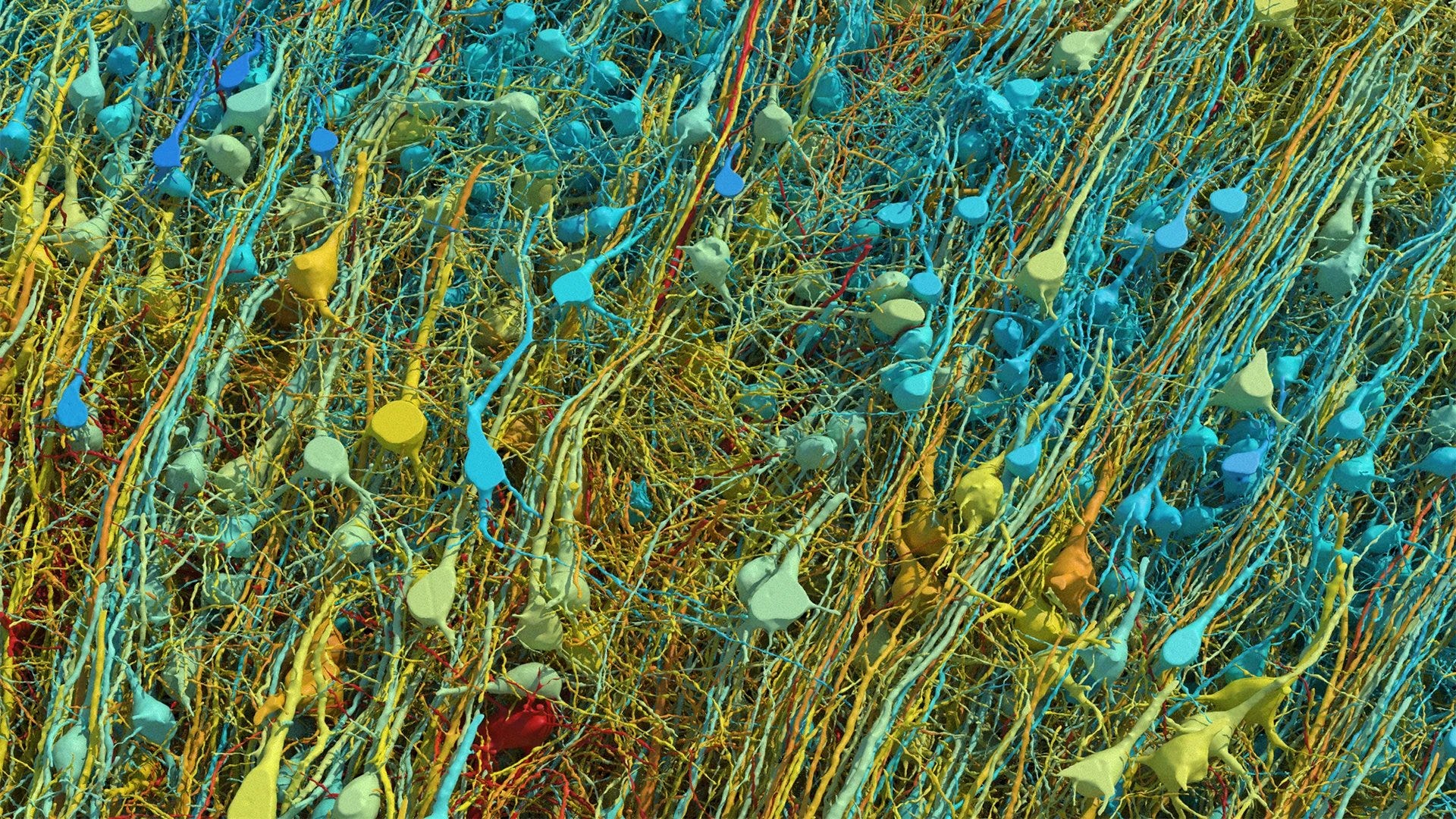
Image of 1 millionth of the human brain from Harvard-Google imaging
If you believe in God and disagree with evolution, apparently you’re a bad thinker. At least, that’s what an atheist told me yesterday.
And it was the least shocking interaction ever because that’s how most atheists treat Christians.
They are obsessed with the theory of evolution, never think twice about it, and when someone decides to critique it in any way, or dares suggest it should be scrapped entirely, that person is just nuts.
Dogmatic much?
Ironically, the conversation revolved around the concept of thought itself, which atheists reduce to matter in the human brain.
Here’s what the atheist from yesterday said. Tell me if this sounds familiar:
It really is rather simple: your brain wasn’t designed for the purpose of thinking. It evolved to solve real-world problems like how not to get eaten by a tiger, how to successfully hunt big game, and how to get laid. Increasing mental complexity leads to greater universality, meaning greater chances of survival in disparate environments. And this is before we consider the fact that the major constraint is competition from other members of your own species, who are playing the same game and getting smarter about it, just the same as you. The key driver of increasing human intelligence is other humans.
As for how you can trust your thinking, it follows directly from the foregoing: you predict future world-states and find out if you were correct, or not. That’s what thinking is. However, past a certain point of complexity of modelling, you can use it to model counterfactuals just as well as factuals. Even then, however, counterfactual thinking is usually applied to real-world problems such as “the Babylonians have conquered us, and now we’re trying to preserve an ethnic identity in exile” or “Oops, the Romans just killed our supposed Messiah. What now?”
All of this is pure conjecture about history that can’t be prove with any confidence unless we go back in time and watch history unfold, which can’t do. But let’s play devil’s advocate and take it as a serious argument.
The linchpin, of course, is “survival of the fittest.” Evolutionists, especially of the atheist variety, believe it explains everything.
But what about art, music, public faith systems, etc.? What do those have to do with survival?
Atheists ignore art and music, but they have lots to say about religion. Ask an atheist and they’ll tell you religion bad. It doesn’t help us survive. The fittest are those without religion.
But there are hundreds of religions active around the globe. If they aren’t fit, shouldn’t every religion have disappeared ages ago, as the people who believed were deposed by the alleged more fit?
Also, note how the atheist begins by presuming evolution is de facto true. He holds to his faith just as rigorously as everyone else.
And these are a mere handful of problems with his argument. The rationality, mimetics, and consciousness he presumes simple evolutionary features actually disprove evolution and prove the existence of God.
A Daunting Project
Your brain is an astounding work of craftsmanship like no other. So complex, making a microscopic map of the whole thing would take up minimum 140 acres of computer servers.
It took Google and Harvard 10 years to map 1 millionth of it. This is what they found:
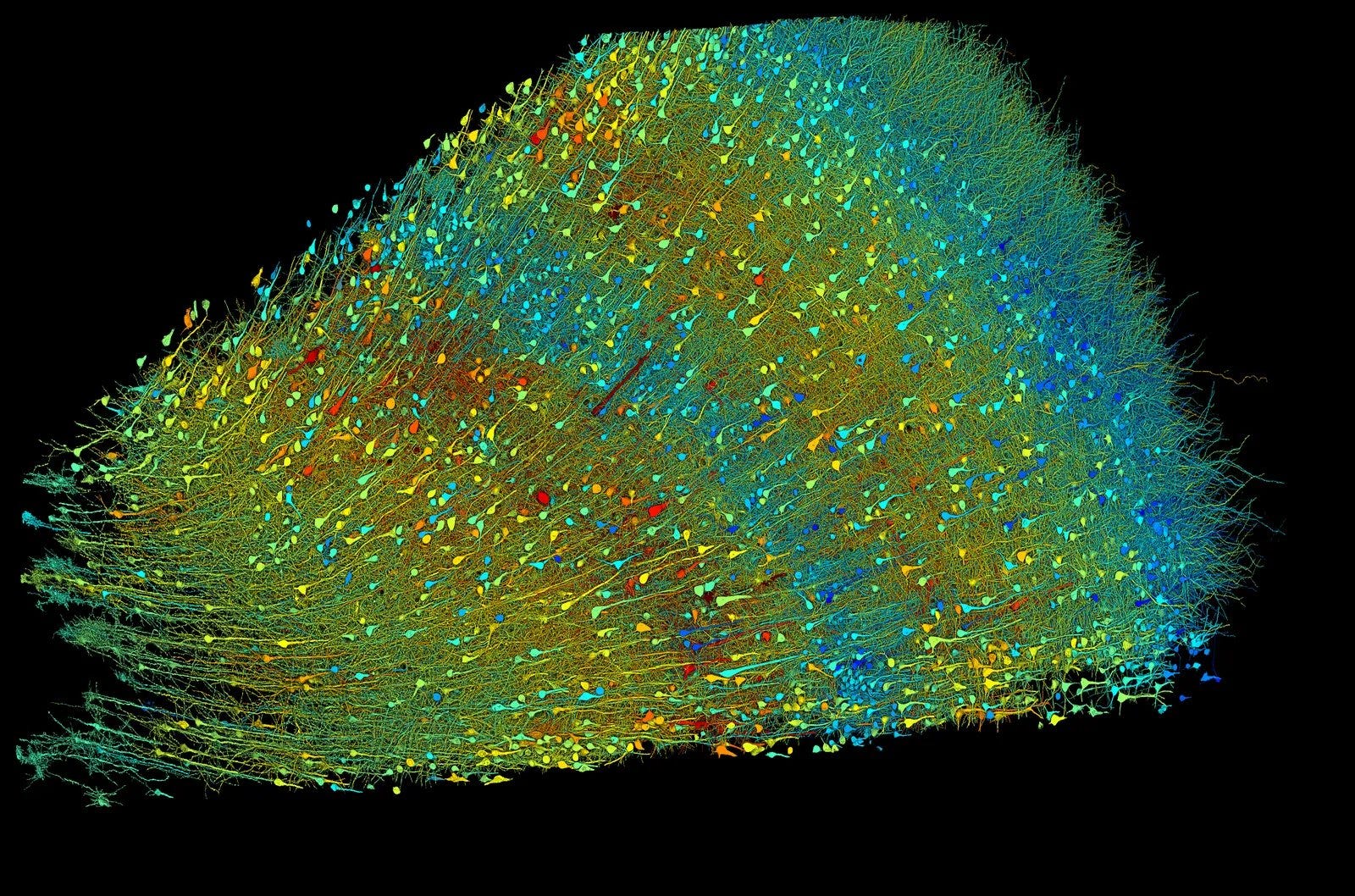
Like with so many other organs and organisms in the world, every part of the brain must be present in order for the brain to work at all. Remove even the tiniest fraction of a cell and death occurs. Making it irreducibly complex.
And atheists want you to think it evolved by random chance through slow simple processes over time?
Maybe they could get away with that explanation if irreducible complexity was all creationists had. But C.S. Lewis astutely observed why simple mindless processes are still a problematic explanation:
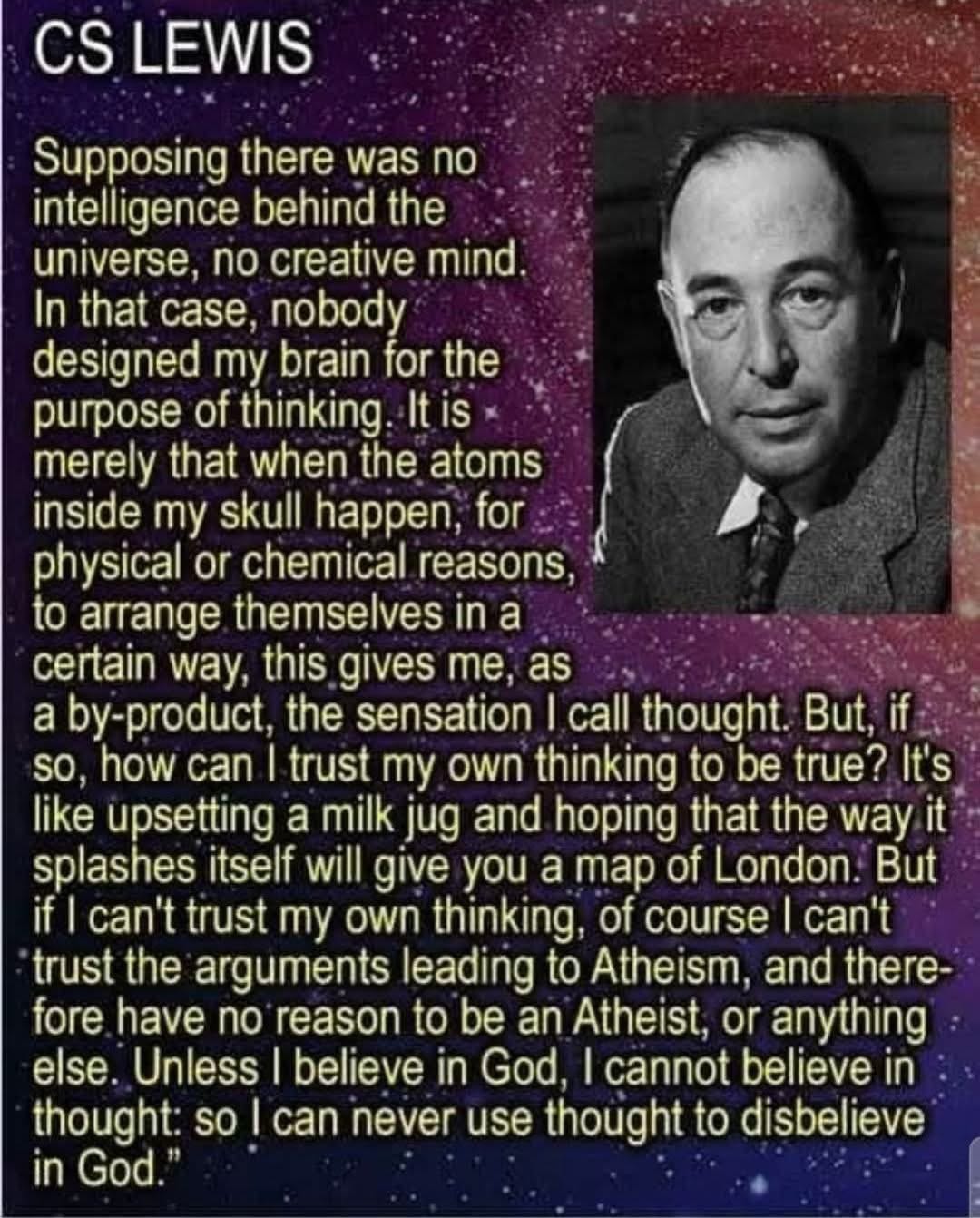
Random chance produces nothing with intentionality or in any meaningful way. If our brains are just mindless processes interacting without design, mere chemical reactions as atheists believe them to be, then the entire enterprise of thought is nothing but superficial feeling without purpose. Including rationality and logic.
So, no arguments matter in a materialist worldview. Exploration is pointless. Curiosity, pure delusion.
The atheist offered survival as a way to give meaning to the enterprise of thought. But if our thinking is chemicals manufacturing sensations without direction, even survival is suspect because chemicals could randomly react to anything. Even trick us into “choosing” (if there even is such a thing) something harmful.
I put “choosing” in quotes because we really have no freedom in such a materialist universe. We are enslaved to our passions and give credence to certain ones over another because they help us live longer.
But how do we know living long is even the right goal? How do we even know what right and wrong are if there are no such things? If we’re pointless slaves to our atomized animalism?
Survival seems nice, but if death is coming for us anyway, no matter what, and there is nothing higher to strive for (it’s just lights out), how can it be considered good?
What even is “good”? It’s a noun, which means it identifies an object. So, what object?
The atheist above never considers these questions. And they reveal another fatal flaw in evolutionary “survival of the fittest” as an explanation for the mind: Abstraction.
Before you go on…
Learn how to write epic articles like this one and build a business online by joining our partner, Masterclass.
The founder, Art of Purpose, built one of the biggest followings (350,000 and counting on X; 14k subscribers on Substack) from scratch within five years, from 2020-now. He’s made millions online and helped others do the same.
And he put together 1000s of hours of resources and a group of the best entrepreneurs, businessmen, ministers, creators, influencers, and more in Masterclass. We will help you:
Identify your ultimate purpose
Create offers people want to buy
10x your reach in less than a year
Write viral content at will
These are only a handful of the benefits you’ll get. You’ll also be surrounded by powerful friends who have your back and want to see you succeed.
Right now, we’re running free trials for a limited time.
7 days
No strings
Nothing to lose
Those who choose an annual plan also get a special $1000 package for only $459:
One Year of Masterclass: Full access to the community, weekly calls, and resources. ($459 value)
Free Ticket to Content Academy: Our upcoming writing cohort focused on long-form content, threads, articles, and storytelling that grows an audience. ($250 value)
A 1-on-1 Strategy Call With Our Founder, Art of Purpose: He’ll review your account, positioning, and growth strategy together to set you up to win in 2026. ($400 value)
AoP’s Private Content Frameworks - The exact frameworks he uses to generate ideas and write viral content. ($100 value)
Creator Spotlight Feature - Selected members will be featured on his account and introduced to his audience of around half a million followers. Value: Priceless
Click my link and join the best group on planet Earth.
Medieval Times
If you’ve never heard of St. Anselm, you should check him out. He’s popular for formulating what’s known as the Ontological Argument for God.
He and a monk named Gaunilo had spat over it in Middle Ages. Every time I read their conversation, I picture an intellectual jousting match.
Anselm argued that the fact we can imagine a most perfect Being indicates that Being exists because it can be imagined. Gaunilo countered by saying just because you can imagine something doesn’t mean it exists.
He used the example of a most perfect island. One can picture such a place, but the existence of that place is only in the mind if not discovered in real life.
In a way, Gaunilo’s argument was a precursor to Immanuel Kant’s later separation between the phenomenal (material) and noumenal (spiritual).
And it is severely flawed.
Anslem made the stronger argument, and it’s proven through the mimetics atheists love so much.
Humans learn through what is called mimetics. Through the senses...sight, sound, taste, touch, and so on.
That means anything we know, any interpretations we have, come from what we’ve observed in the world or what we’ve heard from other humans before us whom we trust.
Like a mime, we follow the lead of our own species if they appear right...and sometimes if they don’t.
Such behavior presumes an objective reality of right and wrong. It also tells us that the thoughts in our minds don’t pop up out of thin air.
In order for us to have an image of something in our brains, we must have had an encounter with it or met someone else who did and described that encounter in detail. And that detailed encounter was then filtered through prior knowledge gained through either observation or previous detailed exchanges with other humans.
Hence, the only way we would have a concept of perfection or a perfect Being is if those objects (nouns) were actual experiences of ourselves or prior humans.
The same goes for Gaunilo’s perfect island. In order to conceive of one, he must know what perfection is and know what an island is, either by having observed one or had one described to him in detail by someone who witnessed an island.
As for perfection, here’s where it gets super interesting...
Where’d You Get That Idea?
Perfection is an abstract object. What that means is there is no tangible real-world material one can grasp known as perfection.
Rather, perfection is the ideal state of something. Existing as intended, as purposed, with no deviation from said intention.
Implied in its definition, perfection presumes the existence of intention or purpose, which are also abstract objects. States of being. Which are by definition immaterial. So, off the bat we have three immaterial realities self-evidenced within human thought in relation to the universe.
But if humans are mimetic and have to observe or be told about objects in order to know about them, how do we know abstractions are real objects?
Here are three possible explanations:
1) We’re completely deluded and nothing matters. Humans made up abstractions to help them survive this world. They are actually subjective, and we just pretend they’re objects.
OR
2) Abstractions are eternal and were written on our heart by a perfect eternal Being. They are also written into the fabric of this universe and inescapable.
3) The first humans encountered perfection. A perfect world, a perfect Being, and interacted with him and then spread the story of his witness to subsequent generations. And while that story has been watered down or altered by societies throughout the ages, it remains imprinted on humanity.
The latter two explanations are not mutually exclusive. They also make the most sense.
If we are moist robots that emerged from atoms colliding together in a primordial goo, somehow developed consciousness (we’ll get to that problem in a moment), and then only experienced a material reality, there’s no logical reason for abstractions at all. Because abstractions can’t be witnessed, measured, or tested in a lab.
Immaterial objects are not subject to the senses. So, states of being and the idea of a perfect, transcendent Being of all beings make no sense in a strictly material universe.
And they certainly don’t help survival.
Could you imagine if perfectionists ran the show? We’d all be dead in week. They’d still be tinkering on the first project they started while everybody starved.
Belief in a higher Being if one doesn’t exist would also be a hindrance because people would be worshipping in temples when they “should” be farming, fighting, and exploiting the less fit to survive, if there even is a “should.”
If abstractions don’t exist, they shouldn’t show up at all. Anywhere in history. But they do.
By implication, the universe isn’t strictly material. An immaterial reality parallels our own.
The Curious Case of Consciousness
Abstract objects aren’t the only immaterial problems for atheist materialists. Abstract thought is an equal pest because it too is immaterial.
Dr. Michael Egnor is a life-long neurosurgeon. In his recent book The Immortal Mind, he documents pages and pages of evidence for a separation of the abstract mind from the material brain.
Nowhere in the brain is activated when you think abstract, aware, sentient thoughts. Ever. Neuroscientists have tried to locate said region of the brain for well-over a century and come up wanting. It doesn’t exist.
The best explanation for this finding is that your brain, the vastly complex super-computer run on 20 watts that would take up 140 acres to map with modern imaging, acts as a receiver for your conscious, sentient mind.
In other words, your consciousness is your soul. And until the moment of death, it is tied to your earthly body.
Why Are We Even Arguing?
We’re still arguing because atheists refuse to acknowledge the presented case and the problems it entails for their worldview. They’re trapped inside their own religion and hate the opposition.
Sure, some act nice in practice. But inside, they’re all suffering from the same bitterness, uncritical dogmatism, and deluded rage they accuse other religious people of harboring and living.
Venture over to Reddit and the mask falls off. They spend all day in an echo chamber mocking religion and religious people in group therapy sessions, filled to the brim with emotion and shoddy logic, and fail to realize how religious they are themselves.
The “bad thinker” ad hominem (which wasn’t just lobbied at me; it was also thrown at C.S. Lewis, one of the most astounding and prolific writers, thinkers, and philosophers of the modern age, appreciated by atheists and Christians the world over) ends up betraying the atheist from yesterday’s own failures.
It turns out he himself is not thinking. At least not critically. His evolutionary explanation is a regurgitation of talking points for the popular narrative about history adopted by his preferred faith.
Though offered to refute C.S. Lewis’s quote, it only skirts the issue brought up by Lewis: the lack of intentionality in the evolutionary worldview.
Without design, we are molecular robots floating in space in a cosmic accident that, through many more accidents, somehow produced order from chaos, life from dead matter, consciousness from the unconscious, awareness from the unaware. In which nothing is trustworthy, and abstractions like “trustworthiness” are illusions.
I don’t know about you, but I don’t have enough faith to be an atheist.
Hello Chris!! Nice article. You might enjoy Probablity Zero by Vox Day. It's on amazxon. He mathematically disproved the theory of evolution by natural selection. It is know provable that it wasn't random. If you haven't read it yet, go grab it now. I'm telling you it's the most hopeful book I've ever read. Natural selection is impossible. Impossible. It cannot be random. God is good. Christ is King!! Create beauty. Speak Truth. Do Good. Rhino UP!!
“If we find ourselves with a desire that nothing in this world can satisfy, the most probable explanation is that we were made for another world.”
― C.S. Lewis