


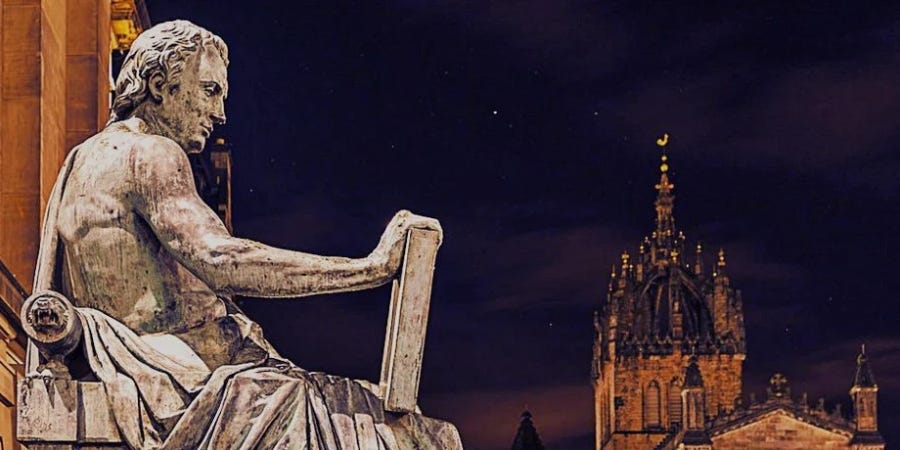
Miracles are possible, probable, and actual because God is possible, probable, and actual, but because of so-called “enlightenment” thinkers like David Hume, miracles get dismissed by modern humanity. This is a major problem for you, me, and society at large because the question of God and His activities undergirds reality.
Yet you touch atheist idol David Hume with even the tip of your pinky finger, and atheists swarm you like a batch of hornets.
After writing an article against him two Wednesdays ago, I was going to move on, but an atheist on Substack who happens to be a scholar obsessed with Hume’s philosophy got wind of my article through one of his followers and proceeded to tell me everything I said about Hume was wrong because I don’t understand Hume. Hume was only saying we should follow the base probability of causes when assessing miracle claims.
To be fair, I did get the historical background of Hume wrong (which I’ll correct in a moment), but as for Hume’s argument against miracles, I outlined the argument in detail and then proceeded to go through it step by step and explain each problem caused by Hume’s reasoning. Which turns out to be illogical and nowhere near enough to negate the possibility or even probability of miracles.
If you want to read that article, you can do so here.
Debunking David Hume’s Dumb Drivel Against Miracles

If you ever discuss miracles with skeptics, the first person they’re guaranteed to bring up is 18th century Scottish philosopher David Hume (1711-1776).
There’s not enough space to go through everything I discussed last time, nor do I want to bore you with a rehash of stuff already said.
Instead, we’re going to play devil’s advocate. Let’s say the atheist is correct that Hume only meant we should follow the base probability of causes for an event when assessing an explanation. That’s not all Hume said in his argument against miracles, but since “On Miracles” was included in his book about his theory of probability, it’s possible, even likely, Hume did mean we should only follow the base probability. Does that preclude miracles from being a viable explanation for certain events? Not even in the slightest.
Miracles remain possible, probable, and acceptable as explanations for certain events because, as it turns out, Hume’s theory of probability doesn’t hold true.
Before you go on, Allegiant Faith Network is a reader-supported community. Become a paid subscriber to help us keep up the good fight for Christ for ages to come and get:
Courageous Chris’s “30-Day Evangelist: How to Share, Defend, and Live Your Christian Faith in a Secular World”
A digital copy of Courageous Chris’s The Atheist Conversion Manual: 17 Cases that Destroy Secular Religion, Prove God, and Show You the Way to Eternal Life.
A bi-weekly “Defenders of the Faith” book club.
Copies of all future published works.
Access to our full archive of articles.
An exclusive subscriber chat.
2 articles every week.
Your support means the world to us and helps us continue to grow online.
Click below and upgrade!
First A Needed Correction
In my last article, I made the mistake of thinking Hume was influenced by French socialists Voltaire and Rousseau. He was not. In fact, to his credit, Hume got in heated debates with Rousseau because he did not agree with much of Rousseau’s socialist philosophy.
The truth is the opposite.
Hume’s secular humanist philosophy, inspired by minds like John Locke, George Berkeley, Isaac Newton, Francis Hutcheson, and more ancient thinkers and ideas such as Sextus Empiricus and Pyrrhonism, combined with arguments from Frenchmen Pierre Bayle (religious skepticism), Nicolas Malebranche (occasionalism and ideas about causation), and Jean-Baptiste Dubos (aesthetic theory) to form the radical skeptical foundation which produced the likes of socialists Voltaire and Rousseau and eventually led to the French Revolution.
I’ll leave you to make your own judgments as to whether that helps or hurts Hume’s reputation as an admirable intellectual.
For our purposes, what matters is Hume’s radical humanist position and its obsession with naturalism. A position that strived to abandon God and explain the cosmos only in terms of what can be considered regular and most probable.
Hume defined a miracle as a violation of the laws of nature and then claimed that the laws of nature rest on uniform and constant experience, so miracles are contrary to the whole of prior experience. Hume then stated that when two kinds of evidence conflict, the stronger evidence must prevail, and in the case of miracles, the competition is between unreliable human testimony and the regular and constant experience of nature. And since the latter is the more reliable experience, we are obligated to view human testimony as false.
Put another way, it’s always more likely there is a natural explanation and therefore no need to invoke a miracle. That’s the base probability.
Where does Hume get this idea? From his theory about the probability of causation.
Hume’s Probability of Causation
Imagine you’re holding a die with six numbers, and every time you throw it, it lands on one of the numbers between 3-6. You start to notice this pattern, so you accept that 3-6 are more likely to surface with every roll and choose one of those numbers each time you gamble.
That’s Hume’s theory of the probability of causation in a nutshell.
He argues that whenever considering possible causes for an event, one must lean on the most probable, which are the repeatable and observable regularities in nature (numbers 3-6). Any singularities (one-time events) must first be subjected to the most probable explanation (numbers 3-6) and never the improbable (numbers 1-2).
But what happens when numbers 3-6 are inadequate to explain a singular event? Does the unlikely then become more likely?
Hume’s position is that the likely (regular) will always be adequate to explain the unlikely (singular) and rules out the probability of the improbable because the probable is probable.
Take a minute if you need to. Your head is spinning, I’m sure.
It should be because Hume’s argument is more circular than the circumference of a Frisbee.
Applied to his argument against miracles, miracles (the supernatural) are numbers 1-2 on the dice and can never be accepted as an explanation for a singularity because the more probable numbers 3-6 (regular nature) are a better explanation, even when they aren’t a better explanation at all. Therefore, the thinker is obligated to choose nature by default even when doing so is irrational.
Make that make sense.
And the circularity of Hume’s argument isn’t even the worst part.
The Worst Part
As noted in my previous article, human experience isn’t uniform, and that’s what ruins Hume’s argument most.
Reality itself is only intelligible to humans. It doesn’t experience anything on its own. Intelligibility requires intelligence. Experience requires an experiencer.
Therefore, the “uniform and constant” experience of nature is wholly dependent on human interpretation and testimony to what is observed and tested. But human testimony, according to Hume, is unreliable. So how can Hume trust that the experience of nature has been “uniform and constant”?
He can’t. That’s pure speculation.
Furthermore, human experience across history testifies to both natural and supernatural experiences everywhere on earth, and most humans today also testify to the supernatural. So, human experience isn’t uniform in favor of the natural.
But the alleged uniformity of natural experience is the central variable of the base probability Hume expects you accept!
The atheist who challenged my previous article by bringing up Hume’s base probability made this same mistake in a different way. He claimed that Christian apologists, including myself, just don’t understand Hume and should read more of what pro-Hume scholars have written about Hume. I pointed out that he wants me to trust the human testimony of these scholars even though human testimony is untrustworthy, according to Hume. His response was that I’m unable to read.
I muted the atheist because I don’t care how much of a scholar he is. He can’t see the imbecility of his insistence on Hume’s argument for base probability being in favor of nature and ruling out miracles, so it was clear that any ongoing conversation with him would’ve been fruitless.
Which is sad because miracles are possible, probable, and actual as long as God is around.
Miracles Are Possible, Probable, and Actual
The only way to disprove miracles is, as I’ve stated before, to disprove God. And the only way to do that is to prove beyond a reasonable doubt that the natural cosmos is all that exists.
But atheists can’t disprove God because the evidence favors the possibility and actuality of a necessary Uncaused First Cause. Both the Ontological Argument of St. Anselm and the Kalam Cosmological Argument substantiate the necessary existence of this Cause and detail some of His traits.
The KCA: Anything that has a beginning has a cause, the universe has a beginning, therefore the universe has a Cause.
The OA: It’s possible a Maximally Great Being exists, a Maximally Great Being exists in some possible reality, a Maximally Great Being cannot be maximally great unless it exists in every possible reality, so a Maximally Great Being exists in our reality (is actual, not just possible).
Physicists agree that prior to the Planck Era of the Big Bang, space, time, and matter didn’t exist, so whatever was before was spaceless, timeless, and immaterial. Nothing physical. But nothing doesn’t act, so whatever caused space, time, and matter to come into existence had to be something, had to be living (since only living beings act), had to be powerful enough to alter its contemporary reality, and had to be intelligent because it formulated an intelligible and complex cosmos.
The best match to this Uncaused First Cause is Anselm’s Maximally Great Being, who also happens to match the Creator God of the Bible, who identified Himself to the Israelites as Yahweh and whom Jesus claimed to be when He walked this earth.
Not only does this Being exist, His taking action proves Him to be an Actor, and His alteration of reality is itself a miracle. A violation of the previous natural state. So, creation itself is an actual miracle, which means one miracle is not only possible and probable but real in our cosmos (the cosmos itself, ex nihilo). This lends credibility to the possibility, probability, and actuality of other miracles occurring within the cosmos since the Actor who altered reality once can alter it again if He so wishes.
Hume is dead, God reigns supreme.
Hume is Dead, God Reigns Supreme
Not matter how you slice it, David Hume fails. He reveals an unbending religious commitment to naturalism and an irrational understanding of probability.
As long as God is possible, miracles are possible and remain viable probabilities to explain certain singular events.
No one is contesting that we should start by seeking a natural explanation. Doing so makes sense since natural events are regularities. But numbers 1-2 still reside on the dice, which means they can happen (i.e. the supernatural is real), and it’s rational to have an open mind toward them as options for explaining certain singularities.
The alternative is unwarranted closed-mindedness that contradicts the vast majority of human experience across the ages and the clear evidence for a transcendent Creator God.
We love writing for you and for our Lord Jesus Christ. All to Him we owe. And you can help keep us in the good fight.
For just $0.26 a day, you can get additional bonuses:
Courageous Chris’s e-guide, “30-Day Evangelist: How to Share, Defend, and Live Your Christian Faith in a Secular World,” soon to be a full course with video lessons and outlines ($50 value).
A digital copy of Chris’s The Atheist Conversion Manual: 17 Cases that Destroy Secular Religion, Prove God, and Show You the Way to Eternal Life ($20 value).
Access to all future publications.
Access to our full vault of resources that will help you defend the Truth of Jesus Christ.
A bi-weekly “Defenders of the Faith” book club where we read and study apologetics books of your choosing together (comes with outlines and study notes).
Exclusive lessons every Wednesday explaining why you can believe in God with conviction and/or how to live for him with courage, OR deeper dives into Scripture, theology, or apologetics.
An exclusive subscriber chat to get real-time fellowship with Courageous Chris and other like-minded Christians and discuss doubts, evidence for God, and much more.
The humble feeling of knowing you are supporting a growing marketplace ministry with a mission to spread the good news of Christ to a dying generation.
Click and upgrade!
Why must a miracle involve a violation of the laws of nature?
We don't know all the laws of nature, and we don't fully understand most of what we think we do know. How can we be sure a presumed miracle constitutes a violation of what we don't know or don't understand?
What makes something miraculous? That it is inexplicable? That it is fortuitous and beneficial to someone?
Is it a miracle when a homeless man facing the onset of winter has someone come up out of nowhere and give him a sleeping bag?
Is it a miracle when someone who hasn't eaten in a few days has someone buy him a meal?
That's not to take away from the healing miracles that defy what we know of biology and medicine. Rather, it is to point out that part of why miracles matter is they remind us that good things do happen.
Whether we understand the mechanism or not, when something good happens in the world, we do well to pause and give thanks to God without whom no good thing can happen.
Why would anyone need a miracle to prove the existence of a creator God?
The existence of creation is the only miracle I need to know.